


 Francais
 Deutsch
 Italiano
Refine Your Search
Adak Alaska USA 1943 stock footage and images
- Showing 8395 to 8400 of 27426 results more
more Hide
Hide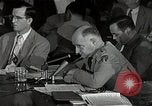
The Army-McCarthy hearings held by the United State's Senate's Subcommittee on Investigations on Senator Joseph McCarthy.
The Army-McCarthy hearings held by the United State's Senate's Subcommittee on Investigations underway. Various witnesses give the jury their statements. Robert Ten Broeck Stevens, the Secretary of Army arrives in the court. He pledges to speak truth. Army Counsel Joseph Welch seen seated to the left of Stevens. The jury members ask Stevens various questions and he answers them. Robert Stevens speaks to Senator Joseph McCarthy of various charges. Senator McCarthy replies to allegations put on him by Stevens. His chief counsel, Roy Cohn sits by him. Jury members of the investigating committee Karl Earl Mundt and others. Robert Stevens speaks of blackmailing charges on Senator McCarthy.
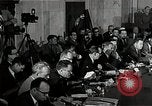
Robert Ten Broeck Stevens presents allegations against Senator McCarthy at the Army-McCarthy hearings by U.S. Senate Subcommittee
The Army-McCarthy hearings held by the United State's Senate's Subcommittee on Investigations on Senator Joseph McCarthy underway. Various witnesses give their statements to the jury members. Senator Karl Earl Mundt and other jury members at their seat during the proceedings of the court. Robert Ten Broeck Stevens, the Secretary of the Army, being asked questions and he answers them. Army counsel Joseph Welch seen covering the microphone and speaking to Stevens at one point. Stevens relates events and dates to the committee. Panel members question him further and he replies. Jury members speak to McCarthy. He replies to them and speaks to allegations against him. His chief counsel, Roy Cohn sits by him.
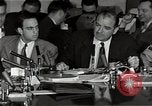
Senator Joseph McCarthy replies to various charges against him, at the Army-McCarthy hearings by U.S. Senate Subcommittee.
The Army-McCarthy hearings underway, held by the United States Senate's Subcommittee on Investigations, regarding Senator Joseph McCarthy's actions. Various witnesses give their statements to the jury members. Senator McCarthy replies to the jury members. His chief counsel, Roy Cohn sits by him. Robert Ten Broeck Stevens, the Secretary of Army sits in the court as a witness and under cross-examination by McCarthy. Robert Stevens discusses with Army counsel Joseph N. Welch who is sitting beside him. G. David Schine seen in the court in Army uniform. Press photographers take his photo.
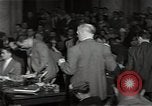
The Army-McCarthy hearings by U.S. Senate Subcommittee on Investigations, regarding Senator McCarthy, questions G. David Schine.
The Army-McCarthy hearings held by the United State's Senate's Subcommittee on Investigations on Senator Joseph McCarthy underway. Various witnesses give their statements to the jury members. US Army soldier G. David Schine questioned by the jury members regarding his meetings with senior Army officers and with Joseph McCarthy. He answers the jury members regarding photographs of Schine and military personnel (Colonel Bradley and Secretary Stevens) taken on orders from higher officials.
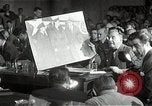
The Army-McCarthy hearings by U.S. Senate Subcommittee on Investigations on accusations between Senator McCarthy and U.S. Army.
The Army-McCarthy hearings held by the United State's Senate's Subcommittee on Investigations on Senator Joseph McCarthy underway. The hearing reviews various photographs of Schine together with senior military officials. Army counsel Joseph Welch seen holding up the photograph and talking about it. The photographs are shown to jury members for inspection. Roy Cohn, Chief Counsel for Joseph McCarthy speaks at the microphone with the photos on the table beside him. Jury chairmen, Senator Karl Mundt with other subcommittee members. Clip closes with an unrelated shot of the House of Representatives chamber in the U.S. Capitol with a meeting of the full House in session.
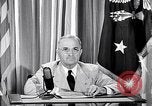
President Harry S Truman of United States addresses the nation after his return from Berlin after Potsdam Conference.
President Harry S. Truman of United States addresses the nation by radio after his return from Berlin and the Potsdam Conference. President Truman speaks of ruined city of Berlin Germany. He expresses his worries about the common German civilians. He discusses establishment of U.S. military bases over various parts of the world to maintain World Peace.
CRITICALPAST.COM: About Us | Contact Us | FAQs - How to Order | License Agreement | My Account | My Lightboxes | Shopping Cart | Advanced Search | Featured Collections | Website Terms & Conditions | Privacy Policy ©2026 CriticalPast LLC.
License Agreement |
Terms & Conditions |
Privacy Policy
©2026 CriticalPast LLC.