


 Francais
 Deutsch
 Italiano
Refine Your Search
Adak Alaska USA 1943 stock footage and images
- Showing 9997 to 10002 of 27381 results more
more Hide
Hide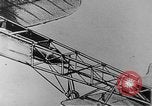
Events in the career of aviator Henry Harley("Hap") Arnold. Scenes from earliest history of heavier-than-air planes.
Sketch of 1909 aircraft that Louis Bleriot flew across the English Channel. Progressive views of airplanes from earliest to formations of B-52 bombers in flight. Picture of Air Force Five Star General Henry (Hap) Arnold. Views of Wright Flyer being pulled into a field and readied and launched with Orville Wright at the controls. Two DeHavilland DH4 airplanes in formation as wing walker climbs from wing of one to wing of the other. (Wing walker wears emblem of black cat and number 13, on his shirt.) Drawing of Wright flyer airplane with various parts labeled by Lieutenant Arnold. Letter, dated 13, May, 1911, from 2nd Lieutenant Henry Arnold, of the 24th Infantry, to Chief Signal Officer of the U.S. Army, reporting on his progress at the Wright flying school in Dayton, Ohio. First pilot's badge (wings) earned by Lieutenant Arnold. President Wilson at inauguration of airmail service, from Washington, DC.
Scenes of World War 1 and the period between the wars, illuminating career of U.S. Air Force General Henry (Hap) Arnold.
Newspaper headline in Washington post reads 'United States and Germany at War'. Civilians recruited into the army. American pilots of the 103rd Aero Pursuit Squadron, in France, with their Spad aircraft. American airplane production factories in operation, with manny women war production workers seen assembling aircraft. People celebrate in the streets at end of World War I at time of armistice. Airplanes, under command of General Billy Mitchell bomb obsolete warships in demonstration of aircraft power in warfare. 1920s: Postwar flyers and stunt wing walkers perform in the roaring twenties. Developments and improvements in parachutes, and view as stunt men parachute from high buildings and airplanes. Aircraft flying forest fire patrols. Aerial view of burning forest fire below. Lieutenant Colonel Arnold commands emergency airlift and drop of food to snowbound Native American Indians in American Southwest, in 1932. World War I scene of American 103rd Aero Pursuit Squadron Spad airplanes taking off, in France. Lieutenant Colonel Hap Arnold with his family, including two young boys and a young girl (his sons and daughter) and his wife.
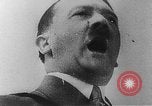
Career of U.S. Air Force General Henry (Hap) Arnold. Advent of World War Two.
Year 1938. Adolf Hitler gives speech. U.S. Army Major General Henry (Hap) Arnold is appointed Chief of the U.S. Army Air Corps. President Franklin D. Roosevelt with General Arnold in an open car, inspecting a new bomber. Sketches of various airplanes proposed to modernize the U.S. Army Air Corps, including Northrup A-17-A; Bell P-39; and Douglas B-23. Views of U. S. Army pursuit airplanes and North American BC-1 training aircraft. Paratroopers jump from C-47 aircraft. A P-38 lightning airplane maneuvers in flight.
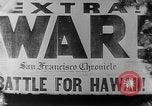
Highlights in career of U.S. Air Force General Henry (Hap) Arnold. World War II.
Japanese attack on Pearl Harbor. U.S. Army Air Corps Chief, General Arnold created Civilian Contract flying schools to train pilots. Recruits seen entering Spartan School of Aeronautics, Air Corps Training Detachment. Trainees being issued parachutes. Student pilots flying in Stearman training airplanes. P-51 mustang airplanes taxiing and in flight. Brigadier General Jimmy Doolittle's bombing raid on Tokyo. General Arnold sitting with General Doolittle. President Franklin Roosevelt presenting the Medal of Honor to General Doolittle. Army Air Corps flyers being decorated by General Arnold. Scenes of air war in Europe from gun cameras of American aircraft. Lieutenant General Arnold mingling with air crews at an air base. An aircraft plant building B-17 Flying Fortress bombers. General Arnold with War Production Chief, Bill Knudsen.
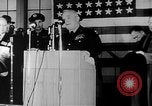
Career of Air Force General Henry (Hap) Arnold. The world War II years.
General Henry Arnold dispenses with his prepared remarks and gives impromptu speech about air power. General Arnold at the Casablanca conferences, seen with President Roosevelt and General Marshall and other Allied military leaders. British bombers departing on nighttime bombing raids. A submarine surfacing. Newspaper headlines report German torpedoing of the ships, SS Robin Moor and SS Sessa. B-24 Liberator bombers taxiing before takeoff. B-24 aircraft seen in flight on antisubmarine missions. View of German submarine surfacing. View from inside cockpit of B-24 flying low with camera pointing toward ocean below. View from aircraft flying low over submarine. Explosion in water. Aerial view of B-24 in flight and view of explosions in water as seen from aircraft in flight. General Arnold consulting with General Joseph Stilwell and Claire Chennault. They walk in front of line of P-40 Flying Tiger aircraft with tiger teeth painted on their noses. Snow-covered Himalaya Mountains shown as narrator discusses "airlift over the hump" in World War 2.
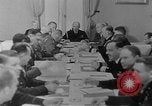
Career of U.S. Air Force General Henry, "Hap", Arnold. The final years.
U.S. Air Force General Hap Arnold meeting with other allied military chiefs at the Potsdam conference, following the end of World War II, in Europe. General Arnold gives a speech during the 38th Anniversary of air power in the United States. Military band plays during the ceremony. General Henry steps from airplane and shakes hands with some of his Air Force Commanders in the Pacific theater. B-29 Super fortresses bombing Japan.Bombardier seen inside B-29 Super fortress. View of General of the Army, Henry (Hap) Arnold. Aircraft of the Air Force demonstration team, The Thunderbirds, in flight. September 18, 1947, formation of the United States Air Force as a separate service. January, 1950, the funeral of General Arnold at Arlington Cemetery, Virginia. Arnold Engineering Development Center building in Tullahoma, Tennessee. President Harry Truman dedicates the Center. B-47 and B-52 bombers taking off. Various Air Force aircraft seen taking off. Views of the United States Air Force Academy, Colorado Springs, Colorado.
CRITICALPAST.COM: About Us | Contact Us | FAQs - How to Order | License Agreement | My Account | My Lightboxes | Shopping Cart | Advanced Search | Featured Collections | Website Terms & Conditions | Privacy Policy ©2026 CriticalPast LLC.
License Agreement |
Terms & Conditions |
Privacy Policy
©2026 CriticalPast LLC.