


 Francais
 Deutsch
 Italiano
Refine Your Search
Adak Alaska USA 1943 stock footage and images
- Showing 10471 to 10476 of 27381 results more
more Hide
Hide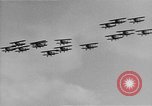
Large formation of U.S. military Boeing P-12 biplanes. Several perform aerobatics while spewing white smoke.
Aerobatic maneuvers in the United States. A large formation of U.S. Army Air Corps Boeing P-12 biplane aircraft in flight. Several P-12s execute loops while emitting smoke so spectators on the ground (unseen) can readily observe their aerobatic maneuvers.
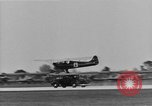
Taylor Cub airplane takes off from car roof.
A Taylor Cub airplane sits on a platform fastened to the top of an automobile. The car drives along a taxiway and as it gains speed, the airplane suddenly takes off steeply from the platform.
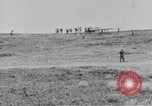
Early primary glider launched from hilltop in the United States
Film leads with slate reading: "How the Wrights learned to fly--the motorless, man-carrying glider." A group of people stand on a hilltop, watching as two men launch a primary glider with a downhill running start. The glider consists of tubular frame tapering to nearly a point at the empennage. It is equipped with wheels, and the pilot sits upright with legs extended straight ahead.. The glider has a single high wing. It rises quickly and flies above ground for a good distance, appearing to approach the ground as it moves downhill.
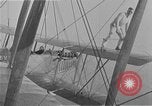
Barnstorming between the wars. Wing-walker preparing to transfer from one biplane aircraft to another, in flight.
Between World War I and World War II, so-called barnstorming was popular. Here a wing-walker stands on wing of a Curtis "Jenny" JN4 biplane, preparing to transfer to another , in flight.
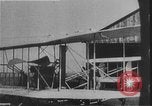
Wright Flyer is rolled from hangar, catapulted, and flown. View of wing, from the airplane.
A Wright Flyer is pulled from a hangar by ground crew. They raise a heavy weight on a tower to provide energy for catapulting the Flyer into the air. The Airplane takes off. Views of the wing from aboard the Wright Flyer. Views of Orville Wright.
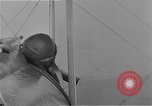
Pilot in a World War I biplane aircraft prepares gun for firing.
Pilot in open cockpit of World war I vintage biplane. He wears helmet and goggles. He taps his machine gun, and looks around.
CRITICALPAST.COM: About Us | Contact Us | FAQs - How to Order | License Agreement | My Account | My Lightboxes | Shopping Cart | Advanced Search | Featured Collections | Website Terms & Conditions | Privacy Policy ©2026 CriticalPast LLC.
License Agreement |
Terms & Conditions |
Privacy Policy
©2026 CriticalPast LLC.