


 Francais
 Deutsch
 Italiano

Refine Your Search
Adak Alaska USA 1943 stock footage and images
- Showing 11287 to 11292 of 27411 results more
 Hide
Color Sound

U.S. Senator Alben Barkley meets journalists after his re-election (following resignation) as Senate Majority Leader
United States Senator Alben Barkley in his office. He addresses a press conference after being unanimously re-elected as Senate Majority Leader. ( Barkley had resigned as Majority Leader in protest over President Franklin D. Roosevelt's veto of a bill to raise wartime revenue.) His desk is filled with laudatory telegrams. Among others present is Senator Kenneth McKellar of Tennessee. The office is filled with note-taking members of the Press.

Graham McNamee announces game 3 of Cubs vs. Tigers 1935 Baseball World Series
Newsreel clip on game 3 of the 1935 World Series at Wrigley Field in Chicago. Famed baseball announcer Graham McNamee seen sitting at microphone, recreating some of his broadcast. Cubs outfielder Frank Demaree (#6) hits home run in the third inning. Cubs' Augie Galan gets hit in fifth inning to drive in Billy Jurges. Galan slides into second when throw goes to home. In sixth inning, the Tigers' Pete Fox hits a triple to drive in Goose Goslin. In eighth inning, Tigers Goslin and Billy Rogell get hits to drive in three runs and tie the game. McNamee does voice-overs for all the plays, with loud crowd noise in background. When game ends, police stand at the edges of the infield to prevent spectators from walking across it. McNamee announces the final score of 6-5 Tigers, in 11 innings.

Technician shows working of Sherman DD propellers in United States.
The U.S. Sherman Medium M4 Tank in United States. The Sherman DD-A report to the Commanding General. Technician turns a valve at Sherman Duplex Drive(DD). He pushes a lever and the canvas sidewall goes down. He works under tank. Wheel track moves. He pulls a lever. The propellers comes out. The propellers run. Technician points to parts. He operates the propellers. Technician presses buttons and pushes lever. The canvas wall side of tank goes up. Sherman DD moves out of Landing Ship Tank (LST) and makes its way towards the beach.
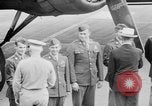
The pilot and the crew members of U.S. AA Force bomber B-17F Memphis Belle introduced in Washington DC during World War II
United States Army Air Force Bomber B-17F, Memphis Belle, lands at Washington National Airport, Washington DC, during World War 2. Secretary of War Robert P. Patterson shakes hands with the crew. Mascot Scotty dog 'Stuka' is held by a crew member. The crew member speaks about his memories when the craft took off. He discusses difficulties the crew members encountered during the mission. Captain Robert K. Morgan, pilot of Memphis Belle, speaks and introduces the members of the crew. The captain calls Sergeant John Quinlan as the Tail Gunner. Logo and name on the craft reads Memphis Belle and name of pilot. Lieutenant General Barney Mc Giles in the background.
The film of T-3A camera developed and a print is taken from B-7 printer in United States.
A U.S. Army training film about developing camera film containing aerial reconnaissance views. Film titled 'Aerial Photography', Part -5, 'Processing the Film'. A T-3A camera is unloaded from a plane. It is taken to a dark room at photographic laboratory Dept. 59. Exposed film roll is removed from camera and is put into its original box. The T-3A film development assembly, placed on table consist of 3 metal boxes, spool plates and motor to transfer film and a loading plate. Development of film starts with first fixing the film onto the loading plate and transferring it on to spools. These spools are then immersed in clean water and transferred from one solution to other. It is then transferred to the developing solution, then in water and hypo solution and then kept in fixing base for 30 minutes. It is washed in running water for 30 minutes. Film is then dried on film dryer blower drum. Then it is transferred to take up spool and laid on lettering table. Each film is lettered on right lower side with title, location, organization, date, day, length and altitude. Developer is prepared at appropriate temperature with water. Print is taken on paper. A B-7 printer is used for printing. The paper is immersed into different solutions and then dried on a canvas belt over a heated drum.
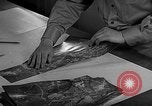
The film mosaic of T-3A camera is assembled together and interpreted in United States.
A U.S. Army training film about interpreting a camera film with aerial views. A print of T-3A camera film is developed. The mosaic prints are mounted by adhesive or staples. Completed mosaic is matched for contrast control networking. It is contrasted with U.S. geographical survey sheets and road maps. These are used to mark known places. Then these prints are pasted together. These pictures are send to an interpreter officer who translates the desired information. He uses stereoscope to find new enemy gun position, camouflage or other informations. (World War II period).
CRITICALPAST.COM: About Us | Contact Us | FAQs - How to Order | License Agreement | My Account | My Lightboxes | Shopping Cart | Advanced Search | Featured Collections | Website Terms & Conditions | Privacy Policy ©2026 CriticalPast LLC.
License Agreement |
Terms & Conditions |
Privacy Policy
©2026 CriticalPast LLC.