


 Francais
 Deutsch
 Italiano
Refine Your Search
Adak Alaska USA 1943 stock footage and images
- Showing 11335 to 11340 of 27381 results more
more Hide
Hide
Flooded city of Zanesville, Ohio in 1937.
Cars move on a flooded street in Zanesville, Ohio. Trees, houses, shops and various other buildings submerged in water of the Muskingum River following heavy flooding of Ohio River and other nearby rivers in February 1937. An overturned truck in water. Water flows at a great speed under a bridge.

People rescued during massive flooding in Marietta, Ohio and Cincinnati, Ohio in February 1937.
Opening scenes are in Marietta, Ohio: Houses submerged in water, people along a railroad track. Men carry a boat, people in boats taken to safer place from the flooded city of Marietta, Ohio. People board a railroad train as they flee from the flooded city. Stretchers carrying injured victims are loaded into train. Scene changes to Cincinnati Ohio, with many parts of the city submerged under flood water. Water flows under the Cincinnati-Covington Bridge, also called the Ohio River Bridge (and later the Roebling Suspension Bridge) at very high level. Houses submerged in water. Aerial view of the city with water all around. Men load their belongings onto a truck. People rescued and carried away in boats to safer places. Police help rescue a woman and a baby. 750,000 people rendered homeless. Houses and industrial buildings submerged in water up to roof lines. Men in boats move through city streets. A boat passes by a stop light at same level due to extreme high flood waters. View of the submerged doorway of the Queen City Hospital in Cincinnati. Vehicles are used to pull cars and trucks out of flood waters.
A sail boat under full sail
Sails of a sailing yacht underway Sailors in the top of masts, adjusting rigging. Additional scenes of the twin masted sailboat under full sail.
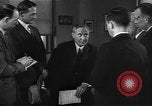
President of Southern States Industrial Council, Fitzgerald Hall, speaks about the NEC report on the economy of the south
Fitzgerald Hall, President of Southern States Industrial Council at his office at Nashville, Tennessee. He speaks to reporters as they take down notes. He speaks out against a report that he says is inadequate, exaggerated and misleading. He says that the south is not Nation's number one economic problem, but rather it is the Nation's economic hope. He is reacting to a 1938 "Report on the Economic Conditions of the South" by the National Economic Council (NEC), that had been echoed in statements by President Roosevelt.
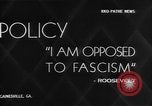
President Franklin D Roosevelt advocates for higher wages and compares feudalism with fascism during a speech in Gainesville, Georgia.
President Franklin D Roosevelt addresses a large gathering in Gainesville, Georgia. He expresses concern regarding the poor economic condition of southern states during the Great Depression and advocates for higher wages and against a system like feudalism. He says the problems are caused by selfishness on the part of a few, leaving one third of the nation ill fed, ill clad, and ill housed. He says "Georgia and the lower south may just as well face facts." He says most wage earners get wages that are far too low, and that "there is little difference between the feudal system and the fascist system" and that he is opposed to both.A large number of people gathered outside a building as they listen to the President.
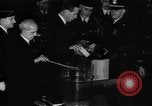
President Franklin D Roosevelt delivers a speech about the Selective Service System in Washington DC, United States.
Official and officers draw draft under Selective Service System at the Department of Labor auditorium in Washington DC, United States. President Franklin D Roosevelt delivers a speech on the occasion, during the lead up to America's involvement in World War 2. He reveals that 95 percent of the people registered under the Selective Service System are not required by the nation and will not be called to military service. He also encourages those new recruits selected for military service to answer the call for duty and defend the independence of the nation. He declares peace keeping as the main task of the United States Armed Forces, and speaks of the those called as members of a peace time army.
CRITICALPAST.COM: About Us | Contact Us | FAQs - How to Order | License Agreement | My Account | My Lightboxes | Shopping Cart | Advanced Search | Featured Collections | Website Terms & Conditions | Privacy Policy ©2026 CriticalPast LLC.
License Agreement |
Terms & Conditions |
Privacy Policy
©2026 CriticalPast LLC.