


 Francais
 Deutsch
 Italiano
Refine Your Search
Adak Alaska USA 1943 stock footage and images
- Showing 11611 to 11616 of 27381 results more
more Hide
Hide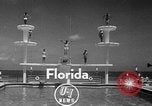
American divers dive from high ramp into a swimming pool at Miami Beach in Miami, Florida.
American divers dive from a high ramp into a swimming pool at Miami Beach in Miami, Florida. The divers perform various acrobatic moves including somersaults, flips and swan dives. Spectators gathered at the pool side watch in delight.
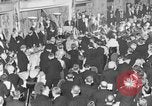
U.S. Democratic Victory Dinner. Washington, D.C. March 4, 1937
A large crowd of the Democratic Party faithful, in formal dress, gather for a Victory Dinner, in the Willard Hotel, Washington, DC, to celebrate Franklin D. Roosevelt's reelection in 1937. An orchestra plays "Happy Days Are Here Again." The President stands at a table (with a man assisting him) as Mrs. Eleanor Roosevelt is escorted to his side. A battery of news photographers take their pictures. Mrs. Roosevelt speaks to President Roosevelt and then leaves. Scene shifts to banquet hall with guests seated at a long table, surrounded by others at round tables. The orchestra plays smooth dinner music. Waiters move among the guests. Reelected President Roosevelt chats with his Vice President, John Nance Garner, seated to his left.
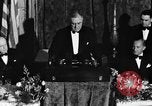
U.S. President Franklin D. Roosevelt speaking at Democratic Party Victory Dinner in Washington, D.C.
President Franklin D. Roosevelt stands at podium and speaks after Democratic Victory Dinner, in the Willard Hotel, Washington, DC, on March 4, 1937. He states that, "Democracy in many lands has failed, for the time being, to meet human needs." He speaks of people being so fed up with debate and party bickering that they surrender democratic principles and processes to get things done. He goes on to speak of history, and failure of dictatorship. He states that, "In the United States, Democracy has, not yet, failed, and does not need to fail." At that point the audience applauds. Roosevelt refers the the Agricultural Adjustment Act. He complains about the Supreme Court. He remarks with a smile that, as the lawyers themselves say, "In this fight, time is of the essence." The audience applauds. He speaks of meeting the needs of the peple, now.
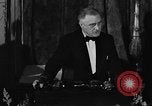
U.S.President Franklin D. Roosevelt castigates the Supreme Court at Democratic Party Victory Dinner in Washington, D.C.
President Franklin D. Roosevelt, standing at podium, speaking after Democratic Victory Dinner, in the Willard Hotel, Washington, DC, on March 4, 1937. He castigates the Supreme Court for issuing what he describes as a "pronunciamento," the Court's decision that neither the Federal Government nor the States may legally address issues of hours and wages. Roosevelt says it defines a "No man's land of final futility." The audience applauds. He goes on to speak to various problems with the Supreme Court. He speaks of freeing progressive actions of the Democratic Party from legal doubt. He calls for courage and wisdom. He notes that "here is one third of a nation, ill nourished;ill clad;ill housed." The President mentions farmers burdened by mortgage interest, and people laboring for inadequate wages. He decries the fact that thousands of children who should be in school, are, instead, working in mines and mills. The audience responds with enthusiastic applause.

Spokesperson delivers speech opposed to President Roosevelt's Court-Packing initiative in 1937
Unidentified spokesperson (possibly a senator or congressman),is seen standing outdoors, before background of the Capitol, in Washington, DC. He delivers a recorded speech in opposition to the proposal by President Franklin D. Roosevelt to add more Justices to the Supreme Court (so-called "Court-packing"). In his speech, he extols the sanctity of the U.S. Constitution and explains the legal process for amending it. He notes that the proposal (to increase the number of Justices in the Supreme Court) comes directly from the Executive Branch (the President). He deplores the action as designed to "place on the Supreme Court six young wreckers." He stops this line of criticism and resumes again, saying that, "the purpose of the Supreme Court Bill is to change the Constitution." He characterizes the bill as unconstitutional, and continues praising the Constitution, itself, explaining, again, the proper procedures for amending it. He acknowledges that the bill's advocates are likely sincere and conscientious.But, he says, "they are raiders off the reservation, raiding the reserve domain of the people." He concludes by saying "they are not playing the American game of Constitutional Democracy."
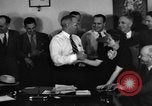
Senator Harry Truman being congratulated upon his nomination as candidate for Vice-President
U.S. Senator Harry S. Truman is standing by a table, surrounded by members of his staff and friends, who congratulate him on his selection as Vice Presidential candidate, by the Democratic National Convention in 1944. Among those seen are Mildred Lee Dryden,his personal Secretary, and U.S. Postmaster General Frank C. Walker. After shaking hands with all present, he sits down at the table, refers to some papers, and makes some remarks. Scene shifts to Truman seated at the table along with Postmaster Walker. Staff and friends are standing around them. They shake hands and Truman rises to start shaking hands all around. This is immediately repeated in another take, in which Postmaster Walker is laughing. After repeating the handshakes, Truman and Walker sit down again at the table.
CRITICALPAST.COM: About Us | Contact Us | FAQs - How to Order | License Agreement | My Account | My Lightboxes | Shopping Cart | Advanced Search | Featured Collections | Website Terms & Conditions | Privacy Policy ©2026 CriticalPast LLC.
License Agreement |
Terms & Conditions |
Privacy Policy
©2026 CriticalPast LLC.