


 Francais
 Deutsch
 Italiano
Refine Your Search
Adak Alaska USA 1943 stock footage and images
- Showing 11641 to 11646 of 27381 results more
more Hide
Hide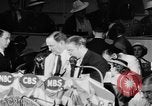
Opening of the 1936 Democratic Party National Convention, at Convention Hall, in Philadelphia, Pennsylvania
Senator Joseph Taylor Robinson calls the 1936 National Convention of the Democratic Party to order and asks delegates to remain standing for the opening invocation delivered by a clergyman. The words of invocation are heard. Afterwards, he asks delegates to be seated. Microphones of all the major radio broadcasters are seen at the podium, such as NBC, CBS, and others. Large crowd of delegates are present in the hall but still milling about. Photographers take pictures. The first speaker addresses the assembly.
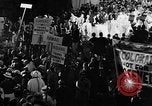
Enthusiastic delegates support FDR for second term, during 1936 Democratic National Convention in Philadelphia
Large crowd of delegates gathered in Convention Hall, Philadelphia, for the Democratic National Convention. Many carry several signs in support of Franklin D. Roosevelt (FDR) as nominee for a second term as President. Some of the banners and signs read, 'Colorado Vote For Roosevelt', 'Minnesota Vote for Roosevelt', 'Young Democratic Club', and other banners. Crowd cheers and sound of band playing can be listened in the background.
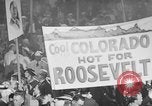
Scenes from the 1936 Democratic Party National Convention in Philadelphia
Thousands of delegates gathered in Convention Hall, for the Democratic National Convention in 1936. Many carry banners and signs supporting President Franklin Roosevelt. Some of the banners read, 'Cool Colorado Hot For Roosevelt', 'Roosevelt Friend of the Forgotten Man' and other FDR signs and banners. Several representatives of United States present among the crowd. A banner supporting the U.S. Democratic Party reads, ' Party With A Soul'.
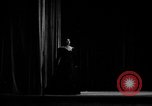
American classical singer, Marian Anderson sings three songs during a concert in the United States.
From a documentary about American Contralto, Marian Anderson, one of the leading classical singers in America. Marian Anderson accompanied by a pianist appears on the stage during a concert and sings the song "Oh What a Beautiful City." The concert hall roars with applause from the audience. Marian sings several songs while the pianist plays. Close-ups of Marian Anderson singing during the concert. Entire audience mesmerized with her voice. She also sings "He's Got the Whole World in His Hands" and "Crucifixtion" (He Never Said a Mumblin Word), followed by reverent silence in the audience.

Relocations centers for Japanese-Americans during World War II.
Life of Japanese-Americans living at relocation centers (internment camps) in United States during World War II. A car driven on a wasteland in United States. View of the wasteland. Workers dig ground. View of barracks constructed on the wasteland for the rehabilitation of Japanese-American families. A Japanese American family enters one of the barracks at the relocation center. Children play on wet-muddy street. Children stand near a barbed wire fence. Watch tower on other side of the fence. U.S. Army General reviews U.S. troops.
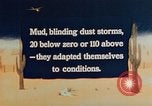
Japanese-Americans at relocation centers in United States during World War II.
Scenes of Japanese-Americans living at relocation centers (internment camps) in the United States during World War II. Woman and child walk on a wet-muddy road at a relocation center. Sand-storm in the far background. Woman crosses the road. Man and woman carry water buckets and containers in their hands. Dishes washed in stationary water tubs. Man rings a bell. People form chow-lines at a mess hall. Food is served to the people. People eat together in a common mess hall.
CRITICALPAST.COM: About Us | Contact Us | FAQs - How to Order | License Agreement | My Account | My Lightboxes | Shopping Cart | Advanced Search | Featured Collections | Website Terms & Conditions | Privacy Policy ©2026 CriticalPast LLC.
License Agreement |
Terms & Conditions |
Privacy Policy
©2026 CriticalPast LLC.