


 Francais
 Deutsch
 Italiano
Refine Your Search
Adak Alaska USA 1943 stock footage and images
- Showing 11971 to 11976 of 27381 results more
more Hide
Hide
May 24, 1939. Minesweeper USS Falcon (AM-28) employs a diving bell to rescue survivors from the sunken submarine USS Squalus.
Aerial view of the U.S. Navy Minesweeper, USS Falcon (AM-28) dispatched from New London, Connecticut, to rescue crew members from the sunken submarine USS Squalus. Closeup from beside the Falcon as crew members open a diving bell that was sent down 240 feet to the ocean floor for the rescue. Several rescued crew members from the submarine are helped out of the diving bell and climb aboard the Falcon. (A total of 33 crew were saved in four descents of the diving bell). Next, survivors reach a dock. A woman speaks with one of the rescued men as he steps into a car. Views of the Falcon and several support vessels. Scene shifts to 13 July 1939, when the first attempt is made to raise the Squalus. An officer officer manipulates valves to send compressed air down into the hull of the Squalus. Next, foam is generated in the water as the bow of the Squalus emerges clearly showing its number, 192. The submarine remains in that condition, with bow elevated and then sinks again. (Note: several more attempts were made in subsequent months to raise the Squalus, until, finally, on 13 September 1939, the boat was successfully raised and towed to the Portsmouth Navy Yard for repairs. The submarine was renamed USS Sailfish and recommissioned in May 1940.)
British royalty visit Washington DC in June, 1939, at the invitation of President Franklin D. Roosevelt
Opening scene shows a military parade along Pennsylvania Avenue in Washington, DC, in honor of the visit of British King George VI and Queen Elizabeth. The parade is led by a contingent of mounted Army cavalry. Spectators line the sidewalks. The Capitol building is clearly visible in the background. Closeup of Cavalry passing the camera. Closeup of King George VI with President Roosevelt conversing in an open automobile. Both are formally dressed. The President wears a top hat. Riding in the back of a car are First Lady, Eleanor Roosevelt and Queen Elizabeth, together with a Navy officer. Next, seen posing on the porch of the Roosevelt family home, Springwood, at Hyde Park, New York, are: First Lady, Eleanor Roosevelt; King George VI; the President's mother, Sara Ann Delano Roosevelt; Queen Elizabeth; and President Roosevelt. Camera pans in closeup across the group, as they engage in friendly conversation.

Montage of scenes, in random order, involving U. S President and Congress, and Navy aircraft carriers. Covers 1920s through 1930s prior to U.S. involvement in World War II
Opening slate reads: "U.S. Seeks Neutrality."Glimpse of the U.S. Capitol building. Speaker of the House of Representatives, William Bankhead, gavels the assembly to order. President Franklin D. Roosevelt in his office signs the Neutrality Act, or Senate Joint Resolution No. 173, on August 31, 1935. Afterwards he chats with Senators who attended his signing. Among those seen in closeup are James F Byrnes, John Nance Garner, and John H. Bankhead II. The Senators shake hands with the President as they leave. Scene changes to German aircraft in flight including Messersmitt Bf 109s and Dornier 17 bombers. A crowd, including civilians and military personnel, stand about the site of a crashed airplane, in Europe. View shifts to U.S. Navy warships at sea. View from one of the Aircraft Carrier, USS Lexington (CV-2) where a Boeing F2B bi-wing fighter airplane is landing on her deck. Closeup of the plane landing on Lexington's flight deck and sailors rushing to arrest and control it. Somewhat fuzzy view of a ship sinking in rough waters. Clear view of an injured sailor in a ship's infirmary. Rescued sailors eating on deck of the rescue ship. One of the sinking victims covered by an American flag, is buried at sea. View of a burning ship.

Celebrity arrives on recently inaugurated United Airlines DC-3 Mainliner service from New York to Chicago
A celebrity arrives at Chicago Municipal Airport,, aboard a United Airlines DC-3 Mainliner in its recently established service between New York and Chicago. He is the only person seen deplaning. As he steps from the plane, he is greeted by a number of persons, including a woman to whom he gives his autograph.
Justice Hugo Black admits his membership in Ku Klux Klan in an address to the nation through radio in Washington D.C.
Associate Justice of the U.S. Supreme Court Justice Hugo Black seen before cameras. Views from outside house at 3122 Tennyson Street NW, Washington DC where he addresses the nation to admit his membership in the Ku Klux Klan (KKK). He addresses the nation through radio and admits his membership before joining the Supreme Court for its new session. Views of people gathered outside the house (and ambient sound there is heard). View of many different men, women, and families as they listen to radio broadcast in their homes. People gathered close to radios for the address. Brief few words of the Black's address are heard near the end of the clip.
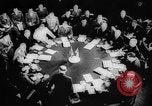
V-J Day: New Yorkers celebrate as President Harry Truman announces Japanese surrender during World War II.
Events surrounding the surrender of Japan during World War II. Scene from the Potsdam Conference meeting. Group of dignitaries together including Clement Attlee, Harry Truman, and Joseph Stalin. U.S. President Harry S. Truman and the General Secretary of the Communist Party of the Soviet Union, Joseph Stalin, in discussion. A parade in Moscow showing Soviet military might (these scenes are from the May 1, 1945 May Day parade just before Germany's surrender). Scene changes to Japanese Emperor Hirohito riding on a white horse in a procession. Next scene shows dignitaries arriving for meeting at the White House in Washington D.C. U.S. Secretary of War Henry Stimson, Secretary of State James Byrnes and Secretary of Navy James Forrestal meet at the White House. Close up view of Secretary Forrestal. View of President Truman with his cabinet in a meeting. Scenes from prior months showing dignitaries involved in the war: Close up of the late President Franklin Roosevelt. A scene of President Roosevelt shaking hands with several Soviet military officers. General Douglas MacArthur seated and talking to President Roosevelt. Close up view of Chairman of Nationalist Government of China, Chiang Kai Shek. View of U.S. Navy Admiral Chester Nimitz shaking hands with a sailor. Views of President Truman meeting in emergency session with his cabinet, and his announcement of the Japanese surrender. View of former Secretary Hull at that meeting. President Truman standing as he reads from a bulletin confirming the Japanese acceptance of the terms of the Potsdam Agreement and their agreement to unconditional surrender. View of media, press, and newsmen running from the White House to file the happy news story. New Yorkers rejoice at the end of war. Daytime scenes of happy, jubilant celebrations on Victory over Japan day, or V-J Day, in the Times Square area of New York City. Crowds cheering, people dancing, soldiers, sailors, and citizens waving hands and American flags. A neon sign with message "Japs Surrender". View of night time celebrations at Times Square as the crowd continues to celebrate VJ Day.
CRITICALPAST.COM: About Us | Contact Us | FAQs - How to Order | License Agreement | My Account | My Lightboxes | Shopping Cart | Advanced Search | Featured Collections | Website Terms & Conditions | Privacy Policy ©2026 CriticalPast LLC.
License Agreement |
Terms & Conditions |
Privacy Policy
©2026 CriticalPast LLC.