


 Francais
 Deutsch
 Italiano
Refine Your Search
Adak Alaska USA 1943 stock footage and images
- Showing 13417 to 13422 of 27381 results more
more Hide
Hide
War veterans learn the art of pipe making as they work on machines at Bertram's Pipe Shop in Washington DC, United States.
A dramatization about veterans of World War II as they learn to make pipes in Washington DC, United States. A World War II veteran Bob Ballad of 69th Infantry Division looks at a pipe. Bertram's Pipe Shop in Washington DC. A number of pipes being displayed in a window at the shop. Bob Ballad outside the shop. He goes there to learn the art of pipe making. Several war veterans learn to make pipes during a training course organized by the Bertram's. Partially disabled men work on machines and learn various operations involved in the process of pipe making.

Function of local Veterans Administration offices in answering questions from United States military veterans after World War 2
A public service announcement or PSA after World War 2, targeted at U.S. military veterans. Narrator communicates how to correspond properly by mail when contacting the Veterans Administration. He encourages veterans to visit their local Veterans Administration office to get answers to questions when possible, rather than writing to the United States Veterans Administration. View of the central office of the Veterans Administration with a number of bags of postal mails and letters piled up. Stacks of letters received from veterans, at a rate of four million letters each month. Mails being sorted out by the staff. A veteran visits a local Veterans Administration office. Animation shows issues that the Veterans Administration cannot assist with, including housing, employment or jobs, and surplus property, and encourages that they contact other government agencies for help on those issues. They summarize problems of veterans that the Veterans Administration does look into like housing, jobs and employment, surplus military property, education, insurance and medical care. They encourage veterans to visit local Veterans Administration offices for answers and help.
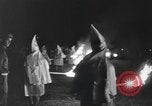
Members of Ku Klux Klan perform ceremonial cross burning in the United States.
Ku Klux Klan (KKK) members during a cross burning ceremony in the United States (possibly Stone Mountain Georgia but location is not confirmed). A U.S. Army soldier in uniform is seen at far left Members of Ku Klux Klan dressed in robes and masks move in a circle carrying lit torches. The U.S. Army soldier sets fire to a huge cross using a lit torch. He steps away from the burning cross. The fire soars up and across the cross quickly. The soldier and KKK members stand in a wide circle around the burning cross. They throw their lit torches in the direction of the cross, landing on the ground..
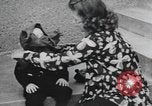
Students of Antioch College learn practical lessons in child study and child care in the United States.
Students of Antioch College in Yellow Springs, Ohio take up various courses and on the job training to learn skills. A college student girl looks after a young child and helps him to put on a Native American Indian costume during play time. A day nursery in Cleveland Ohio where children play around a table and a young boy smiles while he finger paints. Students working at the Sigma Gamma Hospital in Detroit (also called Memorial Orthopedic Hospital, and later St. John North Shores Hospital) tend and treat children suffering from paralysis from polio. A young woman assists a boy in removing his leg braces. She then carries him to an indoor swimming pool and gently sets him down in the water, where the two of them play with a toy boat. Next scene shows a boys' club in Dayton, Ohio where young boys play table tennis (ping pong) and others look on. Students of Antioch College supervise athletics near Chicago, as a group of young women college students practice hand stands and . At the college the students gain first hand experience in child study. A woman at the Bells Research Institute of Antioch College works with a boy who is disabled (possibly polio). Girls look after children and do case work for children in need.
Students of Antioch College in Yellow Springs, Ohio, outside of Dayton, Ohio, take up jobs in science and engineering during World War II
Title Slate reads: "Science and Engineering." This is followed by World War II scenes of American industrial sites, including some dominated by smoke stacks and railroad connections. Men are seen walking at a major shipping port where ships are being loaded and unloaded by large cranes. Sign above one building reads:"Ford." Views inside that plant of ford automobiles being assembled. Mechanics climb a ladder to access a Douglas DC-3 transport plane parked outside a hangar. View of aircraft radial engines being worked on inside a manufacturing plant. young men working in a machine shop are described by narrator, as "Students." and notes that they are engaged in a work-study program that shifted toward the defense industry during World War 2. A member of the Antioch faculty is seen working with a student at a drafting table in a war plant. Closeup of an engine part design on the drafting table. Antioch student, Norman Lawson, works fabricating a giant searchlight for use in the war. He turns the light on to test it. Other students are seen working in a chemistry laboratory, using typical glass equipment and precise balances. A student is seen pouring molten material from a furnace into a crucible. Views of dials being adjusted and belt-driven machinery. A student operating a drill press in a machine shop. A glimpse of the Antioch College campus. A group of students engaged in discussions in their dormitory. Several first year students in a journalism class. Students in an accounting class. View of Antioch's Science building, donated by Charles Kettering (Head of Research at General Motors Corporation), who is pictured. Students conducting research in photosynthesis as well as physics and chemistry in the building. A student studying a book on philosophy.
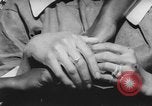
African American children and women in the United States.
Life of African Americans in the United States. Hands of an African American person. African American child and a woman. An African American worker and another man on a field. A worker dressed in battered clothes. An old woman with a wrinkled face. Hens on a field. A hen with chicks. A vessel with feed for the hen. An African American child as the mother combs her hair.
CRITICALPAST.COM: About Us | Contact Us | FAQs - How to Order | License Agreement | My Account | My Lightboxes | Shopping Cart | Advanced Search | Featured Collections | Website Terms & Conditions | Privacy Policy ©2026 CriticalPast LLC.
License Agreement |
Terms & Conditions |
Privacy Policy
©2026 CriticalPast LLC.