


 Francais
 Deutsch
 Italiano
Refine Your Search
Adak Alaska USA 1943 stock footage and images
- Showing 1483 to 1488 of 27381 results more
more Hide
Hide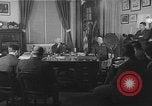
U.S. Marines Lt. General Thomas Holcomb welcomes Major General Alexander Vandegrift back from the Solomon Islands
After commanding raids in the Solomon Islands, U.S.Major General Alexander Vandegrift is welcomed back to the U.S. by Lieutenant General Thomas Holcomb, Commandant of the U.S.Marine Corps. In Holcomb's office, General Holcomb thanks General Vandegrift and congratulates him. Reporters look on. Multiple takes of Holcomb welcoming and congratulating Vandegrift. Flag of the United States in office. After the officers greet each other, they are seated.
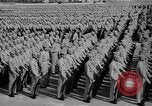
Studies to determine attitude of American soldiers towards their jobs in United States (WW2)
Attitude of United States Army soldiers towards their jobs and World War II. Soldiers stand in formation. Chart reveals their ignorance of jobs. Soldiers march with flags. Charts of the Signal Corps and Corps of Engineers show the percentage of the ASF liking their own jobs most. Soldiers parade. Buildings in the background. The study reveals that most of the United States soldiers not like their job. The percentage of the soldiers in the army reduced to 50 percent in the last few months. A study is made to find out other information. An airplane in flight. Soldiers were asked about their understanding of their jobs, what do they feel about combat and the effects of war films on them produced by the army. They were also asked about their opinion as which country do they feel is trying hardest to win the war.
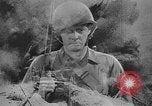
Training the soldiers and providing them with an understanding of their jobs in United States (WW2)
The ignorance of soldiers about their jobs and the war, United States. Stresses the psychological need for hating the enemy. Dramatizes the battlefield treachery of soldiers. Soldiers fire and bombard on the battlefront in World War II. Smoke arises from firing and bombarding. Tank moves on field and fires. A soldier bombing a barbed wire entanglement. Other soldiers fire machine guns. They advance forward on the front. News headlines about the soldiers and their ignorance of job reveals that the soldiers are not prepared to fight. They do not have the understanding of their job. An officer gives lecture to soldiers in the 'Classification Section' to provide them with a proper understanding of their job. The soldiers read books and magazines. They work on the tanks and other war equipment. Training the soldiers mentally. Weekly news about the war on boards.
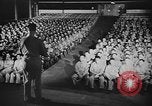
Film of the Nazi German bombing on Britain and the British soldiers fighting the Germans (WW2)
Personnel classification and orientation as morale features. Shows and recommends films of Nazi German bombings, burning towns and dead civilians, in World War II. Stresses the need for esprit de corps. Officer addresses soldiers in a hall and discusses about the need to understand that why they fight. Depicts that the Commanding Officers should show war films of Nazi German attacks on people, to motivate the soldiers to fight for their Nation. The film shows the German planes in flight. The planes bombard on the land where the civilians reside. High altitude view of the city. People run to save themselves from the air attack. Dead bodies lay on the field. Fire and smoke due to bombarding. German flag on the flag pole. Soldiers march. The British soldiers prepare to fight the Germans. The British soldiers in airplanes. High altitude view of the wrecked city.

Take off of the General Motors GM A-1 'Bug' missile from a launching automobile in Muroc, California.
A review of research and development in guided missiles by the United States Air Force from 1919 to 1948. General Motors power-driven bomb (GM A-1 Bug), number 9 on tail, in Muroc, California. Technicians work on the same. The bomb is raised into position for attaching to the launching automobile by means of a hoist on a truck. The missile is nick named the 'Bug'. Technicians work at the automobile being driven beneath the suspended missile. The missile is radio controlled. The automobile specifically built for the launch of the missile is powered by two 165 HP Cadillac engines attached to a single drive shaft. Attaching the 'bug' missile to the launching car. The tractor and the hoist are removed. The automobile is driven across terrain at Muroc. A testing station for testing radio control section of aircraft during test. A technician checks over the radio equipment and shows television camera and equipment used for test. The automobile start at a high speed across the launching strip. Take off of the missile from the automobile. 'Bug' missile in flight. Views from a control aircraft beside the GM A-1 Bug while the Bug is in flight. (World War II period).
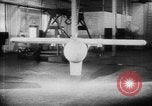
A television controlled GB-4 missile is dropped from a B-17 aircraft in the United States.
A review of research and development in guided missiles by the United States Air Force from 1919 to 1948. A GB-4 radio controlled bomb is suspended from a chain hoist in a work laboratory. This is a television controlled missile. Attaching television equipment to the bottom of missile. A B-17 takes off and is directly overhead. The B-17 in flight, GB-4 attached to its bottom. Interior of the aircraft shows television equipment as a bombardier prepares to drop a missile. The television equipment being put into operation. The B-17 drops the GB-4 missile. Interior of the aircraft shows the bombardier following the course of missile on the television equipment. GB-4 missile dives down towards a train. The locomotive moves across a flat open terrain. The missile hits the target area. The GB-4 missile dives towards a target building. It strikes the ground directly in front of the same and crashes through the building. (World War II period).
CRITICALPAST.COM: About Us | Contact Us | FAQs - How to Order | License Agreement | My Account | My Lightboxes | Shopping Cart | Advanced Search | Featured Collections | Website Terms & Conditions | Privacy Policy ©2026 CriticalPast LLC.
License Agreement |
Terms & Conditions |
Privacy Policy
©2026 CriticalPast LLC.