


 Francais
 Deutsch
 Italiano
Refine Your Search
Adak Alaska USA 1943 stock footage and images
- Showing 15265 to 15270 of 27381 results more
more Hide
Hide
U.S. Army soldiers weave colored cloths on nets for camouflage, and fire camouflaged artillery during World War II
A film titled 'Use of Artificial materials' about use of flat net and camouflage techniques to avoid enemy detection during World War 2. Aerial view of a desert area. Men hide in camouflage nets. Soldiers weave colored cloths into the net. United States Army soldiers uncover a anti tank gun from a net. A vehicle covered by a net. Field artillery weapons and trucks covered by a net. Guns of the artillery seen from a slit in the net. Men fire camouflaged artillery. Men cover a medium tank by net.
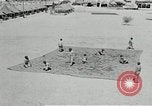
Soldiers stretch a camouflage net and fold it as instructed by an officer in the United States.
A U.S. military film about use of flat camouflage net to avoid enemy detection during World War 2. U.S. Army soldiers stretch a camouflage net flat and taut before folding it. Men fold the net in a standard fashion, as a team, to ensure that the net is properly stored and ready for setup when needed. An officer gives command to the soldiers working as a team to fold the net. Men fold the net as a team. The camouflage net is rolled and tied.
An enemy aircraft bombs a tank and men cover tanks with net to avoid enemy detection in World War 2
World War II training film about use of flat net to avoid enemy detection. An enemy aircraft in flight. The aircraft bombs the tank on a desert. Men cover the tank with net. Men place sticks to make the shape of the tank look irregular. A man fixes the net on ground. Aerial view of broken terrain.
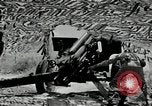
Men lay flat net and place a howitzer under the flat net to avoid enemy detection in the United States
A film about use of flat net to avoid enemy detection in the United States. Men fire artillery mounted on a tank. The tank under a flat net supported by poles. The materials used to support a flat net are poles,sticks,wire gauge,nails,pliers and hammers. A men carry material to lay net. A Non Commissioned officer indicates position of laying the frame. A man hammers nails on top of a pole and on side of the pole. Men place poles on ground. Men string wire on nails. The completed wire pattern. Men place wire on top of pole. Men place wire on edges of poles. Men hammers nails on pole. A man tests the tightness of wire. Net is placed over a wire frame. Net is fastened to the edge of the frame. A howitzer is placed under the flat net. Men break shadow of the net by placing shrubs. (World War II period).
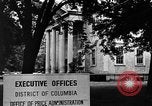
A clerk gives meat to a woman at black market prices and refuses other with ration stamps at a meat shop in the United States
Exteriors of building with sign "Executive Offices, District of Columbia, Office of Price Administration." A grocery and butchered meat shop in the United States. A woman walks into a meat market, presents ration stamps to clerk who tells her he has no more meat left. Another woman enters without stamps, makes purchase of meat by offering an extra cash payment. First woman watches transaction, then goes to a telephone booth and uses the rotary telephone to report the illegal transaction to the authorities.
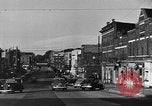
Traffic in business section of unidentified U.S. town; brief view of riverboat; then views of shops on West Main Street in Madison Wisconsin
Majority, but not all of clip shows Madison Wisconsin circa 1946. Clip opens with views of an unidentified town in the United States. Automobile traffic on street of the town. Long views in distance suggest possibly western United States. Next scene is a very brief view of a riverboat or steamboat on a river. Next scene is Main Street in Madison Wisconsin, with cars and trucks on street. Capitol building dome in Madison is visible in distance. Point of view from a moving vehicle of shops and businesses on West Main Street in Madison, Wisconsin. Businesses include The Drake; Fashion Shop; Chris Eckert; Edward Eckert at 125 and 127 W. Main Street. Next is "W. H. Hanger Plumbing and Heating at 123 West Main Street, Madison, Wisconsin. Then a Steak and Fried Chicken restaurant. Next is Margaret's Beauty Salon; Goodyear Tires; J.C. Penney Company. Scene changes to a house. A man comes out of a house carrying a fishing pole. Brief scene of two young men in a library.
CRITICALPAST.COM: About Us | Contact Us | FAQs - How to Order | License Agreement | My Account | My Lightboxes | Shopping Cart | Advanced Search | Featured Collections | Website Terms & Conditions | Privacy Policy ©2026 CriticalPast LLC.
License Agreement |
Terms & Conditions |
Privacy Policy
©2026 CriticalPast LLC.