


 Francais
 Deutsch
 Italiano
Refine Your Search
Adak Alaska USA 1943 stock footage and images
- Showing 1525 to 1530 of 27381 results more
more Hide
Hide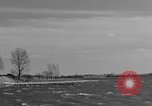
River scene with docks for small boats. Windy with waves on water.
Scene of river with docks for small boats extending into the river. The river is choppy due to wind. No boats are seen.
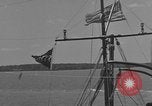
U.S. Navy Coastal Minesweeper operating in a river. Boat displays pennant containing three exclamation and three question marks
Coastal minesweeper operating on James River at mine warfare school, Yorktown, Virginia, during World War 2. Pennant containing three exclamation marks and three question marks (!!!???) suggests it was not yet officially commissioned.
Relocation of Japanese Americans in United States during World War II.
Shows Milton S Eisenhower speaking about the threat posed by Nisei or Japanese American people in United States during World War II. Japanese residents along the west coast have direct access to American oil fields and harbors. Views of harbors with boats and ships. This heightens the need to migrate the Nisei to interiors of America. Commander General of Western Command at his office plans the migration (internment) of Nisei people. Signs and notice banners with headlines "Civilian Exclusion Order number 6" and "Instructions to all persons of Japanese Ancestry." The signs inform the people of the compulsory mass migration. Nisei people fill up documents and submit it to war relocation authority. People undergo medical examination. They sell their property through 'Evacuee property department'. Japanese load their belongings onto trucks and buses. Deserted shops and homes of Japanese Americans. Rows of temporary houses at Santa Anita race track in Arcadia, California. People of Japanese ancestry eat in a large dining hall and attend church service. Men prepare houses for the Nisei. Japanese Americans boarding railroad trains at train stations, and boarding buses to be moved to relocation centers (internment centers).
U.S. Coast Artillery troops board Destroyer Minelayer (DM) and lay buoyant mines in harbors, United States.
Film titled 'Underwater Sentries'. U.S. Coast Artillery troops board a Destroyer Minelayer (DM). Stacked underwater mines in the foreground. DM leaves the dock. Sailors aboard the DM handle mines. Coils of wires on the deck. Sailors on a boat prepare distribution boxes. Cable is connected between the DM and the boat. Mines armed and cables connected from mines to distribution boxes that control firing. Mines are laid by the DM. Animation shows the laying of mines by the DM. (World War II period).
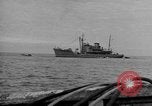
Ground mines laid by Destroyer Minelayer in harbor and destruction of enemy vessels, United States.
Ground mines aboard a Destroyer Minelayer (DM) underway in harbor. Ground mines planted in the harbor. Cover of ground mine is opened and cable to the distribution box is attached. A crane lowers the mine into the water. Cables connected from mines to distribution boxes that control firing. Distribution box is lowered in water. Animation shows the laying of ground mines by a DM. View of switchboards in the central control station at the harbor. Demonstration of reports received, interpreted and acted upon. Enemy vessels are destroyed. Huge explosions in water (World War II period).
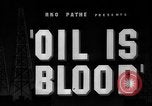
Production of petroleum at oil refineries and its transportation in United States, before and during World War II
Documentary titled, ' Oil Is Blood ' on production and transportation of petroleum and its by products in United States. Crude oil in a pit. Man takes samples from the pit. View of derricks at an oil drilling site. Derricks at sea. Exteriors of a building near the derricks. Service station attendants, pumping gas and cleaning the windshield, on a 1942 Lincoln Continental convertible, at a "Tydol Flying A" gas station. Scenes of busy highways and plenty of fuel give way to empty roads, closed gas stations, and restricted hours for obtaining fuel, as it is rationed during World War 2. Views of persons obtaining ration stamps and books. Various gasoline ration books including the "A" books (allowing the smallest amounts) and "B", "C", and other books allowing larger rations to more essential users. Oil rig "roughnecks" inserting new sections of pipe and proceeding to drill. Closeup of a "gusher" before it is capped. Men filling railroad tank cars with petroleum products. A long train of tank cars pulled by a steam locomotive. Animated map illustrates the ocean shipping lanes that formally served as means to transport fuel and oil, before the German U-Boat threat made them too dangerous for general use. Drums of fuel and oil being loaded aboard a ship to supply the Allies during the war. A convoy of ships heading to the war zone of North Africa.
CRITICALPAST.COM: About Us | Contact Us | FAQs - How to Order | License Agreement | My Account | My Lightboxes | Shopping Cart | Advanced Search | Featured Collections | Website Terms & Conditions | Privacy Policy ©2026 CriticalPast LLC.
License Agreement |
Terms & Conditions |
Privacy Policy
©2026 CriticalPast LLC.