


 Francais
 Deutsch
 Italiano
Refine Your Search
Adak Alaska USA 1943 stock footage and images
- Showing 15859 to 15864 of 27381 results more
more Hide
Hide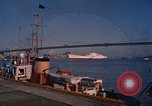
The NS Savannah undergoes final sea trials including operation at full power from its nuclear reactor
The Nuclear Ship ( NS ) Savannah during its test trials in the United States. The NS Savannah leaving the New York Shipbuilding Corporation yards at Camden New Jersey, enroute to Yorktown, Virginia, is seen passing the Delaware Memorial Bridge, as she cruises along the Delaware River. views of spray blowing across the ship underway. View of reactor control room, where increasing levels of power are demanded until full (100%) power is set on April 14, 1962 and the Savannah achieves a speed of 22 knots. The NS Savannah docks at her home port of Savannah, Georgia.
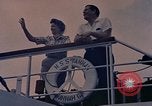
Modern and luxurious accommodation and facilities aboard the NS Savannah as it travels with its first passengers in the U.S.
Modern and luxurious facilities on the Nuclear Ship (NS) Savannah in the United States. A passenger aboard the NS Savannah stands near railings. Modern and attractive accommodations of the ship in its role as a cruise ship. Passengers enter a cabin which is spacious and well equipped. The passengers seated in a luxurious lounge. A woman looks at a wooden table. The passengers have drinks. A golden model of the Savannah is displayed at the entrance to a dining hall. A couple enters the dining room. People seated around a dining table have food. A couple climbs down stairs towards a swimming pool. People seated in resting chairs beside the pool. The passengers dance on a dance floor. A couple has drinks at a table in the foreground. A passenger looks through an equipment on the ship bridge. Engineers work on radar equipment in the control room. Giant and massive gear on the ship. An officer in a control room. Officers and the captain standing aboard the Savannah.
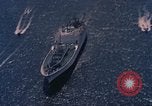
The NS Savannah is welcomed at the ports of various cities in the U.S.
The Nuclear Ship( NS ) Savannah is welcomed at ports of various cities in the United States. The NS Savannah underway at sea. She receives a welcome. Citizens standing in a harbor to welcome the Savannah. People aboard the ship in the foreground. A woman watches through binoculars. The United States Atomic Energy Commissioner Robert E. Wilson speaks. Flags of the United States in the background. U.S. Secretary of Commerce Luther Hartwell Hodges speaks. Other officials seated in chairs listen. A car is lowered on to a deck aboard the Savannah. The ship underway at sea. She makes her first trip through the Panama Canal. On this trip she carries very special passengers. The passengers watch out from the ship. She heads towards the Pacific Ocean. The port of Seattle. Large sign for "Port of Seattle" is seen behind a large old ferry ship. View of the Space needle and harbor in background. The Savannah arrives at the port of Seattle. Citizens of Seattle welcome the Savannah and a banner reads "Welcome Savannah to Seattle Worlds Fair." The captain of the ship draws routes on a map.
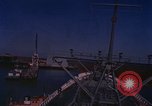
NS Savannah completes reconditioning and departs Galveston, Texas, with new crew, on tour to new ports of call
The NS Savannah is seen at Nuclear Service facility, Galveston, Texas, for reconditioning before making new port visits. Here she is delayed several months by labor dispute involving her nuclear engineering crew. Maritime Administrator, Nicholas Johnson, poses with ship's officers from the American Export Isbrandtsen lines, who are the new operators of the Savannah. The Savannah departs on a mission involving new ports of call. U.S. President Lyndon Baines Johnson comments from his office regarding the mission of the NS Savannah. View of cargo being loaded aboard the Savannah. Views of a world globe. Views of the NS Savannah underway.

Rescue operation steps followed by the crew of a submarine as it sinks in the united States.
A U.S. Navy training film "Submarine Escape" depicts rescue precautions in emergency for men if a submarine sinks. A sunken submarine in the United States. Operation officers check an operation board that the reporting time of the submarine has passed out. A man makes a radio call to the submarine but it does not answer. A squadron officer leaves the office of communication and contacts with an officer of Ships and Shore Station for aid. Two aircraft and an airship in flight to find the submarine and to rescue its crewmen. A ship at sea. Two methods of rescue to be followed in emergency: individual (S.E.A.) and collective (Rescue Chamber). Crewmen in the submarine as it goes down. They smoke. A man on a phone receives no answer. A man checks condition. Two men stand near a compartment. Floating debris in the sea. Men in a forward compartment to talk over the problems that the ship is encountering. Important steps to be followed in an emergency written on a board. Men follow the steps. A man gives a pack of absorbent powder. A man spreads a mattress cover on a lower bunk. He puts on rubber gloves. He pours the powder and spreads it in thin layer. Instructions are read by a man. Emergency drinking water, fruit juices and oxygen for safety. The man waits. Men rest. The men prepare for escape collectively. They wear the rescue gear. Men prepare for escape individually. A man wearing a rescue gear signals by gesturing. The men work with rescue gear and equipment.
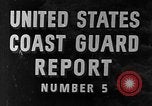
USS Wakefield is painted, cleaned, mail is loaded aboard it and troops embark upon it before it leaves a port of the U.S (WW2)
A U.S. Coast Guard report shows the 'story of a transport' depicting activities of Coast Guard troops and officers aboard USS Wakefield in the United States during World War II. Ships at a sea near port of the United States. Truck, supplies, aircraft and other equipment are lowered on to a ship by a crane. A sign board outside the office of a captain reads "US Coast Guard, Captain of Port". The captain and another officer work on a map at a table in his office. USS Wakefield anchored at the port. The U.S. flag on the ship. The ship is painted and cleaned. Bags of mail are loaded aboard the ship. Army officers in an office discuss at a table. Troops carrying luggage board the ship for transport to the war front. The ship is unanchored. It departs from New York harbor. Shadow of an airship on water. The ship underway at sea. A CG ( Coast Guard ) officer looks through binoculars. A crewman turns a wheel. Coast Guard troops and officers work in the ship's engine room and radio room.
CRITICALPAST.COM: About Us | Contact Us | FAQs - How to Order | License Agreement | My Account | My Lightboxes | Shopping Cart | Advanced Search | Featured Collections | Website Terms & Conditions | Privacy Policy ©2026 CriticalPast LLC.
License Agreement |
Terms & Conditions |
Privacy Policy
©2026 CriticalPast LLC.