


 Francais
 Deutsch
 Italiano
Refine Your Search
Adak Alaska USA 1943 stock footage and images
- Showing 16657 to 16662 of 27381 results more
more Hide
Hide
A political broadcast shows Richard Nixon shaking hands with people during a campaign prior to U.S. Presidential Election.
A political broadcast promotes Republican nominee Richard Nixon prior to the 1968 Presidential Election in the United States. Still images show Richard Nixon shaking hands with people during an election campaign. A sign reads 'NIXON'S THE ONE'.
Ronald Ziegler reads a statement outlining events surrounding Nixon's 'Saturday Night Massacre'
White House Press Secretary Ronald Ziegler in a press room at the White House in Washington DC, United States reads a statement outlining dismissals of officials (known as Saturday Night Massacre) made by U.S. President Richard Nixon on October 20th , 1973. He says that President Nixon has taken action in which he has fired special prosecutor Archibald Cox in the Watergate Case. It was because of his refusal to comply with instructions given to him through U.S. Attorney General Elliot Richardson. He was not to seek to invoke the judicial process any further to compel production of recordings, notes, or memorandum regarding private Presidential conversations. He says that office of the Watergate Special Prosecution Forces has been abolished and its function will be transferred back to the Department of Justice. Ziegler says that President Nixon sought to avoid a constitutional confrontation by the action he announced on Friday October 19th, 1973 to give the courts the information from the tapes which the President had considered privileged. Further he says that President Nixon's action was accepted by responsible leaders in the Congress and in the country. But special prosecutor Cox's refusal to follow the President's instructions at a time of serious world crisis made it necessary for the President to discharge him. Ziegler says that before taking any action the President met with Richardson to instruct him to dismiss Cox, but Richardson refused to do so. After Richardson submitted his resignation, the President directed Deputy Attorney General William Ruckelshaus to dismiss Cox. When Ruckelshaus refused to carry out President's directive, he also was discharged. President Nixon then directed acting Attorney General Robert Bork to carry out the instructions and Bork fired Cox.
President Richard Nixon speaks on the occasion of a photo opportunity with the BSA in Washington DC, United States.
Clip shows opening slate and contains audio only. No visual images. U.S. President Richard Nixon at a photo opportunity with the Boy Scouts of America (BSA) in Washington DC, United States on 21st February, 1974. A boy scout speaks about the activities of the boy scouts in the recent years. President Richard Nixon is presented with a collection of coins. President Nixon speaks during the occasion. He speaks about character building, boy scouts joining the armed forces and progress of the boy scouts. He thanks the boy scouts for the honor and for the invitation to their Jamboree and regrets that he cannot attend, but says he is glad he does not have to go on a 50 mile hike. He invites them on a tour of the White House.
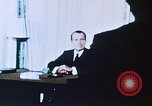
From the Oval Office in the White House, President Nixon talks to Apollo 11 astronauts after their landing on the moon.
Telephone conversation between U.S. President Richard Nixon and the astronauts of Apollo 11, while they are on the moon, July 20th, 1969. President Nixon seated at a desk in the Oval Office of the White House in Washington DC, United States. Technicians setting up video cameras. Nixon talks over a phone. Men setting up a monitor screen. Flickering moving images of the astronauts beside the Lunar Lander, on the surface of the moon. A camera focuses in on a document titled: DRAFT 'Talk to men on the moon' on the desk. The opening sentence reads: "This is an epic day in the history of man." A split image on the screen shows President Nixon talking and the astronauts on the moon. President Nixon talking to an astronaut on a phone at his desk in the Oval Office. Picture of "Earthrise" as seen from the moon, on wall in the Oval Office. NASA Astronaut, Frank Borman,who commanded the Apollo 8 mission,in 1968, comes before the cameras in the White House and makes speaks on behalf of NASA astronauts involved in the Apollo missions.
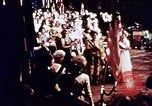
U.S. President Richard Nixon speaks to Continental Congress of Daughters of American Revolution, in Constitution Hall
President and Mrs. Pat Nixon are welcomed to the stage of Constitution Hall, Washington, DC, where the President speaks before assembled women at the Continental Congress of Daughters of the American Revolution. He is applauded and leaves with Mrs. Nixon, waving upwards as he departs.
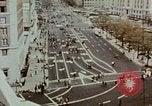
Demonstrators march along Pennsylvania Avenue during an anti-Vietnam War protest in Washington DC, United States.
Anti-war demonstrations in Washington DC, United States, protesting against the Vietnam WAr. A crowd along Pennsylvania Avenue. U.S. Capitol in the background. View of the Washington Monument. Traffic along a street. People march along Pennsylvania Avenue carrying signs and placards during an anti-Vietnam War protest. Signs held by the marching people.
CRITICALPAST.COM: About Us | Contact Us | FAQs - How to Order | License Agreement | My Account | My Lightboxes | Shopping Cart | Advanced Search | Featured Collections | Website Terms & Conditions | Privacy Policy ©2026 CriticalPast LLC.
License Agreement |
Terms & Conditions |
Privacy Policy
©2026 CriticalPast LLC.