


 Francais
 Deutsch
 Italiano
Refine Your Search
Adak Alaska USA 1943 stock footage and images
- Showing 16687 to 16692 of 27381 results more
more Hide
Hide
African American cadets train to become U.S. Army pilots (Tuskegee Airmen), at Tuskegee Army Airfield, Alabama during World War 2
Opening segment of "Army Air Forces special film project 151" known as "Wings for This Man". African American airmen being trained at Tuskegee Army Air Field, Alabama during World War II. Panoramic views of Tuskegee Institute in Alabama. Monument to Booker T. Washington at Tuskegee Institute. Construction of airstrip near Tuskegee Institute. Planes , barracks, and building after construction of airfield nearby. African American pilots, Tuskegee Airmen, board P-40 airplanes and take off during training flights. Various training classes cover topics such as navigation, engine basics, instruments and instrument flying. Trainee in a link trainer, and later in a BT-13 trainer airplane in flight (presumably under a hood). Trainees engage in calisthenics. BT-13 performs barrel roll. Aircraft seen in various scenes include: Lockheed P-38s; Vultee BT-13s; P-40s; and Stearman trainer. (Note: Narrator is Ronald Reagan)
Graduating class of Tuskegee Airmen African American U.S. Army pilots receive wings at Tuskegee Army Air Field, Alabama during World War 2
From "Army Air Forces special film project 151" known as "Wings for This Man". Tuskegee Airmen U.S. Army Air Force African American pilots flying out of Tuskegee Army Air Field, Alabama during World War 2. Training flights in P-47 Thunderbolt fighters. Pilots around bombers parked at Tuskegee Army Air Field. Graduating class receive wings from U.S. Army Air Force officer. U.S. Army Air Forces P-40 Warhawks, P-47 Thunderbolts, and P-51 Mustangs take off from air strip. U.S. African American pilots being briefed in the European Theater. U.S. aircraft strafes grounded planes on enemy airfield. A grave site showing crosses and tombstones. (note: narrated by Ronald Reagan)
U.S. Major General William O. Butler gives address on third anniversary of Tuskegee Army Airfield, during World War II.
Final segment of "Army Air Forces special film project 151" known as "Wings for This Man". Third anniversary of United States Army Tuskegee Army Air Field being celebrated in August, 1944 during World War 2. Tuskegee Airmen U.S. African American cadets march. Commanding General U.S. Army Air Forces Eastern Flying Training Command addresses the cadet soldiers, families and spectators assembled. Cadets march at the ceremony. P-40 airplanes seen parked at the airfield. Several P-40s taxiing. (note: narrated by Ronald Reagan)
U.S. General George Marshall awards Distinguished Service Cross to Lieutenant Gerry Kisters in the United States.
U.S. Lieutenant Gerry Kisters awarded Distinguished Service Cross in the United States during World War II. Chief of Staff of the U.S. Army General George Marshall stands alongside Lieutenant Gerry Kisters and his family. Also in the group is General Lesley McNair. Officer reads citation. General Marshall pins DSC (Distinguished Service Cross) on uniform of Lieutenant Kisters and shakes hands with him. Lieutenant Kisters kisses his wife and his family congratulates him.
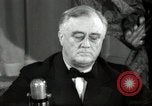
President of United States Franklin Roosevelt delivers a fireside chat in Washington D.C. to the nation.
U.S. President Franklin Roosevelt delivers Fireside Chat speech to the nation on 29th December, 1940 in Washington D.C. during World War II. In portions from his "Great Arsenal of Democracy" speech, Roosevelt talks about lower chances of the United States getting into war by supporting the nations that are defending themselves against attack by the Axis Powers. Roosevelt speaks about supplying equipment required by the nations defending against Axis Powers. He denies any demand for sending an American Expeditionary Force outside the United States. He says that any talk of sending armies to Europe is untrue. He talks about cooperation between the Government, industry and labor. Roosevelt also speaks about immediate expansion of industries essential to defend the nation. He lays stress on aiding Great Britain through lend lease and similar programs, and Roosevelt expresses his belief that the Axis Powers will not win World War II. He says that "we must be the great arsenal of democracy."
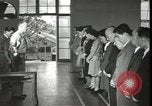
U.S. Colonel Kendall J. Fielder awards medal posthumously to Japanese-American parents of soldiers who died in World War II.
Posthumous presentation of U.S. 442nd Infantry Regiment to Japanese-American parents in Honolulu, Hawaii during World War II. Interiors show Japanese-American parents of soldiers of U.S. 442nd Infantry Regiment, who died in the war. Chaplain Spears addresses the group. Japanese-American parents lined up in front of the room. U.S. Colonel Kendall J. Fielder presents medals and shakes with the parents.
CRITICALPAST.COM: About Us | Contact Us | FAQs - How to Order | License Agreement | My Account | My Lightboxes | Shopping Cart | Advanced Search | Featured Collections | Website Terms & Conditions | Privacy Policy ©2026 CriticalPast LLC.
License Agreement |
Terms & Conditions |
Privacy Policy
©2026 CriticalPast LLC.