


 Francais
 Deutsch
 Italiano
Refine Your Search
Adak Alaska USA 1943 stock footage and images
- Showing 1681 to 1686 of 27381 results more
more Hide
Hide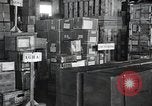
War supplies from different parts of the world, construction of shipyards, and building war ships in the United States.
War equipment and ships built in industries of the United States during World War II. Crates containing war supplies from all over the world stacked. Massive large columns of United States Army Soldiers and huge columns of United States Navy sailors in review, marching and standing in formation. Men work on the construction of shipyards and ships in shipyards. War production workers work on different machines to make and assemble ship parts. A crane lifts a part of a warship to be assembled. Men wearing protective masks do arc welding on parts of ships. A line of ships at dock. Scenes of many different cargo ships, Liberty Ships, battleships, cruisers, submarines, destroyers and aircraft carriers launched. Some of the ship names seen include: SS Zebulon Pike, SS Patrick Henry, SS John C Fremont, SS John Fitch, SS Ethan Allen, SS Mormacwren, SS Irving S Olds, a ship of the Lykes Lines, the U.S. Navy destroyer USS Bristol (DD 453), USS Hancock (CV-19), Men walk down the steps towards the ships. Men load supplies onto ship. Soldiers board transport ships. A Soviet cargo ship with a large flag "USSR" on it. A convoy of ships at sea.
Junkyard cars being driven at a parade to stimulate people to donate automobiles for scrap metal in Decatur, Illinois (WW2)
A World War II film titled 'Jalopies Parading to Victory' a parade intended to stimulate people to donate dilapidated automobiles for scrap in Decatur, Illinois. Automobile traffic on a street. Office buildings in the city. View of pier extending over Lake Decatur. Exteriors of the Millikin University. A industrial area of the city. Old cars at the backyard of houses. Mary Livingstone disembarks from a car. She is greeted by the women. War production officials stand and talk. Cars in the parade. Modern firefighting vehicles being driven at the parade. Soldiers march. Officials seated. Fire fighting department spray water on a car. School girls march at the parade. Decorated cars at the parade. Horse drawn carriage at the parade. American university students and men from the bomber division march. A band plays. Children ride bicycles and march at the parade.
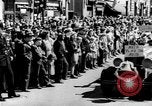
School children and civilians participate in a war time "jalopy parade" to encourage donations of junk cars and other scrap metal in Decatur, Illinois.
Scenes of a a "jalopy and general salvage parade" in an American city during World War 2, to support the war effort. Parade floats that use scrap materials simulate the finished products of war like vehicles and airplanes. Civil Air Patrol airplanes fly over the parade route reminding citizens of the need for scrap metal in manufacturing and producing airplanes for war. Narrator describes need for inclusion of many needed scrap materials in the parade such as tin cans, silk, nylons, fats, greases, etc. and that "jalopies make jeeps." Narrator, on behalf of the United States War Production Board, gives specific instructions of how to hold such a parade in any town in the United States and encourages viewers to hold such parades in their towns all over America to help the home-front war effort. The parade heads down main streets of Decatur, Illinois, with many shops and buildings seen along the route. People stand on roadside to watch the parade. Cars driven at the parade. School children ride on cars, many bearing wartime victory slogans. Man works on a vehicle carried on a truck. A float decorated with papers. School children march. A man pushes a trolley. Girls ride bicycles. Officers address parade attendees as livestock is auctioned off to raise funds for the war effort. Junk yard cars that are candidates for scrap recycling are seen in the backyards of houses. Clip concludes with a message from Mr. Eugene Dunne, District Chief, Scrap Processors Branch, War Production Board, Chicago. Mr. Dunne encourages viewers to hold jalopy parades like the one seen in Decatur, Illinois.
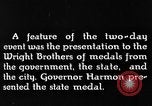
Orville Wright raises a flag and dignitaries including Quincy Gillmore, Edward Andrew Deeds present in the United States.
The 40th Anniversary of the Wright brothers first airplane flight in the United States. A picture of Ohio Governor Judson Harmon presenting a medal to the Wright brothers and people in a stadium arranged to form a flag. A flag being raised. The Wright brothers and other dignitaries surround a flag pole. Aviator Orville Wright raises a flag. A gun salute in front of Air Material building. Aviator Orville Wright, General Quincy Gillmore and U.S. Army Colonel Edward Andrew Deeds present.
Dignitaries grouped in front of the Wright House and Orville Wright with others at dedication of a memorial in the U.S.
The 40th Anniversary of the Wright brothers first flight in the United States. Conference members grouped in front of the Wright House. Orville Wright surrounded by a group. The group enters the house. Aviator Orville Wright, General Quincy Gillmore and U.S. Army Colonel Edward Andrew Deeds with others enter a Colonel Deed's aircraft "The King Bird" for trip to Washington DC. The aircraft taxis for a take off. Delegates posing in a group in Washington DC. Orville Wright in whose honor the conference was held. United States President John Calvin Coolidge, Jr. and United States Secretary of Commerce William Fairfield Whiting present. The group at Kitty Hawk in North Carolina. Orville Wright removes a cover from a stone memorial. Pigeons are released. A plaque commemorating the first successful flight of an airplane.
A P-38 aircraft in flight and an animation depicts bail out techniques from the aircraft in the United States.
Normal and emergency operating characteristics of United States Army Air Force Lockheed P-38 Lightning aircraft in the United States. Three P-38 aircraft fly in formation. A P-38 Lightning aircraft in flight. Animation depict bail out techniques from the aircraft. The aircraft flies low over a shoreline. The P-38 aircraft accelerates while in flight. The propellers of the aircraft rotate. Cockpit panel of the aircraft.
CRITICALPAST.COM: About Us | Contact Us | FAQs - How to Order | License Agreement | My Account | My Lightboxes | Shopping Cart | Advanced Search | Featured Collections | Website Terms & Conditions | Privacy Policy ©2026 CriticalPast LLC.
License Agreement |
Terms & Conditions |
Privacy Policy
©2026 CriticalPast LLC.