


 Francais
 Deutsch
 Italiano
Refine Your Search
Adak Alaska USA 1943 stock footage and images
- Showing 16933 to 16938 of 27381 results more
more Hide
Hide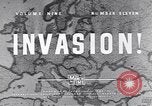
News media military analysts discuss the problems of Allies invading Europe to defeat Germany in World War II
Map of Europe and label "Invasion." Westbrook Van Voorhis leading a panel discussion about the problems arising from the Allied invasion of Europe in World War 2. He introduces panelists: Hanson Baldwin (military editor of the New York Times) Dewitt MacKenzie (Associated Press military analyst), and Paul Schubert (of Mutual Radio Network). He asks Mr. Baldwin about the importance of aerial bombing campaigns. Baldwin also stresses importance of a land invasion of Europe. Relief map of Europe highlighting major German cities. Asked about the merit of invading Italy on the way to Germany, Mr. Schubert cites the problem of the Alps and suggests other more effective invasion routes. Van Voorhis asks Mr. MacKenzie about best route into fortress Germany. He considers the criterion of ease of supply as most important, and suggests the Atlantic coast, near a good port and not far from England. Animated map shows this idea. When asked about this, Mr. Baldwin agrees completely, calling the conflict "a quartermaster's war." He adds, "The problem of victory is the problem of supply."
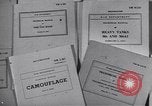
Army Service Forces recruits undergo training in the United States.
images of Army Technical training manuals dealing with gas masks; camouflage; heavy tanks; and machine guns. U.S. Army Service Forces (ASF) recruits rushing down a hillside into waters of a swift river and swimming across. They undergo Live Fire Exercises near \end of their training. The must crawl while trainers fire rounds from a Browning M 1917 machine gun over their heads. An explosive charge goes off as the recruits crawl past. ASF troops are briefed about invasion techniques, by an instructor using a realistic small scale mockup of a port city. Recruits crouch over a model of front line terrain. Model trains operate as a training aid. Students at doorway of the U.S. Army School of Military Government. Numerous student studying in the library. In a classroom, a military officer instructor discusses the mission of governing an occupied country with cooperation of the existing governing officials. Closeups of officers discussing the occupation of Germany, at length. (World War II period).
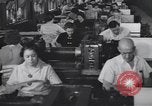
Armed Service Forces men and women ready for invasion of Europe in World War 2, including printing of invasion money.
Armed Service Forces (ASF) personnel at work in the United States during World War 2. Interior of a building. Men and women working. They print invasion money (temporary currency for use in Europe after the Allied invasion, until local currencies can be stabilized). Bills passing through printing machinery. The plan of actions is seen being typed on a typewriter and passed through the ASF network command. An officer talks on phone.
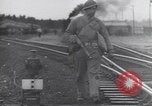
Troops board trains with war equipment and other supplies en route to ports of embarkation from the United States during World War II.
Plans underway in the United States in 1944 for participation in the invasion of France during World War 2 by Allied forces. A U.S. Army sentry of the Army Service Forces (ASF) patrols a rail line, where military men and equpment are being transported abroad., during World War 2. ASF soldiers drive DUKWs (amphibious vehicles) up a ramp for loading into railroad box cars. A long line of DUKWs being driven for loading. Many men load 55 gallon drums of petroleum products into rail cars. An M3 Stuart light tank being driven on an open rail car. Soldiers loading motorcycles on a train. An Army M3 Half-track Amored Personnel Carrier (APC) driving onto a railroad train. (Narrator notes that it requires 75 trains to transport a single Armored Division by rail.) Men loading a 105 mm Howitzer Motor Carriage M7 (Called Priest, by the British) onto a flat rail car and securing it in place with wooden supports. Army personnel that would participate in an invasion are shown. Paratroopers with their packs. Women's Army Corps (WACs) fill their duffel bags with clothing and other items, and are then seen climbing aboard an open stake truck. An Army band plays and marches giving troops a sendoff at a train station. U.S. soldiers board passenger railroad trains, carrying their field packs and weapons. A steam locomotive pulling a troop train. A train load of Sherman M4 medium tanks and other equipment, including a caterpillar tractor, is seen underway. Unidentified tanks being fastened to rail flat car. Many Army trucks and heavy equipment on train passing a town train station. Military equipment moving on trains over bridges. Two ladies under hair dryers at a salon, discussing boys in service going overseas. United States Army troops bound for the war front are seen boarding railroad trains and also changing trains, monitored by Army military police (MPs) at night. Soldiers inside a moving train car occupy themselves by playing cards; shooting craps; An African American porter watches a game. An Army chaplain talking with some of the soldiers. A soldier reading a magazine. His seat partner keeps falling asleep against him. American civilians at a newsstand. Newspaper headline reads: "London expects invasion of Europe at any hour."
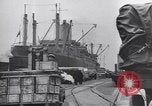
War materiel is loaded on ships to support the Allied invasion of Europe in World War II
A ship being loaded at a U.S. port of embarkation with war materiel to support the Allied invasion of Europe in World War 2. A group of Army dock workers enters the port building. A sign on the front office reads: "U.S. Army Transport Service." Steel structural items and large steel boiler are loaded aboard the ship. Men steady supplies lowered on deck in nets. Men place boxes in the ship's hold. A 2x4 Army truck being lowered into the ship.Tanks and artillery pieces, covered with canvas on the ship deck. A 155mm long tom gun being loaded on the ship More views of equipment and supplies being loaded aboard ship. The covered fuselage of a P-38 Lightning fighter plane being lowered onto the deck. Two civilian men in a wash room talk about upcoming invasion. Troops in full field gear coming aboard the transport ship. Men looking out the port holes of the ship. An invasion convoy getting underway. Soldier on deck, silhouetted against the sky. View of the Pentagon Building in Virginia. Army Service Forces officers meeting in Pentagon. Officers walking in the Pentagon halls. One exchanges salutes with a guard as he leaves the building.

The Signal Corps recruits being trained and study communication equipment in the United States.
A U.S. military training film titled "Pro Patria Vigilans" on the wartime and peacetime activities of the U.S. Signal Corps. United States Army General Douglas MacArthur aboard the U.S. Army Battleship USS Missouri during the Japanese surrender ceremonies of World War 2 in 1945. General MacArthur speaking on board the ship at the closing of the surrender proceedings. Aircraft flying in formation overhead. Antiaircraft guns directed towards the aircraft. Signal Corps recruits train at Fort Monmouth, New Jersey. The recruits dive and swim across water. The soldiers attend lecture by an officer. A sign reads: 'Field Radio Course'. Men working in the radio room are trained. Views of soldiers learning to operate radar. Various radar dishes. Closeup views of radar screens. An officer training the soldiers with the help of a model. The coastal defense training of the soldiers. The soldiers study the communication equipment. Soldiers working on communication switchboard equipment, telegraph, and teletype machines. A small messenger aircraft takes off and lands near the message center. A sign outside the building reads: 'Master Message Center'. Soldiers receive a map and clear it through the message center. Spinning equipment in the message center (possibly related to decoding or encryption). Officers seated at a desk, discussing a map.
CRITICALPAST.COM: About Us | Contact Us | FAQs - How to Order | License Agreement | My Account | My Lightboxes | Shopping Cart | Advanced Search | Featured Collections | Website Terms & Conditions | Privacy Policy ©2026 CriticalPast LLC.
License Agreement |
Terms & Conditions |
Privacy Policy
©2026 CriticalPast LLC.