


 Francais
 Deutsch
 Italiano
Refine Your Search
Adak Alaska USA 1943 stock footage and images
- Showing 1711 to 1716 of 27381 results more
more Hide
Hide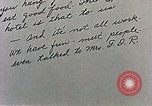
Mobilization and Review of U.S. Coast Guard Auxiliary Division Two in Seattle Washington during World War II
The second annual mobilization and review of U.S. Coast Guard Auxiliary Division Two, in the 13th Naval District, during World War 2. The first thing seen is a portion of a letter from a Coast Guard SPARS woman to someone at home. She mentions having spoken to Mrs. F.D.R. Scene shifts to The mobilization and review event on Lake Washington, in Seattle, Washington which involves some 300 boats belonging to members of the Coast Guard Auxiliary, that parade in review. Secretary of the Navy, Frank Knox (not seen) along with high ranking naval officers, and the First Lady, Mrs. Eleanor Roosevelt, are part of the reviewing party, as guests of Mr. O.D. Fisher, aboard his yacht. (The Coast Guard Auxiliary identification, CGA 2444, is seen clearly painted on its bow.) It is anchored off the north shore of Madronna Park Beach in Lake Washington. Views of the yacht with Mrs. Roosevelt and several admirals aboard. A woman officer, in the Coast Guard SPARS, is invited to chat with Mrs. Roosevelt. She sits down next to her. At one point, they both wave toward the camera. Later, two women SPARS stand on shore and converse with Mrs. Roosevelt, as she stands aboard the yacht.
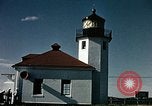
Women in the U.S. Coast Guard Women's Reserve (SPARS) training during World War II
Three Uniformed women in the U.S.Coast Guard Women's Reserve (SPARS) arrive at the entrance of a Coast Guard Station, during World War 2. The station includes a light house. Next, a Coast Guardsman explains the light to them as they stand on a platform at its top. Scene shifts to about a dozen SPARS women boarding a Coast Guard training ship. Some of them ascend rope ladders in the ship's rigging. Three of them drive away in a blue Coast Guard jeep, up a dirt road to a waterfront. There, while standing in a boat (unseen but moving up and down) a Coast officer converses with one of them while referring to a chart. The next scene shows the three women on top deck of a Coast Guard Fireboat, where a Coast Guardsman demonstrates one of their firefighting water guns. The water pressure is increased, creating a powerful stream of water. Scene shifts to about 25 SPARS women assembled on a lawn in front of a frame building. A woman officer motions them into formation and reads orders. Next, from viewpoint, above, the formation of SPARS women is seen marching along with Coast Guardsmen in a parade.

The U.S. Army Quartermaster Corps with their loads of supplies at times of war overseas (during World War 2).
The United States Army Quartermaster Corps in the United States during World War 2. Supplies for the Quartermaster Corps like boots, dresses, cigarettes and hardware. A tent encampment. A soldier standing in a wooded region. An officer seated at a table in an office. The flag with the Quartermaster Corps insignia flutters from a pole. Point of view shot at nearly eye level with large column of U.S. Army soldiers marching toward camera position, holding rifles as they march in formation. The soldiers eat seated at tables in a dining hall or mess area. The Quartermaster Corps unload boxes of supplies during a war overseas. A number of boxes of supplies on a beach. Several Quartermaster Corps unloading boxes from landing crafts on the beach. View of a pair of boots which is part of the necessary uniform equipment. A large number of cabbages in a heap. Pieces of hardware hung on stands on a wall. The boxes of supplies are stacked in a store before distribution. The corps distributed uniforms. United States Army Soldiers on tanks moving on a path. The soldiers arrive at landing crafts on a beach. Large columns of U.S. Army soldiers march in formation. Women's Army Corps (WAC) and nurses move in formation. Women working in textile webbing factory with large spools of webbing or string during manufacture process. The soldiers march. Ships in a harbor. Supplies at a dock for army and navy requirements.
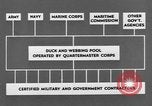
U.S. Army Quartermaster Corps' service areas and procedure of procurement of materials in the United States.
The United States Army Quartermaster Corps in the United States. A diagram showing the functions of the Quartermaster Corps. The service areas of the Quartermaster Corps are the army, the navy, the Marine Corps, the Maritime Commission and other government agencies. Members of the Headquarters Army Service squad and Quartermaster Corps officers seated around a table during a meeting discuss consolidation of procurement of items common to all military services. The U.S. flag behind the officer at the head of the table. Several women in a depot testing materials. Women during the packaging of materials. View of soldiers, paratroopers, jungle troops, mountain troops and amphibious troops who are all served by the Quartermaster Corps. (World War II period).
U.S. Army Quartermaster Corps' plan for procurement of materials for military services in the United States (WW2)
The United States Army Quartermaster Corps in the United States. Members of the Headquarters Army Service squad and Quartermaster Corps officers seated around a table during a meeting discuss the procurement plan of items for the military services in World War II. A signboard over the Quartermaster Headquarters building reads 'Office of the Quartermaster General War Department'. A map of the United States shows locations of procurement offices across the nation where authority is given to field officers for procurement. A field officer with a military personnel signing a contract for a fixed amount for the procurement of materials. A map shows the authority given in the procurement of materials which helps in speedy and efficient procurement. A simplified contract form which is used when the prices are known and when the total purchase does not exceed 500 thousand dollars. A purchasing officer hands over the contract to a staff to be sent to a manufacturer or a dealer. The manufacturer in his office signing the contract. Workers at the Quartermaster Headquarters at work.
U.S. Army Quartermaster Corps market centers, purchasing offices and depots in the United States.
United States Army Quartermaster Corps depots in the United States. Factories where production is a continuously running process. Equipment in operation in the factories. A diagram shows commodities classified into two groups: perishable subsistence and textiles clothing, general supplies, and non-perishable subsistence. Perishable subsistence commodities such as eggs, meat and vegetables are purchased on a daily basis by representatives of the Quartermaster Corps. The representatives move among cartons of vegetables. A map of the United States shows locations of offices at market points. Men and women operating a telephone network co-ordinating activities in these offices. A man takes a printout of hourly market coverage. A map of the United States showing 35 market centers through which perishable commodities for military needs are supplied. The representatives of the Quartermaster Corps among cartons of vegetables in an open market. The men look at the vegetables. The market centers in view. Non-perishable items such as clothing, textile, general supplies and K-ration packets in view. A map of the United States shows the 17 purchasing offices located in depots in the 15 procuring districts through which these items are procured. The Boston Quartermaster Depot purchases all footwear and shoes. Office supplies in view which have been purchased by Jersey City Quartermaster Depot. The Philadelphia Quartermaster Depot procures all textiles. A map of the United States shows the 15 procuring districts.
CRITICALPAST.COM: About Us | Contact Us | FAQs - How to Order | License Agreement | My Account | My Lightboxes | Shopping Cart | Advanced Search | Featured Collections | Website Terms & Conditions | Privacy Policy ©2026 CriticalPast LLC.
License Agreement |
Terms & Conditions |
Privacy Policy
©2026 CriticalPast LLC.