


 Francais
 Deutsch
 Italiano
Refine Your Search
Adak Alaska USA 1943 stock footage and images
- Showing 1735 to 1740 of 27381 results more
more Hide
Hide
Snow vehicle, Weasel travels over snow, obstacles, railway tacks, rocks and gravels and rough terrain in the United States.
Demonstration of the capabilities of the small snow vehicle, Weasel in the United States. The vehicle travels over snow and rough terrain. It carries men and equipment. Lined up Weasels, military headquarters in the background. It climbs steep hills and maneuvers. It is driven over obstacles, railway tracks, rocks and gravels and water stream. It wades through bushed and small trees. It floats in water. It passes through jungle and its small size makes it easy to conceal. Various parts of weasel describe its capabilities. Parts include light weight plate, rubber covering on plate and others. It can load and tow men and equipment.
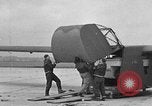
Weasel is carried aboard a glider and dropped by parachute from a plane in the United States.
Demonstration of the capabilities of the small snow vehicle, Weasel in the United States. Weasel is carried aboard a glider. Gilders take off. Weasel is dropped by parachute from a plane. It is ready to move for action as it lands. It travels over snow and rough terrain. Half track vehicle on snow covered land. Interior: Weasels are being improved. Weasel is driven on snow covered land with its new features like stable tracks and cargo body.

U.S. Navy Department develops ships and boats for amphibious assaults during World War II.
Film opens showing the U.S. Capitol building in Washington, DC. Next are views of the U.S. Navy and Munitions building on Constitution Avenue in Washington, DC (Sign on building reads: "Navy Department.") View of Senior Naval officers in a conference room in the building. Next scene shows a group of military planners discussing a three dimensional model of a Pacific island with landing ships and landing craft near the shore. A group of Army and Navy officers discuss documents as they stand in front of a huge wall map of the world. They walk together and point to the Mediterranean portion of the map. A large sign points toward "Naval Research Lab." Inside a Navy Commander and Lieutenant Commander confer over some maps with two civilians. Next, a room full of draftsmen (including a woman) are seen bent over drawing boards. Two engineers bend over an instrumented cutaway of a ship's hull. Senior military officers sit around a conference table. American and British flags are placed at the end of the room. Closeup of two British officer attendees. Civilian engineers and designers gather around a table. Workers at a shipyard gather on and around a Navy ship that displays a battery of four antiaircraft guns. Men in a foundry preparing to pour molten metal from a ladle into a mold. A milling machine taking a deep cut on the edge of a steel plate. A large engine being moved by an overhead conveyor in a factory. Men fabricating boats in a factory. View, from a moving platform, of men painting a newly manufactured Higgins boat (Landing Craft vehicle personnel, LCVP). A new Landing Ship Tank being launched at the Norfolk Navy Yard, Portsmouth, Virginia. USS LSTs 340 and 341 at their launchings in Portsmith.

V-mail procedures including cutting, microfilming, transport, photographic enlargement and processing in the United States.
V-mail procedures in the United States during World War II. V-mail letters are purchased by users on post office window. V-mail letter is written by user. User writes proper address and closes letter in its own envelop. Mail bags of V-mail are unloaded. Letters are opened by cutting machine. Post office personnel sort the mails according to destination group. Seal is put on letters. Letters are bundled. Personnel work on microfilming to save shipment space. Mailbags are transported via airways. A personnel supplies sack of mail at office of city. Letters in microfilm are processed. Personnel work on photographic enlargement. Letters are enveloped and sealed by machines. Letters are delivered to soldiers.

Argyle R. Mackey introduces alien relocation internment and detention facility, from his office in Washington DC.
Introduction to production on alien enemy detention facilities in the U.S. during World War 2. U.S. flag at mast. Ground level views of U.S. Capitol building and street in front of it. A few 1940's era cars and a taxi cab drive by. Argyle R. Mackey, Commissioner of Immigration and Naturalization, U.S. Department of Justice, introduces detention facility.
An electrical specialist checks wires,harness connections,battery during the inspection of B-24 aircraft in the United States.
The 50-hours inspection of the ignition and electrical system of USAAF B-24 Liberator heavy bomber aircraft at an airfield in the United States. Men exercise on the field. An animated diagram of human skeleton and United States Army Air Forces B-24 Liberator heavy bomber aircraft. The B-24 heavy bomber aircraft takes off. The aircraft in flight over grasslands. The B-24 parked at the airfield. The crew members start the 50-hours inspection of ignition and electrical system of the aircraft. An electrical specialist tightens the elbow terminals and nuts of the hammering engines. The specialist checks the chamber and slides wires and makes sure they are not worn. He checks the cable for security of mounting. After inspecting all the wires and harness, the specialist checks other attachments. He examines the switch lead and removes cover from booster coil. The signals for operation test on cover plate switch board flow smoothly, so the specialist gives an 'OK' signal. During the electrical inspection: the specialist notes the operation of the battery disconnect relay. A man in the cockpit operates the battery switches. The specialist signals in the cockpit and replaces canvas covering. He checks battery insulation for proper security of connections. The specialist makes the hydrometer test with electrolytes and removes the sump and cleans it with soda water bath and neutralize acids. He checks the proper connection of accessible electrical leads and also checks the landing lights and examines the inter cooler shutters in the cockpit. The specilaist checks the generator for security of mounting and makes sure that the brushes are in good condition. He tests the oiling and cooling blast connection.
CRITICALPAST.COM: About Us | Contact Us | FAQs - How to Order | License Agreement | My Account | My Lightboxes | Shopping Cart | Advanced Search | Featured Collections | Website Terms & Conditions | Privacy Policy ©2026 CriticalPast LLC.
License Agreement |
Terms & Conditions |
Privacy Policy
©2026 CriticalPast LLC.