


 Francais
 Deutsch
 Italiano
Refine Your Search
Adak Alaska USA 1943 stock footage and images
- Showing 175 to 180 of 27381 results more
more Hide
Hide
The U.S. Army Air Corps processes photo-mapping films covering 21,000 square miles, brought back by the 1934 Alaska Flight
Followup to the U.S. Army Air Corps 1934 Alaska Flight. The U.S. Army Air Corps Photographic department processes and assembles the 60 rolls of film shot by the USAAC 1934 Alaska Flight during its aerial photo-mapping mission over 21 thousand square miles of Alaska territory. Photographic workers mount film onto large rolls and place them into developing solutions. Long strips of film are seen drying on rotating slatted drums.Oblique negatives placed in rectifying printer are transformed into vertical photographs. Workers develop the negatives. Developed single wing photographs. Composite five lens photographs ready for mapping.
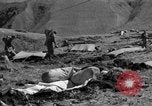
Soldiers cook and drink coffee around fire at camp area in Kiska, Aleutian Islands, Alaska.
Camp area in Kiska, Aleutian Islands, Alaska. Soldiers lay on ground. Foxholes in side of hill. Soldiers get hot coffee poured into cups and cook around fire in camp area. Caterpillar tractor and trailer move down stream. Soldiers march in single file along stream. (World War II period).

President Dwight D. Eisenhower signs Alaska Statehood Act in the White House allowing Alaska to become the 49th U.S. state.
Exteriors of the White House in Washington DC. Interior of the White House shows U.S. President Dwight D. Eisenhower signing Alaska Statehood Act on July 7, 1958, granting Alaska status as the 49th state as of January 3, 1959. U.S. Vice President Richard Nixon and other officials surround President Eisenhower. Workers work with the U.S. flag showing 49th star added to new staggered star design.

Construction of the Alaska Highway that connects the lower 48 United States to Alaska via Canada.
Construction of the the Alaska Highway aka Alaska-Canadian Highway aka ALCAN Highway, in 1942. Montage showing momentary views of American highways seen from underneath, highlighting their structural supports and the like. A man traveling in snow by means of a dogsled. Vehicles bumping along on rough road in a wilderness, passing a piece of heavy road-building machinery in operation. A sign posted on June 15, 1942, soliciting workers for construction of the ALCAN highway. The sign reads "This is No Picnic." Steam locomotive pulling railroad train into station at Whitehorse, Yukon territory, Canada. Men in parkas sorting through boxes of supplies at the rail depot. A caterpillar tractor clearing trees along the planned roadway path. Canvas covered trucks driving across snow-covered landscape. Narrator mentions start of World War 2, as related scenes are shown, including: A formation of military aircraft in flight; Bomb exploding in Japanese attack on Pearl Harbor; and wreckage of the USS Arizona after the attack. Scene shifts to workmen in parkas carrying tools, as they walk past tents in snowy site. Surveyors struggling through snow and underbrush to perform their work. A truck driving across a temporary bridge. A bulldozer clearing underbrush. A convoy of trucks driving along a snowy road. Men attempting to free a vehicle trapped in a snow bank. Vehicles moving along parts of the highway covered by water from melting ice. A Jeep driving past a tent displaying a sign pointing to Tokyo. Gathering of construction workers in completion ceremony at Soldier's Summit on 21 November, 1942.

Four British working men and four American counterparts visit officials concerned with war production, in New York City and Washington DC (WW2)
A British film entitled, "People to People." Four British working men, visiting America, are seen in overcoats on the deck of a ship passing the Statue of Liberty in New York Harbor during World War II. They are accompanied by four American workers who were returning on the same ship, from a similar visit to England. Closeup of the eight men, named by the narrator, who calls them trade unionists on an exchange visit. Brief view of Chiang Kai-Shek, Franklin D. Roosevelt, and Winston Churchill at the Cairo Conference in 1943.Camera pans closeup over Roosevelt and Chiang Kai-Shek. Brief views of Roosevelt, Churchill, and Joseph Stalin at the Tehran Conference in 1943. Closeup of Roosevelt and Churchill, with Anthony Eden standing immediately behind them. Closeup of Stalin and Roosevelt, with U.S. Army Air Force Chief, General Henry H.(Hap) Arnold and British General Alan Brooke, Chief of the Imperial General Staff, conversing behind them. Scene shifts back to the men aboard the ship in New York harbor, with the New York City Manhattan skyline of buildings in the background. Next, the eight men are seen climbing steps to New York City Hall. Inside they are welcomed by New York City Mayor Fiorello LaGuardia. The group is then seen entering a building in Washington, DC, where they sit down at a table with Donald Nelson, Head of the U.S. War Production Board. In the Department of Labor building they meet William Hammatt Davis, Head of the War Labor Board, and also the Secretary of Labor, Frances Perkins. After that they are seen heading into the White House, where they are met by Mrs. Eleanor Roosevelt, who comes out of the White House to greet them on the porch. (Narrator says she later invited them inside for tea.) The men are next seen climbing the Capitol steps. Vice President Henry A. Wallace comes out to greet them and comments about industrial production not only during the war, but in the time of peace to follow.

Allied troops advance as B-24 Liberators bomb target areas in Papua New Guinea.
1943: Animated map depicts Japanese advancement and footholds of Allied troops in Papua New Guinea. Australian 6th Division troops advance through thick jungles towards Salamaua. Soldiers route for enemies in the jungle and fire guns and artillery. Machine gun nests in the jungle. An injured soldier waits to be evacuated. The natives carry soldiers on stretchers. An Australian soldier help a wounded comrade across a river. The Australian troops are relieved by U.S. troops. USAAF B-26 Marauder at a supply depot in Kela village. Native carriers wait for supplies to be dropped from airplanes. 14 August 1943: 5th AAF bombs and strafes targets in the Wewak and Salamaua areas. USAAF B-24 Liberator drops bombs over target areas. Smoke and explosions due to the bombardment. (World War II period).
CRITICALPAST.COM: About Us | Contact Us | FAQs - How to Order | License Agreement | My Account | My Lightboxes | Shopping Cart | Advanced Search | Featured Collections | Website Terms & Conditions | Privacy Policy ©2026 CriticalPast LLC.
License Agreement |
Terms & Conditions |
Privacy Policy
©2026 CriticalPast LLC.