


 Francais
 Deutsch
 Italiano
Refine Your Search
Adak Alaska USA 1943 stock footage and images
- Showing 21529 to 21534 of 27381 results more
more Hide
Hide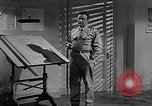
Effects of conventional bombs compared to incendiary bombs in tests against wooden structures, at Eglin Field in World War II
Tests to compare effects of conventional bombs to those of incendiaries,on wooden structures. Test conducted at Eglin Field, Florida, during World War 2. Actor Lee J. Cobb, portrays an Air Force Captain, seated at Project Officer's desk. He shows photographs of a wooden test house constructed similar to houses in Japan. View of wooden structure being ignited from within. The resultant fire is put out promptly. B-17 airplane in flight over the test area, drops conventional bombs, which destroy some of the test village houses. A second bombing using incendiary bombs that break apart and ignite many fires, produces greater destruction across the test village.
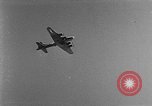
Bombing tests using conventional and incendiary bombs against wooden structures, at Eglin Field, Florida, in World War II.
Tests by the U.S. Army Air Forces to assess the effectiveness of incendiary bombs against wooden structures (typical of Japanese homes) during World War 2. Tests conducted at Eglin Field, Florida. B-17 bomber drops conventional bombs on test village, producing considerable damage where they strike. In contrast, bombing with incendiaries produces fire and smoke engulfing the entire complex, and greater destruction and confusion on the ground.
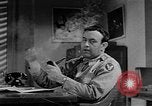
Testing various types of bombs against Japanese-style wood construction, at Eglin Field, during World War II
U.S. Army Air Forces tests of conventional and incendiary bombing of Japanese-style wooden structures, at Eglin Field, Florida, during World War 2. An Army Air Forces Captain (portrayed by actor, Lee J. Cobb) discusses bombing tests conducted at Eglin Field. He holds a pipe in his hand. B-17 bomber takes off over the camera. The plane in flight over the test area. Clusters of small incendiary bombs fall on the test village, causing it to be engulfed in flames. Immediately, thereafter, conventional bombs are dropped on the smoking test village, causing large explosions. The Air Force Captain (Cobb) discusses the results.
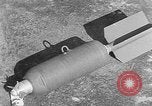
Optimum mix of fragmentation and incendiary bombs is determined during tests at Eglin Field, Florida, during World War II
Conclusions of tests conducted by U.S. Army Air Forces, at Eglin Field, Florida, seeking best way to attack Japanese homeland during World War 2. Actor Lee J. Cobb, portraying an Air Force Captain, smoking a pipe in his "office." Views of M-41 fragmentation bomb and a bundle of M-69 incendiary bombs. The Captain holds a model of a B-17 bomber and uses it to discuss bombing techniques. B-17 in flight. Views of effects of fragmentation bomb, showing numerous small holes produced by it. Aerial view of the test area houses. Mixture of M-69 incendiary bombs and M-41 frag bombs being dropped by the plane on the test area. Various views of resulting damage and effects. Test report is shown, concluding that demolition bombs are not effective against congested wooden structures; that M-41 frag bombs deter early firefighting efforts; and that a mix of 80 percent M-69 incendiaries and 20 percent M-41 frag bombs is optimum. Views of Japanese cities burning, from such bombing, during the war.
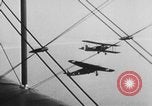
The U.S. Army Air Service Fokker C-2A named "Question Mark" being refueled in midair from a Douglas C-1, in 1929.
Mid air refueling experiments in January, 1929. A U.S. Army Air Service Douglas C-1 tanker plane, with hose trailing below it, flies above a modified Atlantic-Fokker C-2A named "Question Mark." The hose is let down to the Question Mark, where a crew member seizes it and makes a connection for fuel transfer. After transfer of fuel is complete, the crew member throws the fuel line off and it is retrieved by the tanker plane. The Question Mark lands at Metropolitan Airport, Van Nuys, California on January 7, 1929, and taxiis in to park. The crew members, including Major Carl A. Spaatz, Captain Ira C. Eaker, Lieutenant Harry A. Halverson, Lieutenant Elwood R.(Pete) Quesada, and Staff Sergeant Roy W. Hooe, all exit the airplane and gather under the wing with well wishers. The five crew members pose for photographs beside their airplane, the "Question Mark." Ground crew tows the aircraft with a tractor.
Launching of the USS Iowa (BB-61) in New York, and of her sister ship, USS New Jersey (BB-62),in Philadelphia, during World War II..
Camera pans vertically from top to bottom over the bow of the USS Iowa (BB-61) as she is ready for launching at the Brooklyn Navy yard in New York City, on August 22, 1942. Sponsor of the ship, Ilo Browne Wallace, wife of Vice President Henry A. Wallace, Christens the Iowa by breaking a bottle of champagne over her bow, and the ship moves down the ways toward the East River. The Williamsburg Bridge is seen dimly in the background, as the Iowa plunges into the water. Camera focuses, next, on the USS New Jersey (BB-62) ready for launching at the Philadelphia Navy Yard on December 7, 1942. Men knock supports from below the New Jersey, in preparation for her launching. Next, she is seen moving down the ways. Closeups of some shipyard workers smiling as the New Jersey is launched. The New Jersey is seen well out into the Delaware River, with some smoke rising from one of her funnels. (World War 2, WWII, WW2)
CRITICALPAST.COM: About Us | Contact Us | FAQs - How to Order | License Agreement | My Account | My Lightboxes | Shopping Cart | Advanced Search | Featured Collections | Website Terms & Conditions | Privacy Policy ©2026 CriticalPast LLC.
License Agreement |
Terms & Conditions |
Privacy Policy
©2026 CriticalPast LLC.