


 Francais
 Deutsch
 Italiano
Refine Your Search
Adak Alaska USA 1943 stock footage and images
- Showing 22063 to 22068 of 27381 results more
more Hide
Hide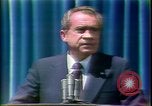
In San Clemente, California U.S. President Nixon talks about the existence of wiretaps during the Kennedy administration.
U.S. President Richard Nixon talks about the role of wiretaps in national security during a press conference in San Clemente, California. A journalist questions the President about his statement regarding the 10 additional wiretaps that could have been initiated by late U.S. Senator Robert F. Kennedy, which would have lead to the discovery of the Oswald plan and thus prevented U.S. President John F. Kennedy's assassination. The President responds that 10 more wiretaps could have found the conspiracy, if it was a conspiracy in the first place, then it would have been worth it. The President also talks about the high number of wiretaps in the National Security area during the Kennedy administration for national security purposes. The taps on news organizations, news people and civil rights leaders were all justified. The journalist then asks the President if he thought that President Kennedy's assassination threat mattered more to the national security wiretaps. The President does not agree with this and believes that the assassination was a breakdown in the President's security. He also states that he personally does not prefer to have secret service.
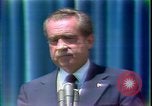
In San Clemente, California U.S. President Richard Nixon talks about the Watergate scandal and the Cambodian bombings.
U.S. President Richard Nixon talks about his officials' role in informing the prosecutors during the Watergate Scandal in San Clemente, California. A journalist seeks an explanation from the President as to why, after being informed by his officials about the White House staff's involvement in criminal activities, had he not given this information directly to the prosecutor rather than allowing his staff to conduct their own investigations. The President explains that he was under the impression that both the people responsible for communication with the prosecutor, White House Counsel John Wesley Dean and the President's Assistant for Domestic Affairs John Ehrlichman, were keeping the prosecutor informed. Another journalist asks the President whether he felt he owned an apology to American citizens with regard to the Cambodian bombing. The President states that he does not feel that way since the bombed area in Cambodia was occupied by North Vietnam Communists and was being used for attacking and killing American soldiers. The President felt that his countrymen would be thankful to him for taking the necessary action in order to save the lives of American soldiers. (Vietnam War period).
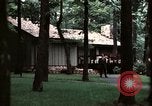
General Secretary of Soviet Union, Leonid Brezhnev and other leaders at President Nixon's residence in Camp David, Maryland.
Leonid Brezhnev, General Secretary, Communist Party of the Soviet Union, visits United States and meets with President Richard Nixon. The cottage at Camp David where Brezhnev stayed during his visit. A secret serviceman stands on guard outside the cottage. Trees and pond at Aspen House, the residence of President Richard Nixon at Camp David. Soviet leaders Brezhnev, Soviet Minister of Foreign Affairs, Andrei Gromyko and Ambassador Anatoly Dobrynin converse while walking towards Aspen House. Brezhnev smokes cigarette and walks inside the Aspen House along with other officials. Gromyko and U.S. Secretary of State, William P. Rogers are seen outside, conversing with Dobrynin
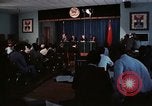
Ron Zeigler and USSR ambassador at a press conference in Camp David Maryland during visit of Leonid Brezhnev to United States.
Leonid Brezhnev, General Secretary, Communist Party of the Soviet Union, visits United States and meets with President Richard Nixon. Various views of Ron Zeigler and a USSR ambassador during a press conference at VFW Hall in a town outside Camp David, Maryland. The spokesmen sit on a table and address the press reporters. Reporters make notes and cameramen take photos. A woman stenographer types on a stenography machine what the speakers say.
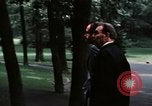
Soviet leader Leonid Brezhnev walks with U.S. President Nixon around Camp David grounds during his visit to United States.
Leonid Brezhnev, General Secretory, Communist Party of the Soviet Union, visits United States and meets with U.S. President Richard Nixon. Leonid Brezhnev and President Nixon walk around Camp David grounds near President's resident Aspen House. The leaders talk to each other.
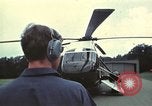
Secretary Rogers and Kosygin board a helicopter at Camp David, Maryland during visit of Leonid Brezhnev to United States.
Leonid Brezhnev, General Secretary, Communist Party of the Soviet Union, visits United States and meets with U.S. President Richard Nixon. An airman stands near a helicopter at a base in Camp David, Maryland. Motorcade of dignitaries arrives. Secretary Rogers and Kosygin followed by other staff members walk towards the helicopter. They board the helicopter as servicemen salute them. The helicopter takes off.
CRITICALPAST.COM: About Us | Contact Us | FAQs - How to Order | License Agreement | My Account | My Lightboxes | Shopping Cart | Advanced Search | Featured Collections | Website Terms & Conditions | Privacy Policy ©2026 CriticalPast LLC.
License Agreement |
Terms & Conditions |
Privacy Policy
©2026 CriticalPast LLC.