


 Francais
 Deutsch
 Italiano
Refine Your Search
Adak Alaska USA 1943 stock footage and images
- Showing 23581 to 23586 of 27425 results more
more Hide
Hide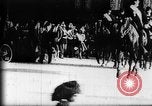
Members of a civil organization parade on horseback, followed by a uniformed brass band, in New York City.
Several members of an organization parade on horseback on a street in New York City. They wear sashes displaying a small emblem, and are followed by a large uniformed brass band. Spectators line the sidewalks to watch. (Probably created by Edison Company cinematographers when they photographed many New York City scenes with a portable camera, in 1896)
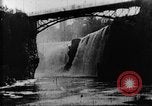
The falls of the Passaic River near Paterson, New Jersey
View of bridge with active waterfalls of the Passaic River behind it, near Patterson, New Jersey. (Produced by International Film Company or the Edison Company, both of whom filmed the same scene in 1896.)
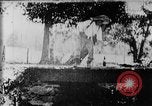
Known as "Fisherman's Luck," this film records a fisherman's misfortune at the hands of a practical joker.
A country fisherman,wearing wide brimmed straw hat, is sitting on the end of a plank, holding a fishing pole. A practical joker sneaks up behind him and removes a heavy stone holding down the other end of the plank, causing the fisherman to fall into the stream. A man arrives in a horse drawn wagon. He joins the practical joker in laughing at the fisherman's dilemma. Eventually, the practical joker jumps into the stream as well.
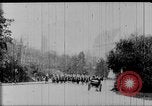
New York City mounted police on horse back stage a charge in formation
A large contingent of New York City mounted police riding in formation, in Central Park, charge and stop only a few yards from the camera, where they linger and can be seen closeup. A horse carriage driving in the Park has to pull to the right edge of the path, to avoid them, as they ride past, 8 abreast. (Edison Company, 1896)
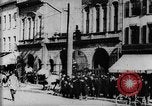
Scenes of the Newark New Jersey Fire Department responding to fire alarms
Films of the Newark New Jersey Fire Department responding to fire alarms. Two segments are seen.The first shows a Hook and Ladder truck coming out of the firehouse of Hook and Ladder Company Number 1. It is followed by a pumper from the Engine Company and another truck full of firemen. They are all led by Chief Kiersted with his driver in a four-wheel open two-seater horse-drawn Victoria carriage. After a pause, the second segment shows rear of a passing Hook and ladder and then a succession of other firefighting vehicles, including another Hook and Ladder, 3 smoking pumpers, and several trucks filled with firemen. There is light snow visible on the ground in this segment. Spectators watch with great interest from the sidewalk. (Edison Company, 1896)
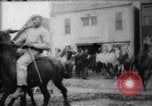
Men lead Horses and some mules to Buffalo stockyard
Men quickly lead a few mules and many horses, from a stable area, toward the Buffalo stockyard. Owners and businessmen follow in wagon and a carriage, plus a few on foot. "Bailey and Mayer, Sale Stables" is painted on the side of the wagon. Later, many horses, are led back to the stable area, accompanied by two men in the Bailey and Mayer wagon. (Filmed by Edison Company, June 1897)
CRITICALPAST.COM: About Us | Contact Us | FAQs - How to Order | License Agreement | My Account | My Lightboxes | Shopping Cart | Advanced Search | Featured Collections | Website Terms & Conditions | Privacy Policy ©2026 CriticalPast LLC.
License Agreement |
Terms & Conditions |
Privacy Policy
©2026 CriticalPast LLC.