


 Francais
 Deutsch
 Italiano
Refine Your Search
Adak Alaska USA 1943 stock footage and images
- Showing 27283 to 27288 of 27381 results more
more Hide
Hide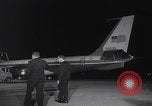
President Kennedy’s hearse leaves Andrews Air Force Base; President Johnson and wife stand at microphones
An air stair moves toward Air Force One aircraft (VC-137C SAM 26000) at Andrews Air Force Base near Morningside, Maryland. The casket bearing the body of President John F. Kennedy is taken out of Air Force One. President Kennedy’s casket is loaded into the hearse. The hearse is followed by a group of staff cars. President Lyndon B. Johnson and First Lady Lady Bird Johnson stand at microphones to make comments to the press following the assassination of President Kennedy in Texas.
MB-1 rocket rail-launched from a U.S. Air Force F-102A Delta Dagger at Holloman Air Force Base in New Mexico.
MB-1 rocket rail-launched from a U.S. Air Force F-102A Delta Dagger at Holloman Air Force Base in New Mexico. Footage taken from GSAP (Gun Sight Aiming Point) camera mounted under right wing of F- 102 in flight. MB-1 rocket fired from rail launcher. Technicians work on F-102A parked outside a hangar. Two technicians wheel an MB-1 rocket on a dolly, underneath F- 102A parked on ramp. Three technicians check out and calibrate special instrumentation to be used during the test run. The instruments include different types of oscillographs, and photo panels. Special camera installations made on the F-102A vertical stabilizer, fuselage, and wings. Technician installs a l6mm camera inside the aircraft nose, then closes access panel. F-102A takes off. Radar vectoring station T-1 at Holloman AFB. Technician operates one of the tracking scanners installed on roof of building. Two men, inside the vectoring station, control the course of the test aircraft by radio communication from the vectoring machine plotting charts. The pilot in F-102A cockpit as he turns on the recording cameras to activate the armament system. MB-1 bomb extended below the aircraft. Engineer talks on the radio phone inside the vectoring station. Pilot's hand on the control stick as he activates the firing switch. MB-l rocket is fired from the short rail launcher. The aircraft is enveloped in a trail of white smoke. GSAP camera mounted underneath the right wing of the F-102A, shows the MB-l rocket being fired from the short rail launcher. Smoke due to the firing of the rocket.
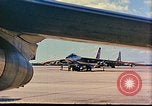
Film shows test of SOC (Strategic Air Command) T.171/ A-5 Turret and Airmen load Gatling gun on Boeing B-47 Stratojet bomber.
Film shows test of SOC (Strategic Air Command) T.171/ A-5 Turret. View of Administration Building at Eglin Air Force Base, Florida. Project officer converses with Airmen. The Project officer signs paper. Airmen salute and leave the room. Board reads MacDill Air Force Base Home of Sixth Air Division. Another board reads 306th Bomb Wing, Headquarters with a crest. Boeing B-47 Stratojet bomber parked on ground. Airmen install turret to Boeing B-47 Stratojet bomber's tail. Airmen check radar unit of A-5 control system against ground target. Airmen load Gatling gun.
Frido W. Kessler's rocket-propelled mail plane launches on frozen lake Greenwood, New York, United States, 1936
Frido W. Kessler and his rocket-propelled mail plane. (Allegedly, the first scheduled mail-delivery rocket flight) Kessler is seen in his workshop with his test stand and apparatus. Launch of Kessler's first winged liquid-fueled (liquid oxygen and Kerosene) mail rocket plane on frozen Greenwood Lake, New York, February 23,1936. Launch team opens the nose to insert mail into the rocket-propelled glider plane (reportedly designed by German rocket pioneer Dr. Willy Ley). Kessler poses with a little girl, Gloria Schleich Quackenbush, for whom the plane is named. She holds a silver cup of snow. They are surrounded by a cluster of men. Photographic equipment is set up next to them. The girl, Gloria, empties the cup of snow onto the tail of the rocket plane, to Christen it "Gloria (I)." Launch team fueling the rocket from containers. A technician in fireproof protective suit lights fuel at tail of the plane. It flares up in flames and then settles down with normal rocket burn, and leaves the launch stand. (A second rocket plane is seen sitting on the ice near the launch stand.) The rocket glider only goes about 20 feet before falling onto the ice. Team members look over the stand and prepare to try again with Kessler's second plane, the "Gloria (II)." They load the mail (6000 letters and postcards) into the nose and set the plane on the launch stand. It launches very nose high, and strikes the ice near the stand. But the rocket motor continues to propel it across the ice until it takes off again and continues, a way in the air until flipping over and crashing on the ice. View of people surrounding the broken plane on the ice. (Note: The second attempt carried the Gloria II and its mail, about 2000 feet, far enough to cross the border from New York into New Jersey, constituting an interstate mail delivery, and making the letters and post cards worthy mementos of the event.)
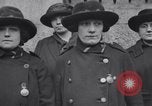
Women join ranks of police reserves in New York City, during World War I.
Closeup of women in the New York City Police reserve, during World War 1. They stand outside the 23rd Police Precinct ("Tenderloin") Station House on West 30th Street, Manhattan, New York City. Their uniforms include round-brimmed hats and overcoats, and they have round badges topped with eagles, pinned to their coats. Next, about 15 are seen, walking two abreast. All wear white gloves and badges, but otherwise, their uniforms are not identical. One supervisor woman walks beside the group, wearing a slightly different badge. Walking casually, a short distance behind the group is a woman (probably Mary Noonan) in the uniform of a captain (with "railroad tracks" insignia on her collar). Scene shifts to a street filled with a traffic mix of horse-drawn and motor vehicles, all staying fairly clear of trolley tracks visible in the center of the road. A police reserve woman stands in the center of the street, directing traffic. Next, a large group of school children is seen standing on a street corner, accompanied by a woman police officer. They begin to cross the street under the watchful eye of another woman reserve police officer, directing traffic in the street. Some adults cross behind the children. (Note: On May 9, 1918, the New York City Police Department announced formation of a new Police Reserve, that would include a women's contingent. This was the idea of Special Deputy Commissioner Rodman Wanamaker, who reasoned, since New York women had received the vote, on November 6th 1917, they should have a role in enforcing the laws. Over 3,000 women were recruited. Their Captain was Mary Noonan. Their duties did not involve direct dealings with criminals. According to the New York Times of May 10, 1918, "If need arose for use of the nightstick or other instrument for curbing crime,the work would be referred to the men members of the force.")
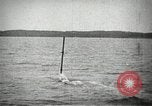
Holland type submarine of the Plunger class undergoing trials at Electric Boat Company
Holland type submarine of the Plunger class undergoing trials at the Electric Boat Company, New Suffolk, Long Island, New York. Submarine running along at periscope depth. Periscope of the submarine. Several times the boat disappears below surface and rises again (porpoising). It makes way on the surface. Civilian testing crewmen in business attire climb out of conning tower and walk on the deck. They start back down into the conning tower. Men on the deck as the submarine runs along the surface. Submarine tied up at the pier, men walking around on deck and using a plank to walk to the pier..
CRITICALPAST.COM: About Us | Contact Us | FAQs - How to Order | License Agreement | My Account | My Lightboxes | Shopping Cart | Advanced Search | Featured Collections | Website Terms & Conditions | Privacy Policy ©2026 CriticalPast LLC.
License Agreement |
Terms & Conditions |
Privacy Policy
©2026 CriticalPast LLC.