


 Francais
 Deutsch
 Italiano
Refine Your Search
Adak Alaska USA 1943 stock footage and images
- Showing 31 to 36 of 27381 results more
more Hide
Hide
The bombing of Rekata bay, near Munda in the South Pacific,on August 24th 1943.
Bombing of Rekata bay (near Munda and Guadalcanal in the South Pacific) during August 24th 1943. U.S. B-24 Liberator bombers of the 13th Army Air Forces in flight at a high altitude over the bay. Bombers drop bombs on Japanese targets at Rekata bay. (World War II period).
The story of AFN ( American Forces Network) Radio. Founding announced in 1942. First broadcast in 1943; growth in 1944.
U.S. Army soldier reads newspaper while listening to radio. Soldiers doing their respective chores, listen to AFN (American Forces Network) Radio. General Marshall and General Eisenhower announce the creation of AFN, in 1942. July 4, 1943, the first broadcast of AFN. General Eisenhower mingling with paratroopers of the 101st Airborne Division, on the eve of D-day. U.S. B-26 aircraft in flight. United States soldiers aboard landing craft and wading ashore at Normandy, France, on D-day, June 6, 1944. Soldiers tuning radios in the field. United States Sherman tanks and infantry move along country road in France. Audio includes portions from AFN broadcasts, including an announcer saying "You are listening to AFN Paris. This is the American Forces Network, on the road to Berlin." Road sign points to St. Lo. Group of U.S. soldiers gathered around a jeep with a radio, listening to AFN, in Germany. (World War II period).
Analysis of the German labor force from 1939 to 1943 (WW2)
Analysis of the Germany's labor force, military strength and effects of World War II on manpower. German soldiers march. Men work in factory on equipment and machinery. Women work in factory. A cemetery of World War 1 soldiers in Germany. Narrator explains how loss of man power from world War 1 deaths, and subsequent lower birth rate leads to war production worker needs being filled by many young German women and even German boys and girls working in industrial factories also. Wounded German soldiers being treated in field during World War 2. A map points Germany, Sudetenland and Austria. Graphs examine labor force by sex, age and military replacement availability; compare the labor force according to sex from 1939-1943; detail the increase of work force through the women part time workers and the veterans. Women weld equipment in a factory. Men do mining work. Narrator speaks of foreign workers (such as from Poland, Netherlands, Czechoslovakia, Yugoslavia), and how some now serve "under economic pressure and compulsion" (as forced labor or slave labor). Views of forced labor crews working digging earthworks. Laborers also work on building or repairing railroad stations and track work. Lines of prisoners of war, also used for labor, walk under German guard as lines of German uniformed troops walk in the opposite direction. Graphs compare the labor force in agriculture, industry, trade services, transport and government.
The comparison of Germany's total labor and military manpower from 1939 to1943.
Estimation of Germany's total working manpower. People walk with their equipment towards a factory. They read a notice pasted on the wall. They work in the factory. Vehicles parked on the street. Soldiers walk. Comparison of the military manpower from 1939 to 1943. The number of soldiers missing is also estimated. Destroyed military vehicles on the battlefield. Soldiers advance with tanks on the battlefield. Dead body of a soldier lay on the field. (World War II period).
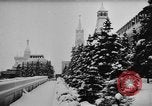
Battle of Stalingrad during Christmas and New Year, 1942, and continuing until February 2, 1943
The final struggle for Stalingrad during World War Two. Christmastime, 1942 in Moscow. Russian civilians obtaining fir trees for Christmas celebrations. A large beautifully decorated Christmas tree set up in the Hall of Pillars, in Moscow, Russia, Soviet Union. Men and women couples dancing in the hall to music from Tchaikovsky's Nutcracker Suite. Smiling Russian children at play indoors, on slides, on a carousel ride, and playing hand games with one another. New Year's eve is different. World War 2 Soviet war production workers in a munitions factory greet each other but continue working without stopping. On the Stalingrad front lines, the Soviet Army marks the New Year, 1943, by launching artillery barrages, through the night and continuing unabated well into the next day. Russian Sukhoi Su-2 light bombers drop incendiaries on German positions. Brief partial glimpse of a Russian Sherman tank. Soviet Army soldiers using flame throwers. Soviet troops moving across ice and snow on armed Aerosan ice gliders. Batteries of Soviet Katusha rockets fire barrages. Soviet infantry and tanks advance across vast barren snow-covered terrain. Animated map depicts Nazi German military forces being pounded on several fronts. A solitary horse standing in midst of Stalingrad destruction and ruins. Scene from February 2, 1943 as Soviet soldiers, symbolically, fire the last shot in the Battle of Stalingrad. A smiling Soviet soldier then places a cover over the muzzle of the field artillery piece. Scenes of the battle's aftermath. Russian officers hug one another. The Soviet Union flag is hung from a city building. Numerous German soldiers surrender under a white flag of truce. Many surrendering German Generals are seen.
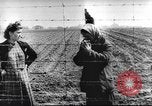
Nazi perpetrators in custody; Vyacheslav Mikhailovich Molotov and Robert Anthony Eden sign the Moscow agreement in 1943; concentration camp scenes.
Preparations that are made for prosecution of war criminals after the end of World War 2 in Europe. Women war victims standing on a farm. People weeping. Scenes of the main gate and barracks at the German concentration camp of Buchenwald. Scenes from Allied military interrogation of Doctor Adolf Wahlmann, head physician at the Hadamar Euthanasia Centre. Allied soldier opens door of a gas chamber at Dachau with label "Brausebad" (Shower Bath) over the door. A view of the gas chamber interior. A book titled: 'Moscow Conference of Foreign Ministers 1943' on a table. Hands opening the book. Officers seated at a desk sign the Moscow Agreement. Soviet politician and diplomat Vyacheslav Mikhailovich Molotov and British Foreign Secretary Robert Anthony Eden seated at a desk. They sign the Moscow Agreement document in 1943. Doctor Hans Frank, Nazi minister of Justice, seen at a podium addressing an audience of Nazi officers. Interior of the Lincoln Memorial in Washington DC, United States. Officers inside a building. The U.S. flag on a wall as narrator describes justice system for World War 2 war criminals with goal that it will be objective and there will be no martyrs of a flawed judicial proceeding. German citizens being led to view a concentration camp. Dead bodies and bones piled up in the camp.
CRITICALPAST.COM: About Us | Contact Us | FAQs - How to Order | License Agreement | My Account | My Lightboxes | Shopping Cart | Advanced Search | Featured Collections | Website Terms & Conditions | Privacy Policy ©2026 CriticalPast LLC.
License Agreement |
Terms & Conditions |
Privacy Policy
©2026 CriticalPast LLC.