


 Francais
 Deutsch
 Italiano
Refine Your Search
Adak Alaska USA 1943 stock footage and images
- Showing 5953 to 5958 of 27426 results more
more Hide
Hide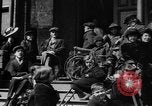
Group of physically disabled people gather for an outing
Group of physically disabled people sit on the steps of a building. The group of disabled men, women, and children are gathered for an outing. A sign on the building reads 'This property for sale, apply W.J. Kennedy, Grand 5600, 178 Henry St'. Crippled people with various handicaps and maladies get into automobiles. Other homes and trees in the background. A man helps disabled people to get in the cars. Wheel chairs on the pavement. A young girl uses crutches.
Gun Turret (16 Inch) fired aboard USS Missouri
Sixteen inch gun turret of USS Missouri. Number three Gun Turret (16 Inch) fired starboard aboard the USS Missouri (BB-63). Number two gun turret fired. Number one turret trained forward. USS Missouri underway. Bow area of the ship. Sixteen inch projectile comes up on projectile hoist. Gun chamber rammer man depresses hydraulic lever. High capacity projectile turns on projectile ring. Projectile being pulled into projectile hoist by par buckle operator. Turrets one and two training and elevate.
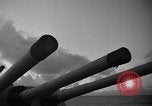
A turret Captain gives orders to load and fire guns while aboard USS Missouri
Sixteen inch gun turret of USS Missouri. Turret Captain giving orders "Stand By" and then "Load". Explosion occurs in water. Beach shrubbery in the foreground. Scenic view of flat land and water.
A sixteen inch gun is loaded by the turret crew aboard U.S. Navy ship USS Missouri (BB-63)
Sixteen inch gun turret of USS Missouri. Turrets one and two elevated. Superstructure of USS Missouri in the background. Radar revolves atop. Turret Captain aboard USS Missouri. Breech comes up on gun. Rammer man stands by open breech. Breech is opened and sixteen inch shell loaded in it. Powder bag comes up on hoist from magazine. Powder bag unloaded. Turret Captain giving orders "Stand By" and then "Load"
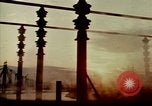
Film juxtaposes transportation of electricity, with transportation of people, and shows myriad uses of electricity.
Electric power lines and insulators. A bridge across a river in United States. Cars pass on it in wintertime, with snow at edge of road on a cold morning. High voltage long distance electric transmission lines and towers. Statue of Liberty from behind, with helicopter flying past it. Series of very close-up views of appliances and conveniences that use electricity: Chicken roasting on electric powered rotisserie. Clock hands moving on electric powered clock. Person turns on electric desk lamp. Electric powered beaters spinning. Electric powered industrial machining operation. A couple dancing to music powered by electricity. Several kinds of electric transmission lines. Electricity in the 1960s office environment: Extremely close-up views of hand dialing a rotary dial telephone; hand using an adding machine; close-up views of typewriter in operation; close-up of punch card sorter for punch cards of early computer; early computer tape drive spinning; close-up view of electronic system warning lights. Closeup views of fingers pressing keys and dialing. Night view of Times Square on Manhattan Island, New York City with many illuminated commercial signs and neon signs.

Various methods of power production in the United States, including hydroelectric, coal and nuclear power.
Views of various sources of electric power generation in America, with emphasis on nuclear being cleaner and more efficient than other methods such as coal. Opening shot is a dam generating hydroelectric power, and its associated electric power substations. Coal fired power plant, with mountain of coal, railroad, and associated electrical switch yard. Spherical gas tanks holding fuel for power generation. Natural gas storage tanks and electric generator cables. Smoke, steam, and a mountain of coal, associated with electric power generation. Cranes off-loading coal from train cars onto conveyors feeding a power plant with smoke stacks emitting fumes. Cranes with clamshell buckets leaking coal as they offload it from barges in a river. Coal being transported on conveyor belts at a plant. Fire burning in the furnace of coal-fired power plant. Clean Control room of a power plant, with technician monitoring instruments and adjusting control settings.View of pristine turbine deck in a power plant, with several steam turbines visible. Contrasting view of coal-fired power plant exterior, with smoke seen near transmission lines and incredibly long trains filled with coal move on railroad. Nuclear fuel fabricators seen placing nuclear fuel rods into assemblies bearing Westinghouse name, covering them with plastic and preparing them for shipment in large steel containers. The containers of fuel rod assemblies are loaded into a truck.
CRITICALPAST.COM: About Us | Contact Us | FAQs - How to Order | License Agreement | My Account | My Lightboxes | Shopping Cart | Advanced Search | Featured Collections | Website Terms & Conditions | Privacy Policy ©2026 CriticalPast LLC.
License Agreement |
Terms & Conditions |
Privacy Policy
©2026 CriticalPast LLC.