


 Francais
 Deutsch
 Italiano
Refine Your Search
Alencon France 1944 stock footage and images
- Showing 601 to 606 of 9964 results more
more Hide
Hide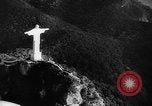
FBI agent William Sebold (posing as Harry Sawyer), and successful filming of members of Duquesne spy ring in the United States.
Aerial view of Christ Redeemer Statue on Mount Corcovado, Brazil. The director of the Federal Bureau of Investigation (FBI), John Edgar Hoover, narrates this 1944 clip and talks about enemy agents in the United States during World War II, before America's entrance into the war. German and Japanese suspects seen in South America. A German fleet carries German agents aboard merchant and cargo ships. German agents in formation on deck of ship, shown debarking the ship after receiving instructions. Japanese and Nazi German colonies being established in South America in large cities and in remote areas of Patagonia. Automobile industries, hotels, shops, and other industries established by Nazi German agents. German signs and Nazi Swastikas and Nazi flags shown on some buildings in South American countries including Brazil. A Nazi flag. A view of German factories in South America. Photographs of Adolf Hitler in a school building where young boys and girls are being instructed by their teacher. German pilot shown operating a passenger airliner; aerial view of from aircraft of Rio de Janeiro Brazil, including port and city areas. A dramatization depicts well planned accidents in the factories and sabotage attempts to slow production of goods bound for the United States. The Federal Bureau of Investigation (FBI) receives reports about planning of German attack on the Panama Canal. A woman watching a teletype machine as a report arrives. A man in a radio room of the Federal Bureau of Investigation receives information and turns to type out a report on his typewriter. Men and women convicted as spies are seen together in a room with U.S. federal agents. The spies are taken in a police van. Man serving as projectionist seen running a film projector. A film of Fritz Duquesne case in the FBI office shows FBI Agents' successful secret filming of members of the Duquesne spy ring. The film is shown being loaded onto a projector and then played. FBI agent William Sebold (posing as spy Harry Sawyer) is seen with Fritz Duquesne and other spy ring members: Pedestrians and vehicular traffic on a New York street corner as Sawyer and Duquesne prepare to meet. German spies sit together in a hotel room in New York City, recorded by hidden camera. Heinrich Clausing, a spy ring member and former cook on the cruise ship SS Argentine is seen. Also seen is Hartwig Richard Kleiss putting on his hat and smoking a cigar. He's shown giving money to Sawyer for purchase of a spy camera, according to narration. J Edgar Hoover notes that German agents communicated through a Long Island radio station that was secretly controlled by the FBI. Hartwig Kleiss is seen showing the blueprint plans of the steamship SS America, including plans for its secret gun emplacements. Fritz Duquesne is shown in the film, removing diagrams of various American arms that he had concealed in his sock Japanese agent Takeo Ezima, of the Imperial Japanese Navy, is also seen meeting in the hotel with Harry Sawyer.
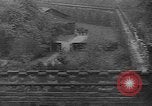
German war criminals are executed by Allied occupying forces in 1945, in World War 2
View from above, of the surrounding walls and courtyard of a prison in Rheinbach, Germany. Ground view inside the prison yard, where German civilian Matthias Gierens is being escorted to the gallows by U.S. military police, and accompanied by a German Catholic priest, on June 29, 1945. They ascend the gallows and final charges and sentence are read to Gierens. Next scene shows bodies stacked up at the Bergen-Belsen concentration camp operated by Nazi Germany. Scene returns to the gallows, and a hood is placed over Gierens' head. View of Allied army officer witnesses, in formation, at parade rest. Noose is placed over Gierens' hood. View of a a bird flying overhead, trapdoor opens, Gierens drops, and noose tightens. Next is an unrelated scene of several German soldiers being executed. They are seen hanging from four gallows in a line in a public square while a large crowd, possibly Soviet citizens, looks on. (Notes: Regarding the execution of Gierens in the opening scene: German civilian Matthias Gierens was a 37 year old railroad worker. He was executed for the August 15, 1944, murder near Priest, Germany, of a downed American airman, who was later identified as U.S. Army Air Forces 2nd Lieutenant Lester E. Reuss. Gierens and three other German civilians, Peter Kohn, Peter Back, and Matthias Krein, were convicted on June 2, 1945 in Ahrweiler, Germany, of the murder. Their trial was the first Allied trial in Germany of civilians charged with a war crime.)

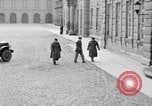
German prisoners arrive at Ludwigsburg Palace during World War II war crime trials in Ludwigsburg,Germany.
World War II war crime trials in Ludwigsburg, Germany. Fifteen Germans come out of a prison gate. They are on a trial for killing seven U.S. airmen captured on Borkum Island after their aircraft crashed there on August 4, 1944. The prisoners, including both former German Army soldiers and Borkum Island civilian resdients, aboard a truck. Two armored cars escort the truck. They arrive at Ludwigsburg Palace. Sign over door reads "Borkum Island Court Room." The prisoners enter the courtroom in the palace. They take their seats. Seven United States judges seated in the court.
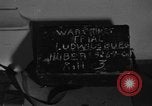
Proceedings take place at Ludwigsburg Palace during the World War II war crime trials in Ludwigsburg, Germany.
World War II war crime trials in Ludwigsburg, Germany. Defendants on trial for killing seven U.S. airmen captured on Borkum Island after their aircraft crashed there on August 4, 1944. A courtroom at Ludwigsburg Palace. Proceedings take place in the court room. Chandeliers hanging from the ceiling. Prisoners seated in the courtroom. Witnesses and court personnel arrive and leave the palace. Trucks parked outside the palace. The trucks move.
Prosecutor Major Joseph D. Bryan reads a testimony during the World War II war crime trials in Ludwigsburg, Germany.
World War II war crime trials in Ludwigsburg, Germany. Trucks arrive at Ludwigsburg Palace. Witnesses and court personnel arrive and leave the palace. Vehicles lined up in the parking outside the palace. A truck arrives at the palace and prisoners exit the truck. The defendants are appearing for trial for killing seven U.S. airmen captured on Borkum Island after their aircraft crashed there on August 4, 1944. In the courtroom prosecutor Major Joseph D. Bryan reads a testimony. Three of the seven judges Colonel Barden, Colonel Jackson and Colonel Hicks are seated. Investigation officer Major Levine points out locations on a map of Borkum Island. Chandeliers hanging from the ceiling.
German spies are executed by a firing squad and Germans who killed American prisoners of war are hanged, at end of World War II
Three German soldiers, who were captured in American uniforms, spying behind the American lines, in the Fall of 1944, are executed by a firing squad. In a separate sequence, one of several German civilians is marched toward gallows at Bruchsal prison near Karlsruhe, Germany. They were condemned by a military tribunal for killing six United States Army Air Force aviators who were being held as prisoners of war after crash landing their airplane near the end of the war. A hangman makes preparations. The German criminals are hanged.
CRITICALPAST.COM: About Us | Contact Us | FAQs - How to Order | License Agreement | My Account | My Lightboxes | Shopping Cart | Advanced Search | Featured Collections | Website Terms & Conditions | Privacy Policy ©2026 CriticalPast LLC.
License Agreement |
Terms & Conditions |
Privacy Policy
©2026 CriticalPast LLC.