


 Francais
 Deutsch
 Italiano
Refine Your Search
Alencon France 1944 stock footage and images
- Showing 619 to 624 of 9964 results more
more Hide
Hide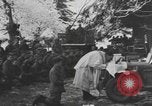
Supplies being dropped from airplanes and gliders landing on a snow covered area in Bastogne, Belgium.
A film depicts the Battle of the Bulge in the area of Bastogne, Belgium by U.S. troops during World War II. Belgian civilians are evacuated from an area. Civilians and soldiers in an area. Guns on a field. U.S. aircraft flying in formation to deliver supplies, ammunition, and food to U.S. Army forces including 101st Airborne Infantry soldiers fighting in the battle of the Bulge. Soldiers watching the airplanes through binoculars. Point of view shot from inside a glider hooked via a tow rope to an aircraft in flight, preparing to cut loose for glide to the ground. Aerial view of the target area. The airplanes in flight overhead. Supplies are being dropped via parachutes. View inside supply aircraft as troops push supplies out of doors. Gliders loaded with supplies and equipment landing in a snow covered area in time for Christmas 1944. Combat in the snow with a night artillery barrage by American soldiers firing at the Germans. U.S. soldiers using flame throwers at night directed at Germans. Dead bodies of German soldiers lying on the snow covered battlefield the next day. German prisoners of war standing under the guard of the U.S. soldiers, some of German prisoners found wearing civilian clothing or wearing pieces of U.S. uniforms. The 101st Airborne Infantry soldiers march in a victory celebration in town. A board reads: "Bastogne Bastion of the Battered Bastards of the 101st."
USAF Lieutenant General Ira Eaker speaks about his experiences in the U.S. Air Force in the United States.
An interview of United States Air Force Lieutenant General Ira Eaker conducted by Dr. Maurer in the United States. Dr Maurer and General Eaker seated at a desk. Dr Maurer talks about the work and the contribution of General Eaker in the U.S. Air Force. He says that General Eaker was the Commander of the 8th Air Force. In 1944, he became the Commander in Chief of the Mediterranean Allied Air Force. Then from 1945 until his retirement in 1947, he was the deputy commander of the Army Air Forces and chief of the Air Staff. General Eaker talks about his experiences. He talks about the first airplane flight he saw. He further speaks that he was sent to a training camp in 1917. A man came in the camp looking for some fliers. He was already selected for an examination of regular army. He says that in November 1917, he was on a parade grounds. An airplane was in flight overhead. The aircraft landed and he looked at the engine of the aircraft.
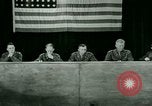
German civilian Pusch testifies in trial of Franz Strasser for shooting of American aviator prisoners; scenes from tribunal in Dachau (WW2)
Excerpts from 24 August, 1945 (World War II) military commission tribunal in Dachau. Swearing in of translator and charges read against Franz Strasser for: "Violation of the Laws and Usages of War. In that on or about 9 December 1944, FRANZ STRASSER, Kreisleiter of Kreis Kaplitz, an Austrian National, did at or near Kaplitz, Czechoslovakia, wrongfully and unlawfully kill an American airman, whose name, rank and serial number are unknown, [by shooting him with a machine pistol]. Strasser replies with a plea of not guilty. Next scene shows entry of German civilian truck driver, Josef Pusch, who is sworn in and provides testimony about the incident. Pusch describes the events of the shooting of the American prisoners by Strasser. United States flag and judges on raised platform. U.S. officials, defendants and civilians in the court room. Shows hearing as it begins. The Nazi commandant seated with other officials. The German civilian is questioned by an interpreter. German civilian Pusch identifies Strasser. Pusch gives his account to the tribunal about the shooting of the American flyers.
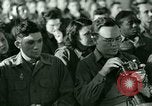
Witness gives testimony in trial of Nazi Kreisleiter Franz Strasser, during a War Crimes Trial in Dachau, Germany (WW2)
Scenes from Military Commission trial held by United Stated 3rd Army in Dachau, Germany during World War II. Scenes from courtroom during trial of Franz Strasser for his shooting of prisoner American flyers on December 9, 1944. Soldiers seated in the court room look at the camera as it pans across the room. A German witness to the killing gives his account of the shooting of the American aviators with a machine gun by Strasser and by Lindemeyer (dead - suicide). The Nazi Kreisleiter Strasser is sworn in near the end of the clip.
U.S. Signal Corps officers and soldiers use mine detectors, modern radars, and meteorological equipment during World War II.
The role and contribution of the U.S. Army Signal Corps in combat and war. U.S. shuttle ships loaded with signal communication supplies for U.S. and Allied troops in the European Theater make their way in the Atlantic ocean. The Squier Laboratory at Camp Alfred Vail in Fort Monmouth, New Jersey. A technician works on signal communication equipment in the laboratory. U.S. soldiers use mine detectors in the European Theater during World War II. The mine detectors detect metallic, non-metallic mines, wooden box mines, and mines in glass containers. Artillery soldiers bury large microphones into the ground in advance zones. The microphones relay back information on enemy artillery. Soldiers receive the information on radio sets. U.S. aircraft on a training flight simulating real combat situation: The aircraft lost in heavy rain and rough weather, looking for the location of Boston. The pilot switches on a modern advanced radar. The radar waves pierce thick clouds, are reflected by Earth's surface and display an image on the scope. The image shows the clear location of Boston harbor directly under the aircraft. U.S. bombers attack over the Channel coast on D-Day (6 June, 1944). U.S. soldiers employ meteorological equipment for long range weather forecast in the European Theater during World War II. Soldiers release a hydrogen balloon into the sky. Another soldier uses an apparatus to take readings of atmospheric conditions behind enemy lines. An aircraft drops an automatic weather station called SCM-18-TI by parachute into enemy territory. The timed mechanism sends out weather data in codes. The interior of the automatic weather station lying open in a field.
Inhabitants of San Pietro Infine, Italy, attempt to begin life anew, after U.S. Forces capture the village from German Forces, during World War II
Aftermath of the Battle of St. Pietro Infine, Italy, after it was taken by soldiers of the U.S. Army 36th Division, 143rd Infantry Regiment and troopers of the 82nd Airborne Division, 504th Parachute Infantry Regiment, during World War 2. Several U.S. soldiers of the 143rd Infantry Regiment, scramble down a mountainside over rubble from destroyed buildings in San Pietro Infine, Italy, following the battle there during December 1943. (These scenes were photographed later, in 1944.) Next, more local people are seen running from a mountain cave, where they had taken refuge during the battle of San Pietro. Old people, women, and children make their way down the rubble strewn hillside and onto a remnant of road surrounded by destroyed buildings. Italian women carry their belongings balanced on their heads as they walk towards the remains of their dwellings. A man leads two cattle. One woman carries a new coffin balanced on her head. An 82nd Airborne trooper warns local people about the danger of mines and booby traps left behind by retreating German soldiers. A soldier removes a booby trap in a doorway. Women trying to clean up and settle in the ruins of their homes. As one woman sweeps debris, an huge explosion occurs, bringing down large portions of a building. U.S. Soldiers dig through debris, with shovels. An MP and infantryman stand with several Italian men as one is grief stricken while they retrieve the body of a loved one from the rubble. A woman weeps. Women nurse and comfort their babies. Small children are seen happily emerging from a cave. A mother admonishes her boy. Women and children are relieved and smiling. Several children scamper down a hill. Others are seen walking about and posing shyly for the camera. Local men clearing rubble and women washing clothes in an outdoor stream as they try to reestablish some normalcy in their lives. A shoemaker resuming business at a small bench outdoors. Men unloading sacks of flour from a truck. People purchasing flour being weighed in an outdoor market. Farmers plowing fields with oxen. A church procession, led by a youth carrying a Christian banner, moves from a bombed out church, between mounds of rubble, . Statue of a Saint at the church.
CRITICALPAST.COM: About Us | Contact Us | FAQs - How to Order | License Agreement | My Account | My Lightboxes | Shopping Cart | Advanced Search | Featured Collections | Website Terms & Conditions | Privacy Policy ©2026 CriticalPast LLC.
License Agreement |
Terms & Conditions |
Privacy Policy
©2026 CriticalPast LLC.