


 Francais
 Deutsch
 Italiano
Refine Your Search
Alencon France 1944 stock footage and images
- Showing 637 to 642 of 9964 results more
more Hide
Hide
Soviet advance and liberation of Warsaw and Poznan during drive toward Berlin in World War 2
Russian attacks on Warsaw and Poznan in World War II in late 1944 and early 1945. Soviet army using tanks, heavy artillery, machine guns and grenades advance forward. Marshal Zhukov and Marshal Rosokofskey inspecting Russian cossacks advancing on horses. A Soviet soldier is shot by a sniper while running through street intersection. A Russian machine gunner firing a Soviet DP-28 light machine gun shoots at building to take out a sniper's nest. Dead bodies of German snipers in rooms next to windows. Views of ruined city of Poznan. Liberated concentration camp victims, including a woman who has been blinded in one eye. Interior of a room in Poznan Prison loaded with torture equipment, including a guillotine. Piles of bodies of persons mass executed during German retreat. Women crying over bodies in coffins of three Polish men that were found hanging in the liberated prison. German Generalmajor Ernst Mattern and his fellow officers seen after surrendering Fort Winiary Citadel (Poznan Citadel). Soviet soldiers. Liberated civilians in Poznan hit and beat German soldier prisoners of war as they are marched under Soviet guard. Scenes of ruined Warsaw include a sign that reads, 'Adolf Hitler Platz.' A wrecked trolley or street car with signs on it that read, ''Wierzeno' and 'Ein u. Ausstieg nur fur Deutsche' which translates to English as, 'On and off exit points only for Germans' The ruined home of Frederic Chopin in Warsaw. The Polish flag flying again after battle.
City views of San Francisco; United Nations Conference on International Organization held in San Francisco, California (WW2)
A documentary on The United Nations Conference on International Organization that continued from April 25, 1945 to June 26, 1945 in San Francisco. A plane in flight and ships are seen in San Francisco Bay. 1940s San Francisco city views: Aerial views of Golden Gate Bridge. People on streets on San Francisco, with streetcars, buildings, pedestrians, and mid 1940's cars seen. Aircraft parked at a USAF Base as delegates from 50 countries arrive. Delegates like Jan Christian Smuts from South Africa, Vyacheslav Molotov from Russia, U.S. secretary of State Edward Stettinius arrive in San Francisco. Delegates register for the conference. United States flag on a building. Interior of the War Memorial Opera House serving as the initial meeting hall. Delegates seated. U.S. President Harry S. Truman addressing the general assembly remotely, as delegates listen through radio speakers in the opera house. Narrator recalls words of Franklin Roosevelt and recorded audio of Roosevelt is heard where he urges continuation of the work first begun by the defunct League of Nations. View of various working committees and smaller groups of the organization meeting during the Spring of 1945. Representatives debate and review concepts initiated at the Dumbarton Oaks conference in Washington DC in 1944 during World War II. Delegates addressing those assembled and signing documents that create the United Nations.

Early pictures of General Eisenhower showing his childhood home and his welcome ceremony when he returned home.
'The Big Picture' depicts the life of U.S. General Dwight D Eisenhower. Sergeant Stuart Queen of the U.S. Army stands in front of a map. He gives an introduction of Eisenhower. In 1945 Eisenhower returns to his homeland in Denison, Texas. A banner reads 'Welcome IKE'. People gather on the sides of the streets to welcome him. He waves from an open car at the cheering crowds. People at parade carry the U.S. flags during a ceremony. Eisenhower salutes. D Day, June 6, 1944- Barges carrying American troops land on the shore of Normandy. Eisenhower with another military officer. Eisenhower salutes. Streets of the city Abilene. Exterior of the Eisenhower Museum. Two boys enter the museum. Pictures of Eisenhower in his childhood - during infancy, house in which he was born, Eisenhower with a group of children, Eisenhower with his family, with his baseball and football team. View of Eisenhower's bedroom- scripture readings on the walls and books in the shelves. A truck passes the creamery where Eisenhower worked in his spare time. Pictures of Eisenhower leaving home to join the Military Academy at West Point. Cadets marching at the grounds of the military academy. Graduation Certificate of Eisenhower. Eisenhower with his wife Mamie Geneva Doud. Fight in Western Europe during the World War I. Picture of Eisenhower with other cadets. The certificate of the Distinguished Service Medal presented to Eisenhower for his services for training tank crews in Pennsylvania.
Pilots of the USAAF 334th Fighter Squadron celebrate their victories at Debden Airfield in England, during World War II
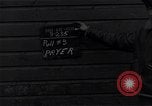
Three pilots, Major Gerald Montgomery, Major Howard D. (Deacon) Hively, and Captain Shelton W. "Shell" Monroe, of the U.S. Army Air Forces 334th Fighter Squadron, 4th Fighter Group, discuss a map during World War 2.. Logos of the Eagle Sqadron and the 334th Fighter Squadron displayed above a wall containing small painted German crosses representing enemy aircraft destroyed, probably destroyed, and damaged. Airman stencils two more under the destroyed column. Major Howard D.Hively of Athens, OH.,with another Major looking at record of aerial victories on the wall. Hively holds a sign reading "300 destroyed." He hands it to the other Major who tacks it onto the wall using the butt of his .45 caliber automatic pistol as a hammer. They smile and shake hands. Then Lieutenant Timothy Cronin stencils three more crosses in the destroyed column, under the 300 sign, as Lieutenant Victor Rentschler looks on smiling. The two men each recorded kills on Christmas Day 1944, one of which was the 300th kill for the squadron. (Shelton W. Monroe was later killed in Korea after his plane was shot down on April 17, 1951. )
German war criminals are executed by Allied occupying forces in 1945, in World War 2
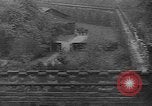
View from above, of the surrounding walls and courtyard of a prison in Rheinbach, Germany. Ground view inside the prison yard, where German civilian Matthias Gierens is being escorted to the gallows by U.S. military police, and accompanied by a German Catholic priest, on June 29, 1945. They ascend the gallows and final charges and sentence are read to Gierens. Next scene shows bodies stacked up at the Bergen-Belsen concentration camp operated by Nazi Germany. Scene returns to the gallows, and a hood is placed over Gierens' head. View of Allied army officer witnesses, in formation, at parade rest. Noose is placed over Gierens' hood. View of a a bird flying overhead, trapdoor opens, Gierens drops, and noose tightens. Next is an unrelated scene of several German soldiers being executed. They are seen hanging from four gallows in a line in a public square while a large crowd, possibly Soviet citizens, looks on. (Notes: Regarding the execution of Gierens in the opening scene: German civilian Matthias Gierens was a 37 year old railroad worker. He was executed for the August 15, 1944, murder near Priest, Germany, of a downed American airman, who was later identified as U.S. Army Air Forces 2nd Lieutenant Lester E. Reuss. Gierens and three other German civilians, Peter Kohn, Peter Back, and Matthias Krein, were convicted on June 2, 1945 in Ahrweiler, Germany, of the murder. Their trial was the first Allied trial in Germany of civilians charged with a war crime.)

German prisoners arrive at Ludwigsburg Palace during World War II war crime trials in Ludwigsburg,Germany.
World War II war crime trials in Ludwigsburg, Germany. Fifteen Germans come out of a prison gate. They are on a trial for killing seven U.S. airmen captured on Borkum Island after their aircraft crashed there on August 4, 1944. The prisoners, including both former German Army soldiers and Borkum Island civilian resdients, aboard a truck. Two armored cars escort the truck. They arrive at Ludwigsburg Palace. Sign over door reads "Borkum Island Court Room." The prisoners enter the courtroom in the palace. They take their seats. Seven United States judges seated in the court.
CRITICALPAST.COM: About Us | Contact Us | FAQs - How to Order | License Agreement | My Account | My Lightboxes | Shopping Cart | Advanced Search | Featured Collections | Website Terms & Conditions | Privacy Policy ©2026 CriticalPast LLC.
License Agreement |
Terms & Conditions |
Privacy Policy
©2026 CriticalPast LLC.