


 Francais
 Deutsch
 Italiano
Refine Your Search
Alencon France 1944 stock footage and images
- Showing 757 to 762 of 9964 results more
more Hide
Hide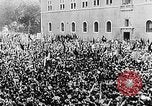
The fall of France and entry of Italy, on side of the Axis Powers, in World War II
Crowd fills the Plaza Venezia in Rome where Benito Mussolini appears on the balcony of the Piazza Venezia (formerly known as the Palace of St Mark) in Italy, on June 10, 1940. He announces that Italy has entered World War 2 on the side of the Axis powers. Views of the jubilant crowd waving Italian and some Swastika flags. Next, a road sign points to Paris and to Poissons, in France followed by view of German troops triumphantly entering Paris, through the Arc de Triomphe during occupation of France. View of the Eiffel Tower, and of a German flag flying atop it. More views of German troops marching through Paris. A German railway gun firing. (Narrator implies that the target is the Maginot Line, which is not correct. It was bypassed by the Germans, negating need to attack it directly.) Other German railway guns and siege mortars firing and many huge explosions and fires are seen, including some from flame throwers. Next, German troops are seen marching around a circle where a railroad car is parked near Compiègne, France. This rail car is the scene of Germany's surrender to France in World War I. Statue of French Marshal Foch, who had then, received the delegates of vanquished Germany here. Adolf Hitler walking past a German Honor Guard, salutes. He is accompanied by Marshal Hermann Goering and other high ranking military persons. The nearby 1918 "Alsace-Lorraine monument" is covered by a German flag. The German delegation headed by Hitler and Goering, enter the rail car and take their places. Outside, the French delegation, headed by General Charles Huntziger, is escorted by German officers. They enter the car and he German delegation stands. Both delegations exchange salutes. Next, Hitler is seen stepping from the rail car, followed by Goering. The German delegation walks past the honor guard, and Hitler salutes them. German and French officials still in the rail car exchange salutes. Hitler expresses jubilation.
Casket containing the first American Unknown Soldier is viewed in France and carried through Châlons-en-Champagne and LeHavre.
Ceremonies attending the burial of the unknown and unidentified American soldier after World War I in France. France honors the Unknown U.S. Hero before the body is transported to America for burial at the Tomb of the Unknown soldier at Arlington National Cemetery. The ceremony marks the selection of the Unknown Soldier to be taken to the United States for burial. French citizens pay final homage to the body of the American lying in state at the Hôtel de Ville in Châlons-en-Champagne (City Hall in Châlons-en-Champagne, France). French men, women, and children wait in line and then file through to pay last respects. A banner on the road honors the American Hero. French soldiers stand by the large crowd of mourners outside the City Hall. People emerge from the Hall and more inside the Hall. View of the coffin with the simple offering of white roses to indicate that this would be the body sent back to the U.S. to represent all of his Unknown Soldier brothers. United States and French soldiers around the coffin. Close-up view of U.S. Army Sergeant Edward F Younger, who fought in all the American offensives and who had the honor of selecting the body from among four identical coffins on October 24, 1921, at the City Hall in Chalons-en-Champagne, France. A car arrives. French and American Generals emerge and greet the waiting officials. General Allen with a French General near the coffin. Allen pays tribute to the Unknown Soldier. The Generals and officers salute as the coffin is taken out of the City Hall and laid in a caisson. Marching troops lead the procession. The casket is brought to Le Havre where French citizens turn out in respectful tribute. Soldiers carry the casket past railway carriages followed by military officers and government officials. A large crowd on the streets watches the procession. The horse drawn caisson moves through people gathered on either side.

Electric power plants set up in France to supply electricity using the country's water resources.
Shows an electric power plant set up in France to supply electricity using the country's water resources, during build-out of post-war industry in France. Trams running on the streets in French city. A train on railway tracks. French men work on assembly line of Renault 4CV cars at a Renault automobile production plant. View of various sater falls, rivers, streams and lakes in France. A map shows the 58 proposed dams, which have been planned to be built all over France.
Soldiers affected by gas attack in a trench in France during World War 1.
United States Army soldiers fire from a trench dug out in France. They put on protective mask and fire. Snow covered field. A soldier affected by gas comes out of the dug out. Another soldier puts a protective mask over his face. Soldiers help the affected soldier. Stretcher bearers carry gassed man into gas proof dug outs in France. Soldiers clear the trench with Ayrton fans in France. Soldiers fire from the trench in France. They remove the masks from their faces. After testing they put on the masks again. They clean their rifles.
Allied bombers strike German military installations in Abbeville and Rennes, France, during World War II.
Opening scene shows view from a Martin B-26 Marauder aircraft looking down and back at others in a formation on a bombing mission in World War 2. Black flak bursts are seen all around them. Aerial closeup silhouette view of Douglas A-26 Havoc bomber crossing the English Channel en route to France. Others are seen flying far below. Next, a patchwork of farms is seen below from one of the bombers, followed by views of bombs striking a German airfield at Abbeville, France. Another view of Douglas A-26 bombers penetrating the coastline of France as they proceed on a mission to bomb the German supply depot at Rennes, France. View from cockpit of an airplane approaching the French coast at extremely low altitude and proceeding inland, skimming over buildings as it heads toward the target. Scene shifts to views from inside a British aircraft showing large holes from antiaircraft hits to its left wing, and then views of bombs bursting and dense white smoke rising from below as it passes over the German supply depot target.
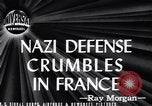
Newsreel titled Nazi Defense Crumbles in France depicting the U.S. soldiers fighting and victorious at a battle during WWII.
Newsreel titled 'Nazi Defense Crumbles in France'. A fighter airplane strikes the ground and gets destroyed by huge explosion. American soldiers take guard as fierce infantry firing goes on at a battle field. Soldiers firing artillery at the enemy positions. U.S. soldiers advance under the guard provided by the artillery and infantry firing. A German soldier moves out of bushes with his hands raised up in surrender. U.S. soldiers guards a marching troop of surrendered German soldiers. Medical aid the wounded soldiers. Bodies of those who died during the battle and a dead horse. Ruins of the city where fight took place. Destroyed houses and rubble all over the streets. Destroyed German artillery and equipment. Tanks and U.S. soldiers in a truck and on foot moving towards the next frontier. (World War II period).
CRITICALPAST.COM: About Us | Contact Us | FAQs - How to Order | License Agreement | My Account | My Lightboxes | Shopping Cart | Advanced Search | Featured Collections | Website Terms & Conditions | Privacy Policy ©2026 CriticalPast LLC.
License Agreement |
Terms & Conditions |
Privacy Policy
©2026 CriticalPast LLC.