


 Francais
 Deutsch
 Italiano
Refine Your Search
Alencon France 1944 stock footage and images
- Showing 7777 to 7782 of 9932 results more
more Hide
Hide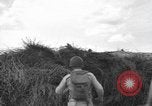
A demonstration about creating gaps in various walls and obstacles with the help of bar charges in the United States.
A demonstration shows bar charges being placed and exploded against a wall in the United States. Soldiers place bar charges on a Japanese stump wall. 24 packs of bar charges are placed on the wall for detonation. An explosion takes place and smoke rises. The explosion results in a 12 feet wide gap in the wall and tanks pass through the gap. The bar charges are placed on a five feet high Japanese log wall. An explosion occurs and a 15 feet and 3 inches wide gap is created. A U.S. Army tank passes through the gap. 24 packs of bar charges are placed on a Japanese wall and an explosion occurs. Smoke rises due to the explosion. A U.S. Army tank passes through the 16 feet wide gap created in the wall. The soldiers near the bar charges. They place the charges under water for a detonation. A steel obstacle. The bar charges are placed at the joint of a member of a steel fence for a detonation. (World War II period).
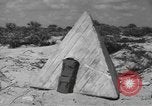
A demonstration about creating gaps in a log wall, a masonry wall and a concrete wall with the help of bar charges in the U.S.
A demonstration shows bar charges being placed and exploded against a wall in the United States. The bar charges are placed against concrete anti vehicular obstacles. Vertically placed bar charges against an obstacle. The bar charges are placed against a log wall, a masonry wall and a concrete wall for detonations. Soldiers place C-2 and other charges with a thickness of 8 inches against the concrete wall. Explosives being detonated and smoke rises. The soldiers carry the charges. An explosion occurs and billows of smoke rise up. A tank passes through the gap created as a result of the explosion. M1, M2 and M3 demolition blocks being used for the purpose. (World War II period).
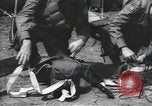
Pathfinders of United States 9th Air Force Troop Carrier Command in Grantham, England during World War II
United States Pathfinders paratroopers of 9th Air Force Troop Carrier Command work on their Eureka Beacons and Rebecca Transmitters at North Witham RAF Station,Grantham, England during World War 2. Their actions are monitored by Capt Neal McRoberts, Commanding Officer, Company F, 2d Battalion, 505th Parachute Infantry Regiment, 82d Airborne Division. He reviews the soldiers. They unload full packs and place them on the ground. Troops unpack and set up equipment. Signal blinkers and power packs being set up. Men work on the power packs as the signal blinker placed on a tripod stand blinks. .
U.S. paratroopers of 9th Air Force Troop Carrier Command are reviewed by Brig. Gen. Williams during D Day practices in England.
A film about D-Day invasion practices by United States 9th Air Force Troop Carrier Command in England during World War II. Paratroopers are milling about at an airfield in England. The Commander of 9th Air Force Troop Carrier Command Brigadier General Paul L. Williams dramatizes as the paratroopers leave for D Day practices. Brigadier General Williams speaks to a paratrooper and asks his opinion about the invasion. The paratroopers speak about the invasion as a great responsibility on them. The paratroopers including Captain Charles D. Gun, Captain William K. Colp, Lieutenant Colonel Joel E. Crouch, Captain Frank L. Lillyman. Lined up at the airfield as Brigadier General Williams reviews them. He offers a cigar to Captain Lillyman. The paratroopers board a U.S. Army Air Forces C-47 aircraft.
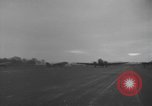
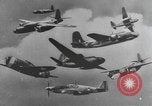
U.S. paratroopers of 9th Air Force Troop Carrier Command jump and land during practices prior to the D-Day invasion
A film about the D-Day invasion practices by United States Army 9th Air Force Troop Carrier Command in England during World War II. U.S. Army Air Forces C-47 aircraft taxi and take off from an air field in England. The aircraft fly in formation. Paratroopers of U.S. 9th Air Force Troop Carrier Command aboard an airborne plane. Captain Frank L. Lillyman with a cigar. The paratroopers jump from the aircraft during a practice landing prior to the D Day invasion. They jump and descend with parachutes.
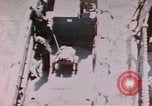
USS Bayfield (APA-33) loading equipment and troops during preparations for the invasion of Normandy during World War 2.
USS Bayfield (APA-33) anchored off Plymouth England to load troops and equipment of the 8th Infantry Regiment (U.S. 4th Infantry Division) and the 87th Chemical Battalion. Cargo net being lowered into a Higgins Boat, LCVP ( Landing Craft Vehicle Personnel) alongside. Crew on the boat secure cargo in net. Several crew aboard the ship look over the rail of the ship. The cargo net being hoisted aboard the ship. Another Higgins boat arriving filled with combat troops. U.S. sailors remove the cargo net and unload two wheeled carts holding ordnance. One of the ship's landing craft can be seen on deck, bearing the number PA33-25. Crewmen work on cargo nets. One uses a wooden taper pin. Ttroops of the 87th Chemical Battalion begin boarding, carrying their special equipment. Coast Guard officer on deck . Several British vessels are seen in the water. Low hills in background.
CRITICALPAST.COM: About Us | Contact Us | FAQs - How to Order | License Agreement | My Account | My Lightboxes | Shopping Cart | Advanced Search | Featured Collections | Website Terms & Conditions | Privacy Policy ©2026 CriticalPast LLC.
License Agreement |
Terms & Conditions |
Privacy Policy
©2026 CriticalPast LLC.