


 Francais
 Deutsch
 Italiano
Refine Your Search
Alencon France 1944 stock footage and images
- Showing 133 to 138 of 9964 results more
more Hide
Hide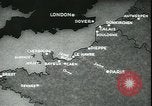
German forces fire at Allied vessels. Battle of Villers-Bocage in World War II
German soldiers in France during the Battle of Villers-Bocage of World War 2. A pictorial map showing cities along French coastline. A German soldier looking through binoculars. Allied ships at sea. German soldiers prepare artillery and fire. Smoke rising from explosions. German soldiers beside artillery. Smoke rising from Allied vessels at sea. Explosions on land and smoke rising. Two German soldiers talking. A wrecked landing craft at a beach. Debris of wreckage spread on the beach. A bomb wrecked U.S. LST (Landing Ship, Tank) on the beach and armored vehicles aboard the ship. Vehicles moving along a road. recked British Cromwell tanks and M3 Halftracks along the side of a road. A German soldier beside a damaged tank. Wide shot of a Stuart light tank. A damaged signboard which reads 'Villers Bocage'. Damaged buildings on the street of Villers-Bocage and a wrecked Tiger tank beside the buildings. Debris strewn on the ground and a damaged tank among the debris. A damaged tank with its front part into a building. A British helmet in the debris on a Cromwell tank. (Note: During this battle, On June 13th, 1944, German tank commander, Michael Wittmann, in a single Panzerkampfwagen VI Tiger tank reportedly destroyed up to 14 tanks and 15 personnel carriers along with 2 anti-tank guns. Many were of the British 22nd Armored Brigade of the 7th Armored Division, AKA the 'Desert Rats'.)
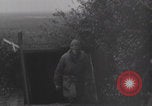
General Omar Bradley with other generals, United States soldiers before the start of Operation Cobra (WW2)
United States General Omar Bradley emerges from a bunker with other generals in Normandy during World War 2. United States generals walking as a group, with General Bradley speaking with General Eisenhower. Television host Alexander Scourby says with regard to Operation Cobra, “No plan in war is fool-proof. But this one is bold, and if it worked it would enable the Allies to break the stalemate in which they have become bogged down”. “Brittany was still the eventual goal” says Alexander Scourby as he points to the region of Brittany in France on the map. United States troops resting and doing chores during their free time. A soldier gets a haircut. A young soldier reads a letter. A soldier doing laundry using a washboard and metal tub. A soldier polishes his leather boots. Soldier cleaning a spot from his uniform. A United States soldier wearing a bowler hat reads a newspaper. Daily News headline reads “OWN OFFICERS BOMB HITLER; PURGE STARTS” after the 20 July plot to assassinate Hitler in 1944. German Chancellor Adolf Hitler speaks to a crowd at rally. A group of German military troops, with an officer wearing the Iron Cross, convene for a meeting in a forest. A German soldier with machine gun rounds slung over his shoulders smoking a cigarette. German soldiers smoke cigarettes while resting. Shirtless German soldiers digging a trench. German soldier spreads butter on bread. A German soldier drinks water from a bucket. A group of German troops, with close ups showing tired faces. United States General Omar Bradley shakes hands with another officer before boarding a Jeep. Soldiers sitting beside a hedgerow. United States soldiers sitting in a ditch next to a hedgerow and smoking. A soldier holds a pocket watch. A soldier lights up another’s cigarette. A formation of B-17 flying fortress bombers in flight. Close view of bombs dropping towards ground. Aerial view of explosions on ground. A German soldier uses binoculars. A tank on the field. Soldiers creep up beside hedgerow. Soldiers hiding while wearing camouflage. German commander commands troops to fire. German soldiers firing artillery. German soldier puts shell into artillery. Artillery fires behind shrubs. General Omar Bradley observes battle from afar. General Omar Bradley listens to Major General J. Lawton Collins, who is describing how the city of Cherbourg was taken. German armored vehicles covered in camouflage driving. German half-tracks moving.
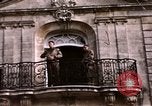
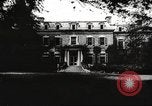
U.S. Army officers and war correspondents at the bombed, abandoned French Chateau de Pont-Rilly during World War II after D-Day
Uniformed U.S. war correspondents and U.S. Army officers explore the house and grounds of the French Chateau de Pont-Rilly, in Négreville near Normandy France, soon after the Invasion of Europe. (The chateau was designed in 1765 by architect Pierre-Raphaël de Lozon for the Marquis d'Ourville). U.S. Army officers in the balcony of the mansion overlooking the entrance. Exteriors of the palatial chateau. A large bomb hole is visible in the roof, right of the main entrance. A French boy points out something distant on the grounds of the Chateau. A swan in a pond. Exteriors of the mansion. At the end of July 1944, near the time this footage was shot, the chateau became the headquarters of Advance Section of Com Z, also known as "ADSEC" (Advance Section, Communications Zone).

General Eisenhower as a World War II officer and as the U.S. President.
Scenes from life and career of Dwight D Eisenhower, 34th President of United States. U.S. Air Force plane lands and the President disembarks the plane in India, in 1959. He is greeted by the Indian President Dr Rajendra Prasad and other dignitaries. Emblem of 'Panama'. Sign of 'welcome Ike Crusader'. Large crowd welcomes Eisenhower. Motorcade goes through the city's street. Milestones in General Eisenhower's life and the international esteem with which he is held. Lt Col Eisenhower concerned about U.S. isolationism in 1940 as World War 2 is underway. Explosions in Europe due to bombing by German aircraft. Eisenhower and other officers in the General Staff study a map. Eisenhower plans the strategy as the commander of Operation Torch (he is shown talking to General George C. Marshall and Winston Churchill). President Eisenhower visits 4 continents and meets several leaders. Large crowds welcome him. General Eisenhower prepares for D-Day Invasion of France during World War 2. June 5, 1944: The Allied forces including troops, artillery, equipment, ammunition, aircraft and ships prepared. June 6, 1944: The Allies invade Normandy. Troops wade through the water during D-Day Normandy beach landings, while under enemy fire. German soldiers surrender. May 7, 1945: Nazi General Alfred Jodl signs the unconditional surrender of his government. General Eisenhower returns to the U.S. He receives a hero's welcome in New York during a parade. He visits his hometown in Kansas. Pictures of his family, childhood and college days. Eisenhower on his visits to various countries as President.
Allied leaders meet in Quebec, Canada and the Germans launch an attack in Bulge, Belgium during World War II.
Allied campaign against the Axis in 1944 during World War II. Exteriors of Dumbarton Oaks in Washington DC. Representatives of the United Nations at a meeting inside the mansion. A railroad train arrives and British Prime Minister Winston Churchill gets off the train in Quebec, Canada for the Quebec Conference. Churchill confers with U.S. President Franklin D. Roosevelt about Allied plans during the war. French FFI or Maquis groups in France. President Roosevelt, seated in front of a large celebrating crowd of people in the U.S., acknowledges them after being reelected President for a third term. People celebrate his victory and hold election victory signs as they cheer. American Civilians (mostly women war production workers) work in war production factories to produce aircraft, tanks and other equipment in the United States. Rows of aircraft engines, cockpits, and gun turrets being produced. On December 16, 1944, German forces launch a major-counter attack through the Ardennes forests, resulting in the "Battle of the Bulge" in Belgium. View of German soldiers and a German Jagdpanzer IV tank destroyer rolling by. German soldiers advance past destroyed Allied tanks and trucks.
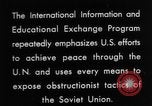
Events of World War 2, and creation of United Nations Organization following the surrender of Germany and Japan
Summary of World War II events and formation of the United Nations Organization. Soviet troops on Eastern Front of Europe fire artillery on German positions in 1944. Russian troops advance. German soldiers come out of buildings and surrender. Allied Forces land in France on D-Day. Allied troops and tanks fight Germans on streets in towns and villages of France. U.S. Army tanks fire at German positions. Various groups of German prisoners of war march along roads and are herded into prison camps operated by American and British forces. In 1945, the Allied leaders meet at Yalta on the Crimean Peninsula to discuss Allied military strategy in the final months of WWII. Leaders included British PM Winston Churchill, U.S. President Franklin D Roosevelt and Soviet Premier Joseph Stalin. The meeting of U.S. and Soviet Russian troops at the Elbe River. German Nazi Swastika symbol blown up in explosion atop Zeppelinfeld Nazi party rally grounds in Nuremberg. Aerial view of Berlin in ruins, as seen from low-flying aircraft flying directly over the Unter den Linden boulevard and the Brandenburg Gate. Wrecked and bombed German buildings seen everywhere. German officials signing surrender instrument at Rheims. U.S. President Harry S Truman, Winston Churchill and Joseph Stalin at Potsdam Conference. U.S. Marines battling on beaches of Pacific Islands. Iconic shot of U.S. Marines raising the American flag on Mount Suribachi at Iwo Jima. Aerial view of bombed and ruined city of Tokyo, Japan. The Japanese surrender to MacArthur aboard the battleship USS Missouri. General MacArthur speaks aboard Missouri. Victory celebrations all across the world, with some scenes from earlier V-E Day (Victory in Europe) day in May 1945, including crowds celebrating in Paris, France, and some scenes on V-J Day (Victory over Japan day) in August 1945. Crowds on streets celebrate. Happy crowds jam streets. Delegates of Nations, among them Andrei Gromyko and Vyascheslav Molotov meet in San Francisco and create a United Nations organization. Truman arrives at signing of UN charter. Various delegates sign charter. U.S. troops disembark troop carrier ships at U.S. ports and are discharged after completing military service in World War 2. Group of U.S. Army soldiers exits a church (the Chapel at Fort Dix, New Jersey), waving their discharge papers in hand.
CRITICALPAST.COM: About Us | Contact Us | FAQs - How to Order | License Agreement | My Account | My Lightboxes | Shopping Cart | Advanced Search | Featured Collections | Website Terms & Conditions | Privacy Policy ©2026 CriticalPast LLC.
License Agreement |
Terms & Conditions |
Privacy Policy
©2026 CriticalPast LLC.