


 Francais
 Deutsch
 Italiano
Refine Your Search
Alencon France 1944 stock footage and images
- Showing 151 to 156 of 9964 results more
more Hide
Hide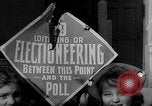
The 1944 U.S. Presidential election in World War II
On Election Day, November 7, 1944, in World War 2, Americans are seen waiting patiently to vote. They stand in a long line extending down a city sidewalk next to brick and stone buildings. Views of several persons in the line. Scene shifts in flashback to the election of Woodrow Wilson, in 1912. Four men on horseback arrive at a polling place. Another travels to vote, in his 1910 Ford Model T truck. Change of time and place shows farmer arriving by horse-drawn wagon and walking to polling place past 1930s car and truck. A fully laden truck stops at a rural gasoline station, temporarily serving as polling place. American town residential street scene in the 1930s. Citizens gathering to vote at a polling place set up at a laundry shop, in the Bronx Borough of New York City. Views of various places in the United States, serving as polling places. Americans seen waiting to vote at various places, in the 1944 national election. Among the sites shown is Bridgeport Central High School, built in 1916, (which later became Bridgeport City Hall), at 45 Lyon Terrace in Bridgeport, Connecticut. Persons in various places, registering to vote, including actor Lewis Stone, actress Esther Williams, and USO entertainer, Bob Hope. Voter closing curtain behind him as he votes in a voting booth. Views of voters' feet, below curtains, as they vote. Various types of boxes. Newspaper headline speaks of the large voter turnout in millions during the 1944 election. Shipyard workers at end of their shift, are seen heading to the polls to vote.
Americans voting and electioneering in national election on November 7, 1944, during World War II.
On November 7, 1944, during World War 2, citizens of Marblehead, Massachusetts, United States, are seen entering the Old Town House (built in 1727) to cast ballots in 40th quadrennial presidential election (in which incumbent President Franklin D. Roosevelt is running for an unprecedented 3th term). Scene shifts to inside a polling place, where voters stand in booths to privately mark their ballots. Others are seen depositing their marked, folded paper ballots in a collection box, as they finish voting. Closeups of several aged voters. One, an African American man, the narrator says is old enough that he was sold as a slave early in his life. Scene shifts to a full-blooded Native American Indian voter in Maryland, entering his polling place to cast a ballot. An old man who is a United States Civil War veteran, is shown sitting on a bench in a park in Los Angeles California, with friends. He holds a newspaper and wears a Civil War Union cap. A U.S. soldier wearing field uniform and steel helmet, looks at a bulletin board containing State-by-State voting information. A Technical Sergeant marks his paper ballot and leaves to mail it. A soldier takes an oath confirming legitimacy of his ballot as he turns it in at a military collection site. Sign in commercial establishment window of a U.S. town declares "Election Today." A bank window sign reads: "this Bank will observe Election Day, Tuesday, November 7th, a Legal Holiday." Sign in Bar window reads: "Bar Closed during Election Hours, Tuesday, Nov.7, 1944. Will Open at 9 PM." Republican political party workers advertise for their Presidential candidate, Thomas E. Dewey. Democratic political party workers drive a truck towing a trailer office plastered with advertisements for their candidate, Franklin Roosevelt. Republican and Democratic party voter information booths are seen next to one another where advertise their respective candidates to passersby on the sidewalk. A voting place identified by white wash sign on a window, and another, in a rural setting, by a sign pointing to it on a fence post. More signs and voters showing sentiments for their candidates. One displays a picture of Dewey on his car. A woman wears a large Roosevelt button on her sweater. Views of more imaginative signs for candidates and for ballot issues. People discussing ballot issues on the streets.
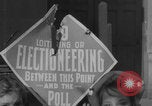
American voters head for the polls to vote in the 1944 Presidential Elections during WWII
Sign saying “No loitering or electioneering between this point and the poll”. Long line to election poll in the United States during World War II. 1944 American voters wait in line on the street to vote. Woman, wearing a Tartan patterned headscarf and fur coat, waits outside. Cowboys gallop with their horses to the polling station. Man, wearing cowboy hat, gets off from his Ford Model-T car. Worker walks out to the street. A truck with workers on open-cargo area. A woman walks in an empty city street. View of crowd outside Bronx Beacon Laundry at W 169th Street Bronx NYC. People enter a house used as a polling station with a huge tree in front. View of different kinds of buildings used as polling stations for the 1944 United States Presidential Elections. Including the Barbara Fritchie House ( 154 W Patrick St Frederick, MD 21701) “Bridgeport High School” engraved in front of Bridgeport Central High school (44 Lyon Terrace Bridgeport, CT 06604 ) now Bridgeport City Hall. United Stastes voters wait in lines outside polling places. Two women eating biscuits together as they wait in line. A stylish woman, wearing a matching leopard print cocktail hat and scarf, smiles. A man, wearing cowboy hat, waits in line. A group of nuns, belonging to the Sisters of the Holy Cross (CSC) Congregation, waiting to vote. Man, with mustache and fedora, looks slightly up. View of American Red Cross volunteer. Americans forming a long line to the polling station to vote. A woman sits as she waits for her turn to vote. African-American voters waiting in line to vote. Woman, wearing a polka-dotted headscarf, glasses and overalls, waits in line. Men waiting in line in the suburbs. Americans wearing thick coats waiting in line to vote.
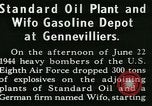
Standard Oil Plant and Wifo Gasoline Depot at Gennevilliers in Paris bombed by the U.S. Eighth Air Force on June 22, 1944 in World War 2.
Results of air assaults by the British Royal and U.S. Eighth Air Forces over industrial areas in and around German-occupied Paris during Wolrd War II. The adjoining Standard Oil Plant and German Wifo Gasoline Depot at Gennevilliers bombed by the U.S. Eighth Air Force heavy bombers on June 22, 1944. The destroyed manufacturing facilities, buildings, storage tanks, loading platforms, railroad tank cars. Damaged steel structures and collapsed roofs. Aerial view of the plant and the depot.
Destruction in Saarlautern (Saarlouis) Germany, the day after Christmas, 1944, during World War II
Slate indicates the area shown is occupied by the U.S. 3rd Army, 95th Infantry Division. Bombed out buildings are seen with rubble piled at side of road, in Saarlautern (Saarlouis) Germany, the day after Christmas, 1944, during World War 2. View of apartment buildings and shops across from a park. Another street of shops. No people or vehicles are seen. An American soldier carrying a large camera, walks past an antique French 155mm gun, circa 1877, on display in a public Square. A view of the seemingly undamaged Catholic Church of St. Ludwig (Katholische Kirche St. Ludwig) on Kavalleriestrasse. A jeep drives past it. A U.S. soldier rides a bicycle past destroyed buildings
Crash landings of Navy airplanes on USS Makassar Strait (CVE-91) during training in waters off Hawaii, 1944
Documentation of crash landings,of Gruman Wildcat (F4F) airplanes,on the USS Makassar Strait (CVE-91) during a training cruise, off Hawaii, in 1944. One almost veers off the deck completely, and one the involves a nose-over. In one instance, the pilot comes in too hot, on one wheel, and prudently executes a "go around" for another try.
CRITICALPAST.COM: About Us | Contact Us | FAQs - How to Order | License Agreement | My Account | My Lightboxes | Shopping Cart | Advanced Search | Featured Collections | Website Terms & Conditions | Privacy Policy ©2026 CriticalPast LLC.
License Agreement |
Terms & Conditions |
Privacy Policy
©2026 CriticalPast LLC.