


 Francais
 Deutsch
 Italiano
Refine Your Search
Alencon France 1944 stock footage and images
- Showing 325 to 330 of 9964 results more
more Hide
Hide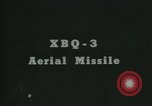
Fairchild XBQ-3 flying bomb taxiing at Fairchild facility in North Carolina
Opening slate reads: "XBQ-3 Aerial Missile." Next, an XBQ-3 flying bomb is seen taxiing on an airfield. It resembles an AT-21 training airplane. But it is actually a flying bomb (aka an aerial torpedo or an Assault Drone). The one shown in this film is the first of two built by the Fairchild Company. It displays serial number 43-25252. (The second was 43-25253). With a safety pilot aboard, it taxis about on a concrete ramp, at Fairchild Field in Burlington, North Carolina. The XQB-3 accommodated one pilot for testing or ferrying purposes, but otherwise was designed to be remotely guided to it's target and detonate on impact. Guided missile technology was progressing at such a pace as to render the 'flying bomb' concept obsolete and so the U.S. Army Air Corps cancelled the program in late 1944. (World War II period).
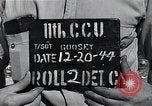
B-29 , tail number 42-224802 on Guam, Mariana Islands during World War II.
Camera pans across North airfield on Guam, Mariana Islands, in World War 2. Next a large group of Airmen are seen standing around a shiny B-29 bomber parked on the ramp. It has "K333" stenciled on left side of its forward fuselage. Its tail number is 42-224802. (This B-29 is named "Purple Shaft," but that is not stenciled on its left side.) The airmen walk around and examine it. Next, The aircraft commander, Lieutenant Warren Richard Aylsworth is seen speaking with a Captain, as they stand next to the plane. Others join in the conversation. (Note: The plane is scheduled to fly to Tinian this night, the 20th, but will land at Saipan, instead, because runway lights were not yet operational on Tinian. The "Purple Shaft" will be the first B-29 to arrive at Tinian, the following day, December 21, 1944.)
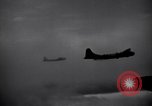
U.S. 8th Air Force operating B-17s and B-24s in Europe and B-29s against Japan in Pacific during WW2
Formation of U.S. 8th Air Force B-17 bombers in flight over Germany during World War 2.Gunners firing 50 caliber machine guns from various positions in a B-17, as attacking German interceptor aircraft race past. One German aircraft is hit and pieces of it fall off. B-17 enters bombing run. View of bombardier and bomb sight image. German aircraft continue attacks and gunners continue defending as the bombardier announces "bombs away." This is a high altitude mission and all crew members are on oxygen. Glimpse of pilot and copilot in cockpit. Pilot alerts gunners to a German FW-190 aircraft attacking them. Waist gunners pause to look at a German fighter smoking, as it falls, and strikes the ground in an explosion. Sequence shifts to formation of B-24 Liberator bomber on a mission with bombs visible dropping from bomb bays. Sequence shifts again, rapidly, to a formation of B-29 Superfortress bombers dropping bombs. Nighttime view of incendiary clusters being dropped on Japan. (Note: One of the B-29s seen is serial number 42-24547, assigned to the 6th Bomb Group, 315th Bomb Wing. This B-29 crashed short of the runway on 31 Dec 1944, at Borinquen Field, Puerto Rico, where the 6th bomb Group underwent combat crew training. And the B-29s shown do not display any tail codes.)

General Eisenhower inspects U.S. 9th Air Force in England; Allies battle German aircraft during World War II
Allied forces battle German forces during World War II. Allied soldiers firing artillery under camouflage canopies at Anzio. General Dwight D. Eisenhower inspects a fighter and the bomber aircraft base of 9th Air Force in England. Eisenhower shakes hands with Major Sherman Beaty, commander of the 555th Squadron, and with the crew of B-26 Marauder bomber aircraft with nose art "Son of Satan" (which was downed by flak over Germany on November 18, 1944). Eisenhower sits in a parked fighter aircraft and fires its guns, with instruction from the pilot standing by. Aerial views of American bomber aircraft conducting daylight bombing runs. Point of view (POV) shot through the partially cracked windscreen of an aircraft after it took enemy fire but kept flying. Bombs-away views as American bombers drop bombs over German targets and as U.S. fighter aircraft shoot down German aircraft. Aerial dogfight battles seen. U.S. Army Air Force fighter strafing German aircraft parked on an airfield. A German fighter plane gets hit, setting it on fire. British Royal Air Force (RAF) Avro Lancaster bombers conduct night raids on German targets. A Waco CG-4A glider arrives in England from the United States during World War 2. United States Army soldiers build a Shanty town from glider crates at the base in the United Kingdom. Soldiers enjoy relaxing and recreation inside Shanty houses. A soldier with headset listens to homemade radio and reads a magazine. Soldiers share a meal on a table. Soldiers receive letters from home at mail call time. A barber shop made from scrap where soldiers can get haircuts.
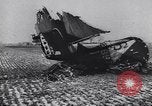
Remains of U.S. 8th Air Force aircraft shot down by German fighter aircraft and flak. U.S.flier POWs during World War II.
Tail and crushed wings of American B-17 bomber, one of several shot down over the Germany-Holland border, during World War 2. Bodies of two U.S. airmen lying on the ground next to the debris. Remains of crashed B-17, Serial number 42-39822, of the U.S. 333rd Bomb Squadron, 94th Bombardment Group, which was shot down by German FW-190s while returning from a mission to Brunswick (Braunschweig), Germany, on January 11, 1944. A fuselage from downed allied warplane being hauled away on a truck. A junkyard filled with American warplane parts, stacked by type, engines in one pile, tails in another, etc. One vertical fin, marked with the 'triangle A' of the 91st Bomb Group, is from B-17G, tail number 42-37737, named "Tennessee Toddy" of the 401st Bomb Squadron. It crash landed after losing two engines, on 10 October 1943, at Brocklanderweg, near Apeldoorn, Holland. Two U.S. Army Air Corps prisoners being interrogated by a German officer. Group of United States airmen prisoners of war, apparently showing personal identifications (dog tags) to a German interrogator.
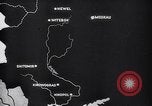
Field Marshal Ernst Busch is relieved of Command after German Army Group Centre suffers severe losses in World War II
Map shows Belorussian and Russian areas near the Dnieper river. Field Marshal Ernst Busch, ostensibly being honored for 40 years of service. (He has been notified that he is relieved from command of German Army Group Centre, following disastrous defeat by Soviets during their 1944 Belorussian Offensive of World War 2.) He steps from his headquarters in Belarus, receiving salutes from his staff. He accepts an elaborate candelabra, as a gift. Busch shares a document with a German General, and they both are amused by it. Members of the staff bid Marshal Busch farewell.
CRITICALPAST.COM: About Us | Contact Us | FAQs - How to Order | License Agreement | My Account | My Lightboxes | Shopping Cart | Advanced Search | Featured Collections | Website Terms & Conditions | Privacy Policy ©2026 CriticalPast LLC.
License Agreement |
Terms & Conditions |
Privacy Policy
©2026 CriticalPast LLC.