


 Francais
 Deutsch
 Italiano
Refine Your Search
Alencon France 1944 stock footage and images
- Showing 4693 to 4698 of 9932 results more
more Hide
Hide
Charles Augustus Lindbergh successfully completes first nonstop crossing from New York to Paris, and is celebrated worldwide.
Opens with scenes of aviators unsuccessful attempts to cross the Atlantic in pursuit of the Orteig Prize. Failed attempt by Fonck in his Sikorsky aircraft as he headed for Paris on September 21, 1926. French aviator René Paul Fonck standing beside his aircraft before takeoff. Fonck's plane taxiing for takeoff. View of the plane crashed and consumed in fire and smoke. Crash of Byrd's Fokker plane on April 16, 1927, injuring Byrd and crewmen Noville and Bennett. View of Byrd in uniform before the crash. View of the crash as Byrd's plane is seen tumbling nose over on landing. Failure of Chamberlin's Bellanca aircraft carrying Chamberlin and two little girl passengers. The plane stalls at landing but passengers are safe. Next scene of crash of plane carrying Davis and Wooster on April 26, 1927 near Langley Field, Virginia, killing both men. The crashed plane beside a swamp. View of France's Charles Nungesser and Francois Coli before their attempt in L'Oiseau Blanc (The White Bird). Plane with Nungesser and Coli taking off; it disappeared after taking off from Paris, with the last sighting of it over Ireland. View of Charles Lindbergh and then also of Lindbergh and his mother, and of the Spirit of Saint Louis on May 20, 1927 before his successful Atlantic Crossing to Le Bourget at Paris on May 21, 1927. The aircraft being backed out of a hangar and being fueled. Captain Charles Augustus Lindbergh enters the cockpit. The Spirit of Saint Louis Wright Whirlwind powered monoplane taxiing and taking off slowly from Roosevelt Field in New York, heavily burdened by fuel. Aerial view of the Spirit of St Louis in flight, taken from another airplane. Charles Lindbergh crosses the Atlantic in the plane 'Spirit of St. Louis'. Charles Lindbergh is greeted by huge crowd in Paris. Views of crowds, dignitaries and celebrations as he is welcomed by people in Paris, Brussels and London. Also views of his receptions in Washington DC and New York City in the United States in June 1927.
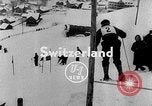
Top skiers compete for the Lauberhorn trophy in Switzerland
Top skiers compete for the Lauberhorn trophy, a top European meet. Participants from France, Germany, Austria and Switzerland compete in the skiing competition. A slalom race and a downhill event ends with the Austrians taking the trophy.
German Operation Barbarossa on the Eastern front in World War II.
View of the city, Pskov, on the Veilakaya river. A steel bridge is seen and city across it with smoke rising. German troops march in loose formation over a bridge in Novogorod. Views of German camouflaged tank (with shrubbery) and other armor and troops entering Soviet cities of Brest-litovsk, Minsk, Mogilev, and Vitebsk. View of German Panzer III tank heading toward the camera as it enters a narrow street in Smolensk. Animated map shows progress of these German advances and highlights German forces under German Field Marshal Gerd Von Runstedt cutting deep into the Ukraine. Headline on Chicago Daily News reads: "Nazis Claim Knock-out Victory" with subtitle line reading,"Moscow line cracks." Other newspapers reflect conviction that Soviet forces face imminent defeat by Germany. Slate shows communique issued by the German High Command, stating: "The issue in the East has already been settled. Smolensk is the last halt on the road to Moscow." More views of marching German troops. A battery of Soviet artillery firing from a snow-covered field. Animated map shows German forces moving close to Moscow. Foreign diplomats are moved from Moscow to the city of Kuibyshev. Hitler speaking on October 3, 1941, saying "This enemy is broken and will never rise again." Animated map depicts 500 thousand square miles of Soviet territory occupied by December, 1941, and compares it to the entire west central United States encompassing the states of : South Dakota, Iowa, Nebraska, Kansas, Missouri, and Oklahoma. Fires raging in agricultural area of the Soviet Union. Destroyed Soviet industrial plants, and huge numbers of Soviet citizens under German occupation. Views of destroyed Soviet armor, aircraft and artillery pieces. As season changes, German forces are seen in rain gear moving slowly through cold rainy weather. Some walk beside horses and other ride on horse-drawn caissons along with artillery pieces. Segments of film show contrast between the German military strategies. The German forces would plunge deep into enemy territory and create an area of conquest. This is illustrated by a slate bearing Adolf Hitler's statement that, "A single blow must destroy the enemy, without regard for losses, a gigantic destroying blow." An animated map illustrates the success of this approach by the Germans in Poland, France, and the Balkans. German Generals seen planning the same "Blitz" strategy against the Soviets. Film shifts to the Soviet strategy, showing their idea of building stronger defense, as they fall back, taking advantage of the great size of their territory. Views of Soviet troops on the move. View of Shells knocking out a German tanks. Panzer III tanks advancing. Panzer VI tanks completely covered by German troops catching rides. Soviet field artillery and machine guns firing in cities, forcing German soldiers to leave their vehicles. Soviet cities bombed out and burning, with debris and obstacles limiting the ability of armor to navigate in them. Montage of battle scenes cities of Rostov, Kharkov, Kiev, Kursk, Smolensk, all thwarting the Nazi blitz into the Soviet Union. Battles being waged in cities. (World War II; WW II; World War 2; World War Two)
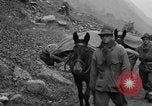
Italian mountain troops (Alpini) recover remains of victims from crash of USAF C-47 in French-Italian Alps
Italian Army Alpini recovering bodies of victims from United States Air Force aircraft C-47 which crashed in French Italian Alps, on October 24, 1954, while on a flight from Rome, Italy, to Lyon, France. The crash site is at 8,500 feet on Mount Carbonè, in Northern Maritime Alps, near Limone Piemonte, Cuneo, Italy. Italian Alpini (mountain troops) lead mules laden with bodies of crash victims, in canvas bags, down a mountain path. They are seen placing one such canvas bag into a coffin. A U.S. and an Italian officer then drape it with an American flag and Alpini pallbearers carry it to a waiting vehicle and gently place it on board. An Italian Alpini honor guard presents arms and its commander salutes.
British ship Patagonia is sunk by the German U-Boat, UB-7, during World War I
Opening slates indicate how seriously Britain views the German U-Boat campaign against Allied shipping in World War 1. Captain Wilhelm Werner of German U-Boat, UB7, is seen on deck with his officers consulting navigation charts. Their navigator sights the sun with a sextant to determine their latitude. Slate tells of their sinking of the British Steamer, "Patagonia." View of the Patagonia, stopped, in the Atlantic, and then listing and sinking. (This occurred on September 15, 1915, in the Atlantic ocean, off the coast of France.) Change of scene shows a crewmember of the UB-7 next to the conning tower, putting on his boots as a wave washes over his feet. Another slate about the seriousness of the U-Boat operations. (World War i; World War 1; WWI; WW1)
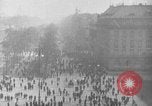
Germans express anger in Berlin over Article 228 of the Treaty of versailles. French General Debeney watches troops in Paris
Unter den Linden in Berlin, Germany after the end of World War 1. German people angry about the Treaty of Versailles, gathering in protest on Unter den Linden, in Berlin. A poster on a wall lambasting the Allies (British and French, in particular) for the provisions of the Treaty of Versailles, especially Article 228 giving the Allies authority to prosecute Germans accused of violating the laws and customs of war. Complete break and change of scene to France. Small unit of French troops, led by officer on a white horse, marching on street in Paris. Closeup of French General Marie-Eugene Debeney, Commandant la place de Paris, as he watches the troops assemble in formation with the officer on white horse, in center, across the street from where he stands . Several Renault FT light tanks parked on pavement next to a building.
CRITICALPAST.COM: About Us | Contact Us | FAQs - How to Order | License Agreement | My Account | My Lightboxes | Shopping Cart | Advanced Search | Featured Collections | Website Terms & Conditions | Privacy Policy ©2026 CriticalPast LLC.
License Agreement |
Terms & Conditions |
Privacy Policy
©2026 CriticalPast LLC.