


 Francais
 Deutsch
 Italiano
Refine Your Search
Alencon France 1944 stock footage and images
- Showing 4867 to 4872 of 9932 results more
more Hide
Hide
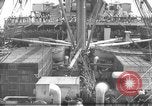
U.S. Navy troop transport operations in World War I
A freighter in foreground,and a troop transport ship, docked at a U.S.Army Transport Service Terminal during World War 1. (A large oceanliner seen berthed on opposite side of the terminal.) U.S. Army troops jam the lower decks of the troop ship as she prepares to get underway to France. Three twenty-man life rafts hang on the side of the troop ship and an American flag flies at her stern. Scene shifts to American Expeditionary Forces boarding a very large Navy transport ship at Hoboken, New Jersey. Some troops with all their gear, climb a steep gangway to an upper deck, while others, below, walk a level gangway to a lower deck.
Life aboard the American troopship, SS Leviathan, during World War I.
The upper deck of the SS Leviathan, carrying American Expeditionary Forces to France during World War 1. Formerly the German ocean liner, Vaterland, she is the largest ship afloat, and carries 12 thousand troops. This footage shows the U.S. Navy commissary Officer inspecting various functional activities related to care and feeding of the crew and troops aboard. He checks sides of beef in cold storage of the meat locker. He samples a pie in the bakery; and inspects the galley. Next sequence shows Army troops forming two chow lines as they come down into the mess area, carrying their individual mess kits. Mess personnel serve the troops, who then proceed to long tables where they eat.
Sleeping quarters aboard the SS Leviathan troopship at sea during World War I.
Life aboard the SS Leviathan troopship, carrying 12 thousand American soldiers to France during World War 1.The largest ship afloat, she was formerly the German ocean liner, Vaterland. Soldiers in regular sleeping compartments lie on vertical bunks, some stacked 3 or 4 high. View of the Sick Bay on the ship where patients have less crowded conditions. A Navy medical officer makes rounds, checking each patient. A medical technician is seen sterilizing instruments in a steam autoclave.
Views of engine controls and boilers of the SS Leviathan troop transport ship during World War I
Engineering personnel at work below decks in the engine compartments of the SS Leviathan troop transport ship while underway, carrying 12 thousand soldiers of the American Expeditionary Force to France during World War 1. Men in control room adjust engine settings. Firemen, stripped to the waist, stoke ship's boilers. View forward from the bridge, as rough seas break over the bow of the ship.
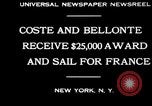
Colonel W.E. Easterwood presents a $25,000 prize to French aviators Coste and Bellontefor the first one-stop flight from Paris to New York to Dallas.
Film opens showing people assembled at a celebratory dinner, honoring French aviators, Captain Dieudonne Costes and Lieutenant Maurice Bellonte, who on September 1, 1930, flew their Breguet XIX aircraft,"Le Point d'Interrogation" (The Question Mark) non-stop from Paris to New York, and thence to Dallas Texas,landing at Love Field, Dallas, on September 4th,where they were greeted by 30,000 aviation enthusiasts. They are being honored by William Edward (Colonel) Easterwood, Jr., a Texas philanthropist and aviation enthusiast who had offered a $25,000 prize for the first one-stop flight from Paris to New York to Dallas,Texas. Colonel Easterwood delivers congratulatory remarks, and presents his check for the prize to the fliers. Closeup of the Easterwood check. Broadcast microphones are placed close to Colonel Easterwood and the fliers. Next, the fliers stand near the end of the event. Scene shifts completely to Costes and Bellonte with their aircraft, "The Question Mark, aboard a steamship, ready to sail back to France. Closup of the aircraft with large question mark painted on its side along with names of cities world-wide to which it had flown. Among these are: Hanoi; Calcutta; Karachi; Alepo; Athens; Rome; Paris; and New York. (Note: There is a display at the Frontiers of Flight Museum, Dallas Love Field, that includes the actual prize check as well as a panoramic picture of the "Question Mark" landing in Dallas, along with a plaque commemorating the event.)
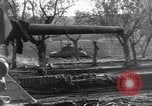
U.S. troops fire guns, advance on a field and drop bombs at a historic abbey in Italy during the Battle of Cassino.
A documentary television program depicts the role of U.S. soldiers in the Battle for Cassino which was a part of the Italian Campaign during World War II. U.S. 6th Armored Infantry Regiment troops advance on trucks. A barrel of a gun in the foreground. Fire by tanks and artillery. Mountains in the foreground. A town on the foot of Monastery Hill. A historic abbey which contains many medieval treasures. A German official at the abbey. A German soldier looks through binoculars. Troops around an artillery fire. A hand holding a leaflet. Leaflets are fired. A U.S. aircraft in flight over Monastery Hill and a pilot in the cockpit. Aircraft drop bombs over the abbey . Smoke rises due to an explosion. Soldiers fire guns. German troops at the abbey look through the binoculars. They fire guns. 5th Army troops on tanks advance. Aircraft in flight. Colonel William W. Quinn seated in a chair talks about the next story that is the invasion of Southern France.
CRITICALPAST.COM: About Us | Contact Us | FAQs - How to Order | License Agreement | My Account | My Lightboxes | Shopping Cart | Advanced Search | Featured Collections | Website Terms & Conditions | Privacy Policy ©2026 CriticalPast LLC.
License Agreement |
Terms & Conditions |
Privacy Policy
©2026 CriticalPast LLC.