


 Francais
 Deutsch
 Italiano
Refine Your Search
Alencon France 1944 stock footage and images
- Showing 547 to 552 of 9964 results more
more Hide
HideMixture of scenes from various U.S. amphibious assaults on Japanese occupied islands in the Pacific during World War 2
First scenes show United States Marines riding in a landing vehicle tracked (LVT) heading toward a Japanese occupied island in the Pacific. View from one of the landing craft of heavy smoke obscuring the island coast. Next, a dozen landing craft from the USS George Clymer (APA-27) are seen with mountains of the target island looming in the background. View from a different perspective shows several landing craft heading toward an inlet to the island. View from a landing craft of a Japanese Mitsubishi A6M "Zero" airplane flying overhead. Closeup of American soldiers in a landing craft headed toward a different Japanese occupied island. U.S. soldiers leaving a landing craft in the surf. View from inside a landing craft as U.S. Marines head ashore. Soldiers splashing in the surf. Troops wading ashore. Soldier dug in on beach near underbrush, firing many round from his Browning M1919 machine gun. Marine firing his rifle behind a palm tree. Troops seeking cover at very edge of shore. Some lying in the water, before moving on. A soldier firing an automatic weapon through foliage. A bomb explodes near an invasion ship. Troops descending on rope nets from the troopship, USS Crescent City (APA-21) and entering her Higgins boats. Heavy equipment and ammunition being offloaded from the troop transport ship. Marines coming ashore. An LVT in the background. Marines behind a barricade built by the Japanese. Marines throwing hand grenades and firing Browning M1919 machine guns. Flame throwers being used to force Japanese from strongholds. Marines gathered all along a shore line. A bulldozer driving along the waters edge. Soldiers rolling steel mesh across the sand. An antiaircraft machine gun with a side magazine mounted on a jeep, moves on the sand. Several ensuing scenes show flame throwers being used. Marines near a wrecked Japanese structure and then escorting a Japanese prisoner. A group of Japanese prisoners being spoken to by a Marine with a microphone. Marines hunkered down on a beach. One is cranking a hand powered radio transmitter. Front ramp of a landing craft is dropped down with a splash at waters edge. An M3A1 light tank drives off the landing craft. A truck being offloaded onto the shore. A heavy field artillery piece being moved into position. Troops work to move another field artillery piece into position. Trucks and other vehicles wading through shallow water as they leave an LST. Troops wading ashore from the LST. Trucks arriving on the shore. A tractor pulls a canvas covered vehicle. Soldiers ride aboard a light tank. Unusual view of troops assembled on shore of a mountain with ice seen in places on it (likely in the Aleutians). Crowded beachhead with LST 477 seen beached. Marines looking at destroyed Shore defense installation containing heavy gun. Remains of a 4-engine Japanese Kawanishi H8K2 (Emily) flying boat in the water. Seabees building an airfield with heavy construction equipment. Troops gathered around a Navy F4F aircraft that landed on the new (unfinished) airfield. Closeup of the smiling pilot climbing down from his plane. Troops saluting as the American flag is raised on remains of a Palm tree trunk, on Eniwetok, February 1944. Remains of a Japanese shrine and views of dead Japanese soldiers.

U.S. industrialist, Henry J. Kaiser appeals to Americans to donate used clothing for war victims throughout the world
American industrialist, Henry J. Kaiser appeals for donating clothing to war victims in China and Europe during World War II. Seated at desk in office, he addresses the nation and announces a drive, commencing April 1, 1944, to collect used clothing for war victims, all over the world. Scenes shows : War victims in food lines. Starving and wounded civilian victims of war. An American woman and a girl at home in America select clothing for donation. Mr. Kaiser shows a banner which reads "what can you spare that they can wear?"
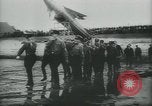
Montage of German rocketry scenes from 1930s through World War II. Nazi surrender. Atomic bomb. Japanese surrender
German rocket pioneer, Gerhard Zucker, attempting to develop postal rockets in the 1930s. Location is Wadden Sea off Cuxhaven, on April 9, 1933, where Zucker follows Nazi Sturmabteilung (also called SA or Stormtroopers) carrying the mail rocket across wet sands. The rocket is set up on a launch stand. Zucker and an assistant ignite the 8 side rockets and the mail rocket takes off. It noses up and loops over backwards, falling to the sand. German Stormtroopers lift up the damaged device. Next, is seen a later, more modern, rocket trial ending in failure. Two German engineers display a model similar to the pulse-jet-powered "buzz bomb" (V-1) employed by the Nazis in World War 2. A brief glimpse of similar American machine on sand flat, as narrator states German acknowledgement of knowledge gleaned from Dr. Robert Goddard's work. A German V-1 flying bomb (aka Doodle Bug) being launched in 1944, during World War 2. View of British houses of Parliament, London, England; an air raid shelter sign in City of Westminster. Londoners waiting out a raid in the shelter. Scenes of fire and destruction during German bombing of London, as narrator speaks about the more advanced German V-2 ballistic missiles employed later in the war. Londoners trudging through debris amongst bombed out buildings. Change of scene to U.S. infantry and armor advancing deep into Germany. Narrator refers to them overrunning rocket bases and other vital war-making facilities, near the end of the war. Glimpse of large number of German prisoners of war. Documents of military surrender being signed by Field Marshal Wilhelm Keitel, in Berlin, May 8, 1945. Closeup of Keitel. Scenes of American forces operating in Pacific theater. Aerial view of atomic bomb explosion. Japanese surrender ceremony on September 2, 1945, aboard the battleship USS Missouri. U.S. soldiers and other service personnel return home and greeting loved ones at end of war. Aerial view of Pentagon building and surrounding area in Arlington Virginia near Washington DC. U.S. troops boarding a ship in San Francisco, bound for war again, this time in Korea (1950).
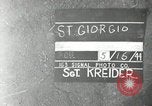
German armored vehicles,tanks and trucks destroyed by U.S. tactical aircraft supporting French forces in Italy
Destroyed German equipment, including some captured American armor, lines the edge of a road near Esperia, Italy during World War II. The German armored vehicles, tanks, antitank guns and trucks were destroyed by U.S. fighter bombers of the 12th Army Air Forces, on May 16, 1944, while supporting the French Expeditionary Force assault on the German Gustav line in that area. French troops stand on the side of a road. Troops examine some of the destroyed armor.
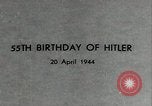
German troops pass under Brandenburg Gate during Chancellor Adolf Hitler's 55th Birthday celebrations in Berlin.
Celebrations during 55th Birthday of German Chancellor Adolf Hitler on 20th April, 1944 during World War II. A German Eagle statue on a base with inscription to the effect that our walls may be broken but not our hearts. A youth raising a Nazi flag on top of a building. People and troops march through the Brandenburg Gate in Berlin. People set up Nazi flags amidst rubble, and a woman sets up a sign reading that our walls may be broken but not our hearts. Demolished building in the background. People buy newspapers at a newsstand.
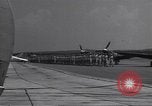
U.S. Major General William O. Butler gives address on third anniversary of Tuskegee Army Airfield, during World War II.
Final segment of "Army Air Forces special film project 151" known as "Wings for This Man". Third anniversary of United States Army Tuskegee Army Air Field being celebrated in August, 1944 during World War 2. Tuskegee Airmen U.S. African American cadets march. Commanding General U.S. Army Air Forces Eastern Flying Training Command addresses the cadet soldiers, families and spectators assembled. Cadets march at the ceremony. P-40 airplanes seen parked at the airfield. Several P-40s taxiing. (note: narrated by Ronald Reagan)
CRITICALPAST.COM: About Us | Contact Us | FAQs - How to Order | License Agreement | My Account | My Lightboxes | Shopping Cart | Advanced Search | Featured Collections | Website Terms & Conditions | Privacy Policy ©2026 CriticalPast LLC.
License Agreement |
Terms & Conditions |
Privacy Policy
©2026 CriticalPast LLC.