


 Francais
 Deutsch
 Italiano

Refine Your Search
Alencon France 1944 stock footage and images
- Showing 5629 to 5634 of 9966 results more
 Hide
Color Sound
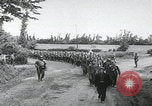
German prisoners after D-Day (WW2)
German prisoners captured by Allied forces marching on highway in Normandy after the D-Day landings in World War II. Allied soldiers watch over them. They march on the side of the road, marching past a DUKW. Prisoners marching towards a compound area with barrage balloons overhead. The prisoners receive food and drinks upon their arrival. German prisoners wading through water to board an LCT (Landing craft tank) on beachhead.

Medics take wounded to hospital tents; East Asian soldiers in German uniforms (WW2)
U.S. Army field hospital tents in Normandy after the D-Day landings in World War II. A DUKW drives past the tents. U.S. military trucks and vehicles drive past soldiers on dusty road. Medics carry the wounded on stretchers from vehicles to the hospital tents. Medics treat a soldier’s injury. One of the medics hold the IV fluid. Women nurses eating and drinking during their break outside the tents. Nurses rolling bandages. A female nurse comforts a patient outdoors. Another female medic tends to a man’s wounds. Unusual scene of captured east Asian soldiers, possibly Korean, in German uniforms.

Injured German and Allied soldiers in Normandy (WW2)
Captured German prisoners carry their wounded on stretchers to the field hospital in Normandy after the D-Day landings in World War II. A medic tends to a soldier’s wound on his back. The medic gestures to the camera for medicine. A 101 Airborne soldier with an injured mouth carries another man in his arms. A reporter takes notes while talking to a patient. A medic from the 101st Airborne. Wounded United States soldiers in stretchers are lifted aboard a ship from a landing craft.
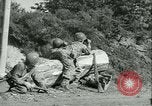
U.S. troops advance towards Cherence Le Roussel.
U.S. troops advance towards Cherence Le Roussel. SOldiers fire at the enemy. A soldier scouts for enemy soldiers through binoculars. Smoke from artillery fire. Explosions across the terrain. Soldiers stand on a camouflaged tank. Barrel of a tank jutting out of the bushes. Soldiers load and fire artillery. Soldiers march on the road and through fields. A sign board for 'Cherence Le Roussel' amid ruins and destroyed buildings. (World War II period).
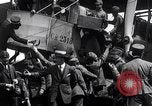
Aerial views of Verdun and Fort Douaumont during World War I
French soldiers and airmen gather around a Caproni Ca.3 bomber preparing for an aerial photography mission in World War 1. The identification number "Ca 2318" is stenciled on the airplane fuselage. The men load camera cases and equipment for the motion picture photographer, as officers watch. The Pilot takes his position in the front of the open cockpit as the photographer and second crewman sit side-by-side behind him. The pilot waves as they taxi out for takeoff. The next sequence contains views from the aircraft as it flies among clouds, and then shows Fort Douaumont clearly below, followed by the city of Verdun-sur-Meuse, and environs, including the Meuse River, bridges, buildings, and roads, without noticeable signs of any battles or damage, since the German offensive would not begin until the following year (1916).
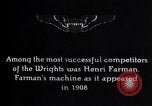
Competitor of Wright brothers, Henry Farmen, and his airplane.
Development of early airplane. The most successful competitor of Wright brothers Henry Farmen and his airplane, in 1908. Men working on it. Farmen fills gas tank of hi s plane while other persons on ground watch. Farmen flying machine takes off in a ground.
CRITICALPAST.COM: About Us | Contact Us | FAQs - How to Order | License Agreement | My Account | My Lightboxes | Shopping Cart | Advanced Search | Featured Collections | Website Terms & Conditions | Privacy Policy ©2026 CriticalPast LLC.
License Agreement |
Terms & Conditions |
Privacy Policy
©2026 CriticalPast LLC.