


 Francais
 Deutsch
 Italiano
Refine Your Search
Alexandria Egypt 1941 stock footage and images
- Showing 301 to 306 of 1883 results more
more Hide
Hide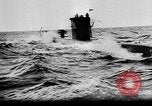
Period before U.S. formal entry into World War II. German submarines torpedo American ships and Japanese attack Pearl Harbor
Preface to U.S. in World War 2. German U-boat on surface. Crew climbing down into submarine and at duty stations while submerged. Torpedo trails bubbles underwater. Ship hit and explodes. Newspaper headlines report torpedoing of American ships: SS Robin Moor, SS Lehigh, SS Sessa, SS Steelfarer, and SS Montana, by German U-boats. Secretary of War, Henry L. Stimson calls on U.S. Navy to secure sea lanes. Wendell Wilkie agrees. U.S. Congress repeals Neutrality Act, November 17, 1941. Deck guns being placed on U.S. Merchantmen. Japanese warships docked and troops entering Indochina, as local people watch.Japanese troops by Dong Dang, near Chinese border. Situation described by animated illustrations.Japanese Special Envoy, Saburo Kurusu, is dispatched to Washington. Pan American Boeing 314 flying boat taking off. Japanese Naval Task Force of warships underway. Kurusu arriving in San Francisco, on November 14, 1941. He steps from the aircraft and makes statement to reporters. Japanese Ambassador, Kichisaburo Nomura, and Special Envoy Kurusu escorted into the White House by Secretary of State Cordell Hull, on November 17, 1941. Japanese troops in China bombarding Chinese city with artillery. November 26, 1941, View of Executive Office Building with statue of Victory atop U.S. Army First Division Monument. Secretary Hull announcing proposal to Japan.The Japanese representatives leaving the White House. Japanese aircraft carriers steaming toward Pearl Harbor. Japanese flight crews getting briefed on December 7,1941. Nakajima B5N (Kate) torpedo bombers taking off and in formation. Secretary Hull at his desk. The aloha tower and aerial view of Honolulu. Sailors at outdoor Sunday service, and relaxing at Pearl Harbor. Vehicle entering Hickam Field. Japanese airplanes bombing Pearl Harbor. Explosions on U.S. warships. USS Arizona (BB-39) suffers direct hit and explosion, as filmed from the deck of U.S. Navy Hospital Ship, USS Solace (AH-5). Shots of pilots and point of view from pilots inside Japanese bomber and attack aircraft, through a mix of dramatized segments from Japanese propaganda films about the Pearl Harbor attack, and real footage from the Pearl Harbor attack. View from Japanese planes bombing and strafing Ford Island. U.S. sailors firing antiaircraft and machine guns down Japanese planes. Secretary Hull describes memorandum from Japanese.
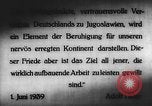
Tripartite (Axis) Pact signed between Germany, Italy and Japan; Nazi German invasion attacks in Yugoslavia, Russia, England
Nazi crimes against the nations of the world during World War II. View of the Peace Treaty between Germany and Yugoslavia which was signed on 1st June, 1939. The treaty breached on 6th April 1941, Germany launched a massive attack on Yugoslavia. German troops attack and advance. A map shows that most of the Europe was in the hands of Germany by 1941. View of September 27, 1940 signing ceremonies in Berlin of the Tripartite (Axis) Pact between Nazi Germany, Fascist Italy and Imperial Japan. Hitler and axis leaders shake hands and pose at pact signing table. Joachim von Ribbentrop signing the Axis Pact. Scene of German tank treads close-up rolling over battlefield and wider view of German armor and troops during Operatoin Barbarossa in June 1941, invading Russia, in violation of their non-aggression pact. German forces enter Russian territory. German Army forces setup and fire artillery at Russia. German rocket launchers fire rockets at Russian targets. Ground and aerial views of formations of German Luftwaffe aircraft on bombing runs. Between August-September 1941, Luftwaffe conducts blitzkrieg raids (blitz) on Great Britain. View of British landmarks like St Paul's Cathedral dome and Tower Bridge. Aerial views as Luftwaffe fighter aircraft roll and dive toward targets. British spotlights and search lights on the ground sweeping and catching German aircraft in their light beams. British anti aircraft batteries open fire on German planes over England. Alternating views of German plane point of view bombing England with bright flashes of light and explosions on the ground, and British anti-aircraft fire filling the air. Ground views in England, United Kingdom of buildings on fire from London blitz bombing, and British fire fighters moving to deploy fire hoses and extinguish fires. Flaming buildings collapse from bombs and fire. Whole blocks of buildings on fire. Scene change to December 7, 1941 bombing of Pearl Harbor by the Japanese. U.S. Navy ships bombed and on fire in Pearl Harbor.
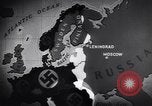
German Operation Barbarossa on the Eastern front in World War II
Animated map shows extent of German controlled areas in Europe following their conquest of the Balkans in World War 2. Norway is under their control and German forces threaten Leningrad and Moscow. A soviet defense line is shown on the map. The German attack is shown to come from 5 directions on June 22, 1941, with the launch of German Operation Barbarossa. A sky filled with German Heinkel He 111 bombers is shown. German Panzer III tanks with 75 mm guns. Army trucks carry German troops into battle. German soldiers on motor cycles and infantry advance under fire. Animated map shows principal German targets as Leningrad, Moscow, and Kiev. It then shows beginning a drive from the North to encircle Leningrad. Arrows show where German Marshal Fedor von Bock's forces drove 480 miles into Soviet territory. Slates identify cities being overrun by German invaders, including: Pskov, Novgorod, Brest-litovsk, Minsk,Mogilev, and Vitebsk. On July 17, 1941, a German tank is seen entering Smolensk, past the Dnieper River threatening Moscow, itself. To the south, German forces, under Marshal Gerd von Rundstedt, cut deep into the Ukraine. Newspapers world-wide consider the Soviet forces close to defeat. Slate shows communique from the German High Command stating: "The issue in the East is already settled. Smolensk is the last halt on the road to Moscow." German infantry marching. Scene shifts to heavy artillery being fired by Soviet forces in a snowy scene clearly later in the year. Animated map shows German forces very close to Moscow on October 15, 1941, forcing the Soviet Government and all foreign missions to move to Kuibyshev, 700 miles to the east. Adolf Hitler, in a speech on October 3, 1941, states that the enemy is broken and will never rise again. Animated map shows 500 thousand square miles of Soviet territory occupied by German forces. Views of fires burning in Russia. Damaged and abandoned Soviet industrial plants. A German guard atop a hill looks down on thousands of Soviet people in the occupied areas of Russia. Damaged and abandoned Soviet T-26 tanks. Glimpse of damaged Soviet aircraft and field artillery. Headline in New York World Telegram newspaper reads: "Berlin Admits Russ War May Last Winter." Another headline reads: "Red Army Holds Push On Moscow." Weary German soldiers traveling in horse-drawn wagons, pulling field artillery. Soviet and German war planners are seen at work. Slate quotes Adolf Hitler saying: "A single blow must destroy the enemy, without regard for losses... A gigantic all-destroying blow." German armor moving along a road. Animated map shows this technique in the German invasions of Poland, France, the Balkans, and Yugoslavia. In contrast, the Soviet planners are seen, as map illustrates how they intend to take advantage of the vast area of their land by holding lines of defense an falling back as necessary to keep engaging the invaders across interior of the Soviet Union. Soviet infantry are seen marching along a road. German troops riding atop their tanks. Soviet troops forcing German invaders into close combat in her cities. Soviet soldiers running in a city and firing heavy machine guns. Bomb damage and rubble inhibit German armor mobility in cities. Cities where this kind of Soviet resistance prevailed were: Rostov, Kharkov, Kiev, Kursk, Smolensk. German troops leaving a city with heavy black smoke rising in the background. More views of cities where Soviet troops are engaged German forces in House-to-house battles, including: Odessa, where the Old Opera Theater building is shown sandbagged and relatively undamaged. The Odessa NI tank, created from an STZ-3 agricultural tractor.
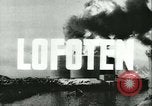
British Commandos raid Lofoten Islands, Spitsbergen Island, and Vaagso Island during World War II.
Pictures taken by military and news cameramen during World War II. Operation Claymore, March 1941: British Commandos raid Lofoten Islands in assault boats. They destroy a fish oil refinery off the coast of Norway. Soldiers and civilians on the docks. Burning refineries and buildings. Clouds of black smoke. 1941: British and Canadian troops on Spitsbergen Island. They destroy Soviet coal mines to prevent the Germans from occupying them. Black smoke clouds due to the explosions. Operation Archery on Vaagso Island, 1941: British Commandos raid the Island. Soldiers walk in the snow. Nazi prisoners surrender and marched by British soldiers. Battle ensues on the Island. Soldiers walk past a fence. Burning buildings in the background.
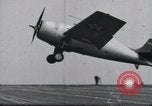
F4F aircraft crash on aircraft carrier, USS Wasp (CV-7) prior to U.S. entry into World War II
Crash of a Grumman F4F-3 aircraft from U.S. Navy Squadron VF-42, on the carrier, USS Wasp, early in 1941. In a slow motion sequence, a U.S. Navy F4F-3, with F-42-17 painted on its side (BuNo 2537) is seen rounded out too high for landing, above all arresting cables, and drifting into the carrier's island, where it impacts, losing its right wing, and flipping over to crash inverted on the flight deck. Sailors stand in the background. After the aircraft settles, a sailor runs across the deck to render aid. (Note: Navy Squadrons VF-42 and VF-71, assigned to the USS Wasp, received their F4F-3 Wildcats in January and February of 1941 under Bureau of Aeronautics contract C-68219, order number 48-020. These aircraft were painted overall aluminum with VF-42 having willow green tails and VF-71 having black tails. Later in 1941 the aircraft were repainted overall light gray.)
Attack on Pearl Harbor by Japanese, and President Roosevelt asks for war declaration on Japan in 'date of infamy' speech.
United States Government film entitled "The World At War" dealing with World War 2. Film opens showing Japanese warplanes in formation above a Japanese military installation. Slate reads: "Pearl Harbor December 7, 1941. An airfield is seen filled with parked U.S. Army Air Forces B-17 bombers. Two Boeing XB-17 (Model 299) bombers are parked next to each other on the ramp. Derricks and ships are shown at the Pearl Harbor naval base. A formation of Japanese Mitsubishi G3M bombers is seen in flight. They are seen overhead as bombs explode on the U.S. Navy Air Station at Ford Island destroying hangars and aircraft. Next, is shown the famous image of the USS Arizona burning, listing, and sinking, after being bombed. Film continues, panning over post-air raid views of destruction. On December 8, 1941, U.S. President Franklin D. Roosevelt, addresses the Congress, delivering his declaration of war message. He calls December 7, 1941 "a date which will live in infamy." Roosevelt recounts that the United States was at peace with japan and in conversation with its government and Emperor, in the interest of maintaining peace.in the Pacific. even at the time of the attack. Japanese ambassador and his colleagues seen visiting State Department offices to meet with U.S. Secretary of State prior and even during the initial attack operations by Japan.Roosevelt recounts that the United States was still in conversation with Japan even at the time of the attack. Japanese ambassador and his colleagues seen visiting State Department offices to meet with U.S. Secretary of State prior and even during the initial attack operations by Japan. Photographers take pictures of the visiting Japanese delegation. President Roosevelt asks Congress to affirm that a state of War exists between the United States and the Japanese Empire.