


 Francais
 Deutsch
 Italiano
Refine Your Search
Alexandria Egypt 1941 stock footage and images
- Showing 421 to 426 of 1883 results more
more Hide
Hide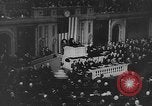
United States passes and implements the Lend Lease Act during World War II. War materiel flows to Allies.
President Franklin D. Roosevelt addressing Congress on January 6, 1941, asking for authority to supply war materiel to Britain and allies. Animated map showing streams of war materiel going to china and to European allies. Views of transport ships, Douglas A-20 Havoc aircraft with British roundel on them. A U.S. light tank M2; a large artillery barrel; and sacks of goods, being loaded on a ship. View of U.S. Capitol. Lend Lease Act passed. Animated map shows German forces overrunning Yugoslavia and Greece, and attacking Soviet Union. German troops in small boats crossing river to invade. German tanks and artillery operating on the Eastern front. Civilian men and women digging fortifications. Lend lease war materiel being unloaded in Britain, and at Red Sea port for British in Africa.Trucks carrying supplies over the Burma road to China. Lend lease supplies piled up in Murmansk, Russia, and Iran. "Hammer and Sickle 'em" chalked on a shipment.Stevedores rolling large tires.Hitler speaking. Head of Statue of Liberty. Animated illustrations about effects of Axis victory. U.S. Forces entering Greenland and Iceland, with consent of their governments.
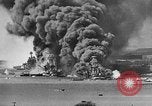
Japan attacks the United States of America at Pearl Harbor, Hawaii. President Roosevelt declares war against Empire of Japan (WW2)
Smoke billowing from U.S. warships bombed by Japanese warplanes in Pearl Harbor, Hawaii, on December 7, 1941. Japanese planes attack Pearl Harbor during World War II. Scenes at other U.S. military installations with aircraft burning in hangars and injured being carried on stretchers. Voice of President Franklin D. Roosevelt declaring war against Empire of Japan.
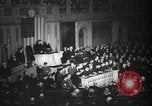
President Franklin D. Roosevelt addresses Congress at the U.S. Capitol in Washington DC, and declares war on Japan (WW2)
U.S. President Franklin D. Roosevelt at the U.S. Capitol in Washington DC. President Roosevelt at podium addressing Congress in World War II. He recounts events leading up to the Japanese attack and delivers his declaration of war against Japan. He describes the attack as "unprovoked and dastardly" and asks the Congress to affirm that since the attack on December 7, 1941, a State of War has existed between the United States and the Japanese Empire. He speaks about the war and states that the Americans will surely succeed in the war. The officials applaud at the President's statement.
Japanese forces entering Thailand during World War II
Japanese forces entering Thailand, December,1941, in World War 2. Views of trucks filled with Japanese troops making their way through the countryside and into the capital, Bangkok. Japanese flags are visible many places. Japanese troops take up positions throughout the city. A Japanese soldier distributes leaflets to a crowd of local people. Among landmarks seen in the capital, Bangkok, are the Democracy monument and the American Consulate. (Note: Thailand declared war on the United States,January 25, 1942. After brief incarceration, the U.S.Ambassador, Willys R. Peck, left Thailand on June 29, 1942.)
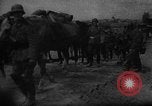
German Forces attack Bialystock, Belorussia, during Operation Barbarossa on the Eastern Front in World War II
German infantry and artillery move towards Bialystock, Eastern Poland (Belorussia) in June, 1941, during their suprise offensive (Operation Barbarossa) on the Eastern Front in World War 2. They enter a town through a decorative gateway. Destroyed Soviet T-26 tanks sit in the woods. German mechanic inspects a destroyed Soviet BA-20 Armored car. Others inspect a destroyed Soviet Bt 7 tank. A badly damaged Soviet KV-1 tank with tread and drives destroyed. german troops in work parties building a pontoon bridge. stacks of wood in a clearing. Troops shoulder a boat to be used as a pontoon. Some soldiers take advantage of a lull in fighting to relax and sleep. A few drink from their canteens. A German armored car crosses the now finished pontoon bridge across the Biala River. Assorted other vehicles follow. Next infantry march across the pontoon bridge. The foundations for a former bridge sit next to this one. Two columns of heavy smoke rise in the distance accompanied by sound of heavy artillery. Glimpse of German gunners at a 105mm howitzer. Smoke rising from a shelled building. Dense white smoke obscuring an entire area. Gunners fire a 105mm howitzer and strike a smoke stack, bringing it down. A wounded German soldier carried on a litter. More German artillery being fired and explosions and smoke from it seen in the distance. Several Soviet soldiers in uniform (and one civilian) surrendering with hands in the air.
Nazi Operation Barbarossa in World War 2. Goebbels makes radio broadcast announcing invasion of Soviet Union.
Invasion of U.S.S.R. on 22 June 1941 (German code name: Operation Barbarossa) during World War II. Early morning street activities in Berlin on the morning of invasion of USSR. Preparation for a broadcast at radio station. At 5:30 AM German Propaganda Minister Joseph Goebbels sits at desk and makes an announcement. People listening. Foreign Minister of Germany, Joachim Von Ribbentrop walks into conference. Newspaper headline.