


 Francais
 Deutsch
 Italiano
Refine Your Search
Alexandria Egypt 1941 stock footage and images
- Showing 445 to 450 of 1883 results more
more Hide
Hide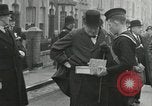
Prime Minister Churchill visits Bristol England and presides over academic ceremony at the University
Prime Minister Winston Churchill, accompanied by Lady Churchill and several officials, visits Bristol, April,12, 1941, the day after the so-called "Good Friday bombing raid." Churchill pauses to contribute to a charity being represented by a uniformed sailor. He takes a small token of his contribution from the sailor's box and pins it to his coat collar. He speaks with some women lining the sidewalk, and pats the head of a small child held up to him by one of the women. Next, Winston, and Lady Clementine Churchill, speak with a woman, standing near some rubble, as a British officer takes a snapshot. The Churchills, and other members of their party, make their way through some rubble, past several bombed buildings. Several citizens take photographs. Scene shifts the University of Bristol's Wills Memorial Building on Park Street. University officials and faculty in academic robes inside the building. At the center of the ceremonial activities, is Winston Churchill, Chancellor of the University, who presides over the awarding of Honorary degrees to American Ambassador, John Gilbert Winant, and Australian Prime Minister, Robert Gordon Menzies. Churchill is later seen leaving the Memorial Building, flanked by the honors recipients, Winant and Menzies. (World War II period).
German invasion of Soviet Union (Operation Barbarossa) in Belarus during World War II.
Operation Barbarossa, the German invasion of the Soviet Union during World War II. Panzergruppe Guderian operating in Belarus (Each vehicle displays a white "G" on its fender.) . Closeups of tracks on German Panzerkampfwagen II (Sd.Kfz. 121) tanks rolling across a wooden bridge.Views flip back and forth between the full views of tanks and of their tracks and wheels. A German soldier rides on the tank gun in one view. The tanks including, Panzerkampfwagen (Sd/Lfz/141/1 Pz.Kpfw III Ausf.L), speeding along a dirt road, accompanied by half-tracks armed with antiaircraft guns (SdKfz Flakwagen). One also tows a field piece..One of the half-tracks is protected by logs and sandbags. The German column passes a knocked out smoking Soviet BT tank at the side of the road. Soldiers on motorcycles and a covered German 15cm Kanone are also seen. More views of the advancing armor column. View from a German invasion vehicle crossing an alternate bridge over a river, on their way to Grodno. (A destroyed bridge is in background.) Next, the city of Grodno (or Hrodna) is seen in a broad view from a bridge on the near bank of the Nieman (or Nyomen or Newman) River on June 23, 1941. Smoke rises from the city, across the river. German armor and vehicles move across the bridge German infantry enters the city past burning buildings.
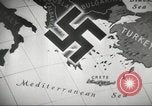
Germany launches Operation Barbarossa against the Soviet Union, which has been mobilizing for war, during World War II
Film begins with animated map depicting conquest of the Balkans by the German-Italian Axis powers. With Southern flank now protected, Germany begins Operation Barbarossa, the invasion of the Soviet Union on June 22, 1941, View of German troops goosestepping on parade in large formation. German troops being transported on parade in formation of wheeled open personnel carriers. Glimpse of upper part of Spasskaya Tower and clock overlooking Red Square in Moscow, Soviet Union. View of Soviet heavy industry complex with many smoke stacks. New farm tractors being moved on a railroad train. Scene segues into train carrying Soviet tanks, and then continues with scenes in a steel mill, a machine shop, a tank factory, and an artillery plant. Soviet troops parade bearing left shouldered rifles and singing as they march. Soviet civilian men are seen reporting for duty in the military and then training in hills overlooking a war plant complex. New Soviet recruits training with calisthenics and with small arms. A Soviet soldier speeds past the camera on a motorcycle and segues into a soldier on a horse jumping over a barrier, and then into several Soviet soldiers in uniforms, with rifles, diving into a swimming pool and swimming across it. Film ends showing Soviet troops in formation bringing their rifles from present arms position to pointing forward, as they march.
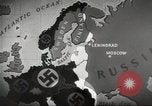
German forces invade the Soviet Union in Operation Barbarossa during World War II
Animated map shows German potential thrusts into the Soviet Union (Operation Barbarossa) coming from six different directions an targeting key cities like Leningrad and Moscow. June 22, 1941 is highlighted on the map. Large formation of German twin engine bombers with extended landing gears is seen in flight. Formation of German Panzer III tanks moving across a field. Formation of German Kfz.70 Personnel Carriers filled with troops. Formation of German soldiers on motorcycles (some with side cars) moving across a field. German troops leaving their transports and running into woods, as they encounter shelling. Animated map reiterates German emphasis on Leningrad, Moscow and Kiev (in Ukraine). It shows German forces converging on Leningrad, and then towards Smolensk. (World War II; WW II; World War 2; World War Two)
Soviet Premier Kalinin and members of Allied military mission in Moscow, Russia, bid farewell to Harry Hopkins
Members of Allied military mission in Moscow, Soviet Union bid farewell to Harry Hopkins, after his visit with them in the week of July 28, 1941, during World War II. A car carrying Harry Hopkins, personal assistant to President Franklin Roosevelt, arrives at a Moscow airport. Hopkins steps from the car and is greeted by a British Naval officer. Next, Soviet Head of State, Mikhail Kalinin, arrives by car and strides forward toward Hopkins and other officials gathered near a C-47 transport airplane. Two Soviet military officers converse with a civilian. American Brigadier General Joseph McNarny (member of Hopkins' party) speaking with Averell Harriman ( Roosevelt's special envoy to Britain for expediting Lend-lease). In a gathering of military officers and civilians, a British officer exchanges salutes with another officer. kalinin and Hopkins conversing amicably. A man lights Harriman's cigarette. Hopkins begins passing out some documents and shaking hands with persons seeing him off. He and Kalinin shake hands vigorously. He climbs aboard the airplane, followed by General McNarny.
Japanese people in various occupations and financial institutions and schools in Honolulu, Hawaii.
Japanese people and Japanese Americans in Honolulu, Hawaii before the attack on Pearl Harbor during World War II. Japanese workers. Narrator discusses origins of Japanese workers and various trades and businesses in which they work. A street with houses on either sides and clothes hanging. Japanese people walking on the street. People walk in front of shops. Automobile traffic in the background. Japanese men pour from a container. People in a flower shop. Children outside their houses. Clothes drying on ropes. Japanese children outside a school. The 1941 telephone book in Japanese. A daily newspaper printed on machines. Stacked newspapers. Japanese workers work in a sugarcane field. They load cargo on a cart. Boards of the various Japanese financial institutions. People enter a bank. Women fishing and boats in a river. Japanese people work as shopkeepers. A Japanese doctor. Workers carry cargo on a trolley. A man sits in a dentist clinic. The dentist opens a door. Japanese nurses come out of a building. People on a street. Exterior of a Japanese hotel. Boards read Japanese people in various occupation.