


 Francais
 Deutsch
 Italiano
Refine Your Search
Alexandria Egypt 1941 stock footage and images
- Showing 511 to 516 of 1883 results more
more Hide
Hide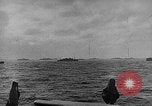
Montage of scenes showing the continuous close coordination between the United States and Britain during World War II
Film shows an invasion task force at sea overwritten by a slate reading, "Casablanca." Narrator speaks of January, 1943, in World War 2. View of the city of Casablanca in Morocco. U.S. President Franklin D. Roosevelt seated next to British Prime Minister, Winston Churchill as they meet in Casablanca, at the Anfa Hotel, January 14–24, 1943, during World War 2. Roosevelt wears a black armband on his left sleeve in mourning over the death of his mother, in 1941. Backs of Military officers seen from behind, with Churchill and Roosevelt on chairs in the background. Then a closeup of Roosevelt and Churchill seated with high ranking Allied military officers behind them, including U.S. Admiral Ernest King and U.S. General George Marshall. View from directly overhead of marching American soldiers. Huge number of British soldiers led by a Rolls Royce armored car, are seen walking across the desert, celebrating their victory over German forces at Tunisia. Prime Minister Churchill and President Roosevelt seated on the lawn in front of the White House during the third Washington Conference (code-named Trident) held in Washington DC, from May 12 to May 25, 1943. Closeups of both men. Scene shifts to a U.S. invasion task force in the Pacific. Glimpse of a Benson-Livermore class destroyer near hills in the Pacific. A navy Douglas Dauntless dive bomber flies over ships in an invasion task force. U.S. troops are seen in a Higgins Boat landing craft from the transport ship USS President Jackson (APA-18). Troops storming ashore from landing craft. U.S. troops firing artillery field pieces, and raising the U.S. flag on a captured island in the Pacific. Scene shifts to European theater, where an Allied warship is firing its guns during Allied invasion of Sicily, code named Operation Husky, 9 July – 17 August 1943. Amphibious assault taking place. A jeep is seen pulling an artillery piece through shallow surf. An army truck drives through shallow surf, out of a landing craft. Breech view of artillery gun being fired and shell ejecting. A shell exploding near the camera. Camouflaged antiaircraft guns firing. Series of brief scenes showing Soviet Russian infantry and tanks advancing against German forces in Russia. Next scene shows Benito Mussolini in military dress uniform, giving a speech, and then posing next to a Bronze statue of Roman emperor, Julius Caesar, in Rome, Italy, as troops march past him. A bust of Mussolini being pulled down. Rioting Italians. Axis defenders in Sicily, carrying a white flag as they surrender to Allied powers. Views of Lieutenant General Mark Clark and a Major General pleased at the surrender. American troops being cheered by Sicilians as they ride in jeeps. Italian men receiving food after the surrender, as a British soldier stands nearby. U.S. Army Air Force B-24 Liberator bombers in flight over the Northwest Pacific. Aerial view of Kiska in the Aleutians. B-17 flying Fortress bomber in flight with bomb bays open. Bombardier at his station in the aircraft he presses button to release bombs. Formation of B-24 bombers dropping bombs. View from aircraft of them exploding on the ground. Aerial view of surfaced German submarine being strafed by Allied aircraft. After several attacks it is sunk. B-24 bombers raining bombs over Germany. Huge explosions on the ground raising plumes of white smoke. Bombed out remains of Coventry Cathedral in England. Religious services being held in the ruins. View of the Pentagon building just outside Washington DC, and the British Prime Minister's residence at 10 Downing Street, London, England. View of Quebec Canada. A Canadian sentry on a hill. The Wolfe–Montcalm Monument in Governors' Garden beside the Château Frontenac, Quebec, Canada. Views of the Chateau Frontenac. Canadian troops patrolling around the Hotel. Royal Northwest Mounted Police on the grounds. Canadian soldiers with antiaircraft guns, scanning sky for possible threats. Armed couriers loading bags of official dispatches into a car. The dispatches being delivered to waiting aircraft. Censors examining postal mail. Conference attendees showing their passes to Canadian Mounted police officers at the hotel entrance. Closeup of an actual pass issued to a U.S. Army Major.
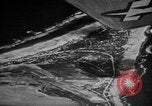
Flag raising ceremonies after surrender of Japanese garrison on Wake Island, Pacific Ocean.
Surrender of Japanese Imperial forces leads to end of World War II. Wake Island on map. Formal Surrender of Japanese garrison on island. Marine officers at Wake Island. Flag raising ceremonies and wreckage of planes on islands. Officers present include USMC General Sanderson, Commander Cross, Commander Masek, Lieutenant Colonel Roberson, and Commander Walter Bayler (who had been the last American to leave Wake Island before its takeover by Japanese forces in December 1941).
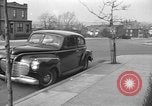
Former American soldier and his English wife greeted by his mother upon arrival of his wife and child, from England
A 1941 Chrysler Plymouth car arrives at curb and former U.S. soldier opens door for his British wife and their child. They go up steps to his home, where his mother warmly greets her new daughter-in-law and baby. View inside home where the couple and baby sit with mother-in-law and family dog. The couple play with their baby boy, and they kiss.
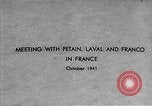
Adolf Hitler meets French leader Philippe Petain and Spanish General Francisco Franco in France
Adolf Hitler in a meeting with Philippe Petain in Montoire, and then with Francisco Franco in Hendaye France. Soldiers stand in lines. Philippe Petain gets out of a car in Montoire-sur-le-Loir. Pierre Laval beside him. Petain exchanging salutes with German officers. Cameramen take photographs. Petain shakes hands with Adolf Hitler. Scene changes to Adolf Hitler and Hermann Goering relaxing and laughing as they ride in Hitler's train car. A sign reads Hendaye, the train's next stop. A bridge in view. A train arrives. 'Espana' written on train. A crowd gathered at the station. Adolf Hitler stands at the station and greets Francisco Franco. Both men walk on the station. Nazi flags hung. They board Hitler's train and pull dark curtain down over window of the meeting room on the train. (Opening slate states 1941, but that is incorrect. This event was October 24, 1940). (World War II period).
Mine warfare conducted by the German Navy's Northern Fleet during World War II.
Group of German Navy sailors in the communications center of the German headquarters of the Kriegsmarine Northern fleet, work at numerous teletype stations. Next, the Admiral (Generaladmiral) in command, Rolf Carls, is seen pouring over nautical charts and maps and discussing them with officers of his staff. Scene shifts to naval armory where marine mines are being prepared for deployment. They move through the processing lines and then transported by railroad train cars. At a port, a crane lifts a mine, on a wheeled dolly onto the minelayer ship, "Tannenberg," where crew members roll it along the deck. Sailors write on it with white chalk. The Tannenberg seen underway, and then with sailors rolling mines (on their dollys) off the stern of the ship in the Baltic Sea. Sailors moving mines along the deck to the stern for launching. View from another ship of the mines dropping from astern the Tannenberg. Next, officers on deck in cold weather gear, look through binoculars as they sight threat from Soviet aircraft. Interior of the ship as sailors manipulate controls for an anti-aircraft gun. The ship's gun and a machine gun being fired. Soviet bombers seen very high overhead. Camera pans about the deck showing sailors firing at aircraft. Something raises a plume of water astern (a near-miss?). Next, several German patrol boats are seen moving at high speed. Sailor on a speeding patrol boat, stands precariously atop it as he signals with semaphore flags. From a patrol boat, bombs (or mines) are seen exploding behind in its wake. (Note: The Tannenberg was a passenger and ferry built in 1935. On 2 September 1939 the German Navy had her converted to a minelayer. In August 1940 she served as flagship of the minelaying ships, in the North Fleet. She was sunk on 9 July, 1941, off Sweden.)
Funeral, in World War II, for German Major General Adelbert Schulz, Commander of the 7th Panzer Division.
Funeral in Germany for German Generalmajor (Major General) Adelbert Schulz killed in action on January 28, 1944 during World War 2, after taking Command of the 7th Panzer Division, only a month earlier. A brass band can be heard playing the mournful strains of the song, "Ich hat ein Kameraden. Front and rear views of soldiers dressed in black, accompanying a German Panzer III tank, bearing the flag-covered coffin of the diseased. Glimpse of German Field Marshal Erich Von Manstein, saluting with his baton, as pall bearers approach carrying the flag-covered coffin. Brief view of the military brass band playing the funeral music. The coffin resting beside the open grave. Contingent of 7th Panzer Division troops assembled behind the grave. View from rear of Marshal von Manstein and two other officers with bared heads in respect. Soldiers standing in front of the tank. Closeup of some soldiers. Field Marshal Von Manstein salutes with his baton and then with help of a soldier, places a large wreath by the open grave. Banner on wreath includes words "Pz. Rgt. Rothenburg", short for Panzerregiment Rothenburg or Panzer Regiment Rothenburg. (That was the nickname of the 25th Panzer Regiment, part of the 7th Panzer Division, in honor of General Karl Rothenburg, who commanded it until he was killed in 1941.) A large honor guard fires three volleys from their rifles. Film ends with Closeup of General Shultz's military decorations