


 Francais
 Deutsch
 Italiano

Refine Your Search
Australia 1942 stock footage and images
- Showing 1795 to 1800 of 2480 results more
 Hide

Merchant Marines work on ship and dramatization of Clipper ships sailing during the California Gold Rush of 1849 in the U.S.
The legislative and maritime history of the U.S. Merchant Marine. Group of men gathered at a stream bed digging and panning for gold. Dramatization of a sailing ship leaving dock as gathered crowd of men, women, and children wave goodbye from dock during mid 1800's Gold Rush. Merchant Marine sailing ships underway at sea. Men working on a clipper ship. Views of tall sailing clipper ships at full sail and in storms with dramatization of crews battling to stay afloat during storm. Clipper ships round Cape Horn during the California Gold Rush of 1849 (dramatized). Fulton's steamship, the North River Steamboat, or Clermont, sails up the Hudson River. Smoke from the stacks of the steam ship. View of a steamship overtaking a sailing vessel at sea, as narrator describes the demise of the tall sailing ships after the arrival of the steamship. (World War II period).
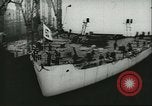
Activities of U.S Merchant Marines and American ships underway in the United States in the 1920's and 1930's.
The legislative and maritime history of the U.S. Merchant Marines in the period between World War 1 and World War 2. Newly launched German, Italian and Japanese ships underway at sea. Ships including the German liner Bremen and the Italian Ocean liner Rex are seen underway. People gather at a dock. American ship underway in heavy seas with waves crashing over. Point of view shot at heavy seas from deck of a ship. A man works in a ship radio room. A man watches through binoculars and uses a sextant. Sailors row a small boat with oars in heavy seas. A sailor decorated by officials of the Merchant Marines. Dock workers and ship construction workers at a shipbuilding yard in the United States working on building new ships. American liners are seen undereway including: SS Washington off shore of New York City skyline and skyscrapers, SS Manhattan also off shore of Manhattan, the SS Lurline, the SS Mariposa, and the SS President Hoover (named for Herbert Hoover) underway at sea. The U.S. flag fluttering from a flag pole. The text of the declaration of policy under the Merchant Marine Act of 1936 is shown.

Training of seamen at the U.S. Merchant Marine Academy and Maritime Service Training Schools in the United States.
The legislative and maritime history of the U.S. Merchant Marine. The Maritime commission is created. A ship underway at sea. Men gather at a dock. A man watches through binoculars. The U.S. Merchant Marine Academy is opened at Kings Point in New York. Seamen are trained in the academy. They are also trained at the Maritime Service Training Schools. The seamen are given navigation and gunnery training. They are also trained in techniques of cargo handling. Men standing in uniform on the dock. They load supplies onto a ship and clean machinery. Men working on a control board. Men in a class room. An officer instructs them. They also learn to prepare food in a kitchen. They learn the work of a radio operator.

A German submarine torpedoes a U.S. ship underway in the Atlantic Ocean.
A German submarine underway in the Atlantic Ocean during World War II. German sailors and officer aboard the submarine. They watch a U.S. ship through a periscope. A sailor watches the target through binoculars. The submarine emerges out of water and torpedoes the ship. The ship burns. German sailors watch the burning ship and cheer.

People gather to meet King Christian X of Denmark in Copenhagen, Denmark
Danish civilians meet King Christian X of Denmark in the streets of Copenhagen. People walking in the street. King Christian X arrives on horseback. People gather near the king. Buildings along the side of the street. The Royal Danish flag flying on a flagpole. Children stand and salute the flag. King Christian X and the Danish Royal family including Crown Prince Frederik and his daughter Princess Margrethe, stands in a balcony of the Amalienborg Palace and waves towards a crowd.
The demonstration of the principles of the steam power in the United States.
A film titled: 'The Magic of Steam' depicts the working of the steam turbines in the United States. A woman seated in her room turns the light on. Men work inside a factory. Electric poles in an area. Wires connected from one electric pole to the other. A pie chart depicts the power used for the production of electricity. 65 percent of steam and 30 percent of water being used for the purpose. Men work inside a factory. They work on steam turbine. A man demonstrates the working of a steam turbine using the steam. A man places a tea kettle to heat. Steam arising out of the kettle as the water boils. A paddle wheel is placed near the kettle from which the steam comes out. The wheels start revolving due to the steam. A lid is placed on the kettle. The high pressure of steam lets the wheels to revolve faster and pushes the kettle in the opposite direction. The lid is then removed from the kettle. Another example to demonstrate the concept of steam is that of the fire hoses. Firemen try to control the fire in a building with the help of fire hoses. Men work near a steam turbine in a factory. (World War II period).