


 Francais
 Deutsch
 Italiano
Refine Your Search
Australia 1942 stock footage and images
- Showing 187 to 192 of 2479 results more
more Hide
Hide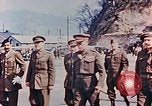
Allied military officers review honor guard at a presentation ceremony of Commonwealth troops, in Japan after World War II.
Allied forces in Japan after the conclusion of World War II. Formal presentation of Massed Colours of Commonwealth countries of Great Britain, Australia, New Zealand and India. Military officers of the review party walk toward reviewing stands. Reviewing party consists of Brigadier General Clifton, General Northcutt of Australian Force, Port Commander Grinson and General DT Cowan. Major E. Maitland commands the troops. British Commonwealth troops lined up for the Guard of Honour. Sailors, soldiers and airmen of the Royal Navy, Cameron Highlanders of New Zealand, Australian Army, Gurkhas and the Royal Air Force Regiment inspected by the reviewing party. Kumaon Indian Band in red coats. A high steel tower supports flags of the British Commonwealth.
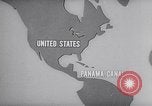
Mutual aids to one another by Allied nations under the lend lease program, fighting against Axis powers during World War II.
Charles Winninger narrates facts about the lend-lease and mutuals aids by Allied nations fighting against the Axis powers during World War II. Animated map shows Japanese threaten eastern coast of United States. British aid under the lend lease flies to U.S. German attack on Suez canal countered by British and U.S. Armies. Map shows timely aids allowed munition factories at work and new recruits joining the military. Australia and New Zealand aid the fighting Allied nations. U.S. warships to Russia in return to graves of German. Aid to China in return to the death of Japanese. Animation shows dropping of atom bomb and unconditional surrender of Axis nations.
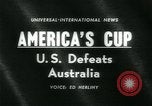
United States team defeats Australian team in a sail boat race and wins the America's Cup Series, United States.
United States team defeats Australian team in a sail boat race and wins America's Cup Series, United States. Sail boats 'Weatherly' from U.S. and 'Gretel' from Australia compete hard in a windy weather in sea. Photographers and spectators in other boats watch the race. Ships, tugs and boats in the bay. Crew of 'Weatherly' on a boat after victory. Sailors enjoy their victory cheered by their families and spectators. Victorious team of sailors party after the victory.
England and France declare war on Germany; German troops conquer Denmark and Norway during World War II
World War 2. Britain (United Kingdom) and France declare war on Germany. German infantry carrying Panzerschreck antitank weapons. British troops mobilizing for war. Sign reads "A Call to Arms." Groups of new recruit British soldiers marching in large columns, including soldiers from Great Britain, Canada, Australia, New Zealand, South Africa. British Queen Elizabeth class battleship with other warships. Animated map showing units of British fleet blockading Germany at Suez, Malta, Gibralter, the English Channel,and the North Sea. Adolf Hitler and German General staff make war plans. Animated map shows European countries around Germany. Ice skaters near Windmills in Holland. Farmers harvest grain. Bicyclists in Netherlands. Radio towers broadcast Nazi propaganda. Joseph Goebbels. Hitler denying intent to harm other countries. German military planners identify Norway as a target. Map shows German U-boats using Norwegian fjords. Map shows British fleet at Scapa Flow, and blockading ships in range from Norway. April 9, 1940, German army enters Copenhagen as Danes watch. German freighters in Norwegian ports smuggle troops and war materiel. German warships proceeding up Norwegian fjords, carrying troops and equipment. German Ju-87 and Ju-88 bombers and Me 109 aircraft in flight. Ju-88 over treetops. Junkers Ju-52 trimotor aircraft carrying German soldiers. Quislings seize power in Norway. View of Vidkun Quisling. Nazi posting up rules for citizen residents of Oslo Norway.
United States President Lyndon B Johnson at Manila Summit Conference with other six nation's leaders.
Kittikachorn of Thailand, Chairman Nguyen Van Thieu and PM Nguyen Cao Ky of Republic of Vietnam and Lydon B. Johnson at the Manila Summit Conference. “We are going to Manila. To try to find the formula for peace, to try to review our military operations, to try to exchange views with the leaders of seven countries. We do not expect any magic wonders, we do not expect any miracles. But we do think that each nation who has man committed to die, their leaders opt to get around the table and get the best thinking of the best man those nations can send” said President Johnson. Cameramen taking pictures as the leaders of seven nations walk and followed by others. Participants of summit conference seated in a private meeting in palace. Philippine President Ferdinand Marcos delivers welcome speech to SEATO members. “On behalf of my people, therefore, I extend warm and affectionate welcome to each and everyone of the heads of government and heads of state who are here. I greet President Park Chung Hee of the Republic of Korea. I greet Prime Minister Thanom Kittikachorn of Thailand. I greet Chairman Nguyen Van Thieu of the Republic of Vietnam. I greet Prime Minister Nguyen Cao Ky of the Republic of Vietnam. I greet Prime Minister Harold Holt of Australia. I greet Prime Minister Keith Holyoake of New Zealand. And I greet President Lyndon B. Johnson of the United States of America.” Ferdinand Marcos said. “For there is a fresh new wind that sweeps over the face of Asia; its peoples are more perceptive, its leaders are more dedicated, passionately, to the interest of their people; and Asia can no longer accept western formulas without questioning or participation. Asia hopes that it shall be given participation in the determination of its own destiny.” says Ferdinand Marcos during his introductory speech. SEATO delegates and other dignitaries walking. Man prints briefings of the conference at the International Press Center of the conference. Women distribute press briefings to foreign newsmen. 2000 international newsmen covering the conference in Manila. First ladies of the states, such as Imelda Marcos, Lady Bird Johnson, and Yuk Young-soo, touring. Filipino women embroider traditional Piña textile. Mrs. Lady Bird Johnson speaks with Filipino women embroiders. View at the conference. Large number of photographers taking pictures. Leaders signing documents. Philippine President speaking and crowd watching the broadcast on television. Views of men typing. Men on their phones. A Filipino emcee reads from a paper. President Ferdinand Marcos concludes the Manila Summit Conference. A traditional Christmas Filipino “Parol” lantern and Christmas decorations (common in the Philippines as early as September), at the Congress Building in Manila (Padre Burgos Ave, Ermita 2004 Manila National Capital Region). Brass band plays the traditional Filipino song “Bahay Kubo” in the background. Filipinos carry Parol lanterns in a parade. President Lyndon B Johnson and other SEATO dignitaries watch the festivities. A woman and a man, dressed in formal Filipino “Reyna Elena” attire, during the festivities. A Filipino man dressed as a bishop (likely Saint Nicholas of Myra). People pull a Karosa or carriage of the Virgin Mary as the Immaculate Conception, who is considered as the Marian Patroness of the Philippines.
Mrs. Franklin Roosevelt visits bases in South Pacific during World War 2
First lady of United States, Eleanor Roosevelt, visits U.S. Base Hospitals in South Pacific areas including Australia and New Zealand during World War 2. Base hospital's wards are seen including some in thatched huts. Mrs. Roosevelt wearing Red Cross uniform. A soldier seen in a wheel chair. Mrs. Roosevelt waves goodbye to United States soldiers.