


 Francais
 Deutsch
 Italiano
Refine Your Search
Australia 1942 stock footage and images
- Showing 355 to 360 of 2479 results more
more Hide
Hide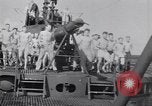
U.S. Marine Raiders standing near a deck gun and doing physical fitness drills aboard USS Nautilus underway in the Pacific Ocean en route to Makin Island.
USS Nautilus (SS-168) underway in the Pacific Ocean during World War II. U.S. Marine Raiders of the 2nd Marine Raider Battalion “Carlson’s Raiders” aboard the submarine. They stand near a deck gun. The marines do calisthenics physical fitness drills aboard the submarine. Marines stretching and raising their arms during exercise. The sub is en route to Makin island for the famous Makin Raid of August 17th and 18th, 1942.
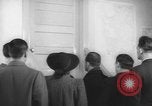
Lieutenant Colonel Stanley J. Grogan hands out communiques to a press group in Washington DC (WW2)
A press group in Washington DC during World War II. The group standing outside an office. U.S. Army Lieutenant Colonel Stanley J. Grogan comes outside. He hands out communiques to them. A reporter telephoning the message to an office. An insert of the communique reads 'War Department, January 8, 1942'.
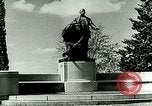
Contributions of African Americans in various fields in the United States.
(See also clip 65675078146 from different film transfer). Famous African American men and women citizens in the United States. Clip opens with of Booker T. Washington at Tuskegee University. Scene in a laboratory with African American scientist and inventor George Washington Carver, as an elderly man, working with another scientist in the laboratory. African American judge of New York city court. African American explorer Matthew Henson is seen looking at a globe (he was with Admiral Peary planting the American flag at the North Pole in 1909), and an unnamed African American surgeon at work in an operating room in New York. Next scene shows famous "father of the blues" musician and composer W.C. Handy (William Christoper Handy) smiling. Next is seen the financier and publisher of the Amsterdam News, Dr. C.B. Powell (Clilan Powell) greeting three uniformed African American women during a World War 2 war bond drive, and handing them a check (close up is shown) for 25,000 dollars, dated January 4, 1942, for the war bond drive. It is from the account of the Victory Mutual Life Insurance Company which Dr. Powell also owned. The check is signed by C.B Powell and Philip M.H. Savory (Dr. Savory was co-owner of the New York Amsterdam News). The next scene shows Elise Johnson McDougald, better known as Gertrude Elise Ayer, who was the first black full-time public school principal after the consolidation of New York City schools in 1898. She was also a noted woman writer during the Harlem Renaissance. She is seated in her office at her desk, likely in P.S. 119 in Harlem, since this is approximately year 1945 and she was at P.S 119 at that time. Her name plaque is visible on the front center of the desk. Principal Ayer smiles as a woman delivers a document to her. Next is seen the African American historian, author, and professor, Lawrence D. Reddick, serving in his role as the curator of the Schomburg Collection of African American Literature. In an art studio is seen the famous African American sculptor and painter Charles Alston, at work on a sculpture. Next scene shows the famous African American contralto singer, Marian Anderson, receiving a bouquet of flowers and smiling after a performance. This transitions to a view of African American orchestra conductor Dean Dixon leading an orchestra in a performance of Beethoven's 9th Symphony. Several views of different sections of the orchestra performing under Dixon's direction. Clip closes with brief shots of campuses of several historically black colleges and universities in the United States like Howard University, Hampton, Tuskegee, Fisk, Prairie View. An American college football game underway at the stadium of one of the colleges.
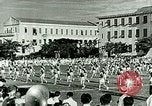
U.S. assistance to the Philippines and the Japanese occupation of the Philippines (WW2)
A film about events leading up to the independence of the Philippines, and about U.S. presence and assistance to the Philippines before the Japanese occupation. Philippine students perform calisthenics. Children being taught in a primary school. Teachers assist and instruct students. University of the Philippines (UP) students conduct experiments in a laboratory. Protecting U.S. Naval ships at a port, including the U.S. Destroyer USS Barker (DD-213). Line of U.S. Martin B-10 light bomber aircraft of the 4th Composite Group parked on an airfield, and then head-on image as a Martin B-10 bomber takes off toward and then up over the camera. The flag of the United States. Filipino soldiers march. U.S. Army General Douglas Macarthur at a desk in the Philippines accompanied by Dwight Eisenhower. A sign reads 'Camp Dau' in Dau, Mabalacat, Pampanga. Newspaper headlines about the American surrender in Corregidor in May 1942 during World War II. Japanese soldiers take down the United States flag after their victory in Corregidor. Surrendering commander Wainwright and other American officers look on. Japanese occupying forces parade in the Philippines.
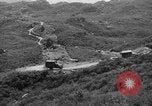
Army trucks travel on Burma Road; Japanese bombers drop bombs; US General Joseph Stilwell discusses with Chinese; Flying Tigers take off.
Trucks driving on Burma Road to China. A caravan of camels travels to China through rough, snowy mountain terrain. British and American army trucks driving up mountainous terrain of the Burma Road during World War 2. Animated map showing two important military supply routes used by the Allied forces- the Burma route and the Iran land bridge (also known as the Persian Corridor). An animated depiction of an Imperial Japanese soldier superimposed over map of Asia, dominating the region. United States General Douglas MacArthur and Admiral Chester W. Nimitz discuss strategy together. Japanese soldiers march with Japanese flag during 1942 invasion of China. An Imperial Japanese Army Mitsubishi G3M1 Model 11 Land-based Attack Aircraft bomber in flight. POV through bomb bay door as Mitsubishi G3M1 drops bombs. Explosion from bomb as seen from ground. British Field Marshal General Harold Alexander holds a map. United States General Joseph Stilwell, while smoking a cigarette, discuss with Chinese colleagues. Animated map depicting Burma Road takeover by the Japanese. A United States airman, belonging to the First American Volunteer Group (also known as the Flying Tigers), hops on a Curtiss P-40 fighter. A group of “Flying Tigers” Curtiss P-40 fighters take off from airfield.
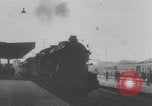
Mulay Hassan el Mehdi, visits Madrid and awards medal to General Francisco Franco (WW2)
Steam locomotive carrying The Caliph of Tetuán, Mulay Hassan el Mehdi, arrives at Atocha Station, Madrid on May 25, 1942 for a state visit during World War II. Mulay Hassan was the second and last caliph of Tetuan and of the Spanish Protectorate of Morocco, reigning from 1925 to the end of the protectorate in 1956. Mulay Hassan el Mehdi shakes hands with Spanish Foreign Minister Ramón Serrano Súñer outside railroad car. Mulay Hassan el Mehdi walks along station platform with another Morocco official (possibly his father, Mohammed el Mehdi) as well as General Luis Orgaz Yoldi, Foreign Minister Serrano Suñer, and General Andrés Saliquet. They are saluted by Spanish honor guard. Mulay Hassan el Mehdi salutes the Spanish flag at station platform and is greeted with fascist salutes he gets into a limousine. Moorish cavalry escort through the streets of Madrid. Crowd applauds along parade route. Mulay Hassan el Mehdi salutes Moorish troops standing outside residence and greets Spanish politicians. The entourage of Mulay Hassan el Mehdi arrives at the Royal Palace of Madrid (Callede Bailén, s/n28013 Madrid Spain). At the Royal Palace of Madrid, Mulay Hassan el Mehdi awards a medal to General Francisco Franco of Spain.