


 Francais
 Deutsch
 Italiano
Refine Your Search
Australia 1942 stock footage and images
- Showing 421 to 426 of 2479 results more
more Hide
Hide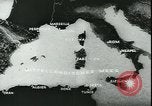
Views of Southern France, under German occupation in World War 2
Film opens with map showing lower France and Mediterranean areas. However, it shows images covering primarily the French Riviera (or Côte d'Azur) under German occupation during World War II, in 1943 or 1944. German infantry march along a road. A flight of German FW-190 Fighter airplanes flies inland from the Mediterranean Sea and crosses low above a harbor. Change of scene shows a single fighter plane buzzing the Marseille Port. (It looks like a P-47 with invasion stripes. But It does not draw any anti-aircraft fire.) Camera tracks it from vantage point at the Marseille Basilica, high above the harbor. Brief view of the Basilica as the aircraft passes. A glimpse of the Marseille Port below from the Basilica. View of the Marseille Transporter Bridge designed by Ferdinand Arnodin and built in 1905. (It was destroyed after these films were made, in 1944.) A German soldier peering through binoculars in front of a 2 cm Flak 30/38/Flakvierling, quad anti-aircraft gun position. Another one is seen in the background. Several more views of German anti-aircraft and other gun emplacements protecting the Marseille Port, including 88mm guns, heavy machine guns, and Atlantic Wall coastal defense guns. Scene shifts to German soldiers marching near the French Riviera beach and palm trees. Italian cavalry are seen riding in formation, ostensibly from Nice. Italian soldiers in trucks are being transported along the Riviera waterfront. A road sign points toward Toulon at 6.3 kilometers away. (So this location is probably near Sanary-sur-Mer.) View of the Toulon harbor, where the French battleship Provence, scuttled in 1942, is seen settled low in the water at a pier.
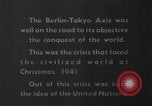
U.S. President Franklin Roosevelt and delegates from 26 nations sign a mutual aid pact in Washington DC during World war II.
A film about the activities in Washington DC during World War II. On 2nd January 1942 the President of the United States Franklin Delano Roosevelt with delegates from 26 nations sign a mutual aid pact in the White House. View of the contents of the pact and the signed pact.
The U.S. Army Quartermaster Corps store procured supplies and enlisted men are trained in quartermaster operations (WW2)
The United States Army Quartermaster Corps in the United States during World War II. A diagrammatic comparison of army manpower of 8,000,000 in December 1943 as against 1,750,000 in December 1941. A diagrammatic representation of huge increase in volume of obligated procurement in 1942 as against 1941. Men wheeling carts of supplies at a store. Men carrying supplies coming down a gangway from a ship onto a dock. Soldiers with guns standing on the dock. Soldiers moving through a wooded area. Men carrying the procured materials for storing. Officers watching the men. Two soldiers wearing their uniforms. People and vehicles moving on a city street. A signboard on a building reads 'Office of the Quartermaster General War Department'. The headquarters building in view. A map of the U.S. showing locations of different procuring offices across the nation. Men and women working in an office at the headquarters. Petroleum, Subsistence and Textile sections at the headquarters. Officers working in the headquarters. Men getting into a truck. Enlisted men being trained in various quartermaster operations at a training center.
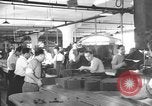
Small war plants' participation in U.S. Army Quartermaster Corps supply program in the United States (WW2)
United States Army Quartermaster Corps supply program in the United States. Workers at small war plants during production of different materials and military uniform parts in World War II. Two officers looking at a sample fur cap. U.S. military personnel with Quartermaster Corps officers seated around a table discuss procurement of materials in association with small war plants. A diagrammatic representation of the increase in the number of purchase transactions and the volume of dollar purchases as a result of the small war plant participation in the Quartermaster Corps supply program for the period of November 1942-43. War produciton workers at the war plants.
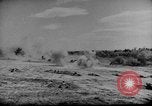
U.S. Army Quartermaster Corps prepare mortars, fire anti aircraft guns, and provide supplies during World War II.
Clip opens with brief World War I scene, circa 1917, of new American army recruits receiving army uniforms being issued by a U.S. Army Quartermaster. Clip then covers U.S. Army Quartermaster Corps' combat operations in various Theaters of Operations during World War II. Quartermaster Corps soldiers with rifles under the cover of a military truck during battle. Troops in trucks. An aircraft in low flight over a field. A U.S. Army truck. A Quartermaster fires an anti aircraft gun. Explosions occur and smoke rises. A British tank in a field. Soldiers beside a truck. Cans and barrels stacked on the ground. An enemy German tank in a field. Soldiers take cover. Quartermasters with guns in a trench. They come up the trench in prone positions. Dramatized battle scene with several Quartermaster corps casualties beside a wire fence. Soldiers prepare a mortar gun. An anti aircraft gun on an army truck. A soldier takes aim and fires a rifle during training. The Quartermaster flag hoisted on a pole. Actual footage shows aerial view of Bataan, and then ground views of groups of remaining U.S. Army soldiers around time of surrender of Bataan in April 1942. American soldier seen with their hands up and under guard of Japanese soldiers during Bataan surrender. Landing crafts arrive at a beach in North Africa. Supplies being offloaded at various battle fronts of World War 2. Soldiers and supplies off-loaded on the beach. Quartermasters seated on supplies boxes. Landing crafts arrive at a beach in the South West Pacific. Troops move across the beach. Troops disembark from landing crafts and move across a beach in Sicily, Italy. The Quartermasters unload boxes of supplies during various beach landings. They unload supplies and fire artillery on a beach head in Italy. Troops in trucks. A convoy of trucks loaded with supplies. Ammunition, ration and personnel in trucks move from Algeria to the front in Tunisia. Explosions occur and smoke rises. Trucks advance through smoke at night and in difficult conditions. Quartermaster General Major General E. B. Gregory speaks about the Quartermaster Corps. He says that the Quartermasters distribute goods to the army during training and combat. The movement of the Corps should be so regulated so as to deliver the goods at the right time in the right quantity.
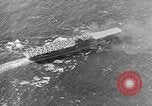
Air Operations aboard the Aircraft carrier USS Enterprise (CV-6) immediately prior to the entry of the United States into World War II
Aerial view looking down at the U.S. Aircraft Carrier USS Enterprise (CV-6) underway below, just before America's entry into World War 2. Her deck is filled with aircraft. Camera view from on the flight deck shows it filled with Grumman F4F Wildcat planes. Pilots are scrambling to some of the planes. Two deck crew sit at the wheels of an 4F4 (as if ready to pull chocks). The engine starts and runs. Several F4Fs have engines running and begin to taxi. One is given clearance to take off and commences its roll with considerable wing flap extension (short takeoff technique). The aircraft takes off and banks right as it clears the carrier deck. Next, two F4Fs are seen in flight above some clouds. Next, a large formation is seen, and individual planes bank and dive from it. Back on the carrier deck, more F4Fs have their engines running. A gunner is seen setting his machine gun into the rear cockpit position of a plane, the narrator calls a versatile scout-bomber. Closeup of the aircraft (a Douglas SBD Dauntless) as engine starts, deck crew pull chocks, and the pilot gets clearance to take off. Next, camera shoots from rear cockpit, with the plane's tail in center of the images. Views cover the complete takeoff and flight away from the carrier. Next an SBD is seen in flight with both front and rear cockpits open. A flight of three SBDs in formation. Closeup of two SBDs in formation. Extreme closeup of SBD with pilot and gunner both clearly visible in open cockpits. The gunner is maneuvering his machine gun. Two SBDs demonstrate rapid descents as in dive bombing. Back on the carrier, an SBD, with wings folded, is maneuvered by sailors, on the hangar deck. Next sailors accompany a Douglas TBD Devastator torpedo bomber on an elevator up to the flight deck. With its wings still folded, they maneuver it into position on the flight deck. An armorer, using a dolly, rolls a bomb to a TBD where two others secure it in a bomb rack under the center of the aircraft. Other armorers distribute machine guns and ammunition to gunners in cockpits of aircraft on the deck. Several TBDs begin taking off. View from hangar deck, of one airborne and departing. A formation of 9 TBDs in flight. (Note: This clip was probably shot in November 1941, based on the aircraft markings in use at the time. Life magazine did a series of stills, and these clips look like they came from that photo session. Enterprise wears Measure 1 camouflage, which she wore from mid-1941 to a month or two into 1942. The flying units aboard are all designated "6" the same as their carrier, CV-6. Thus they are VF-6; VB-6; VT-6, etc.)