


 Francais
 Deutsch
 Italiano
Refine Your Search
B-24-Burma stock footage and images
- Showing 1039 to 1044 of 3678 results more
more Hide
Hide
U.S. Air Force B-57B Canberra dropping bombs on landing zone in Vietnam during the Vietnam War.
U.S. Air Force aircraft targeting Viet Cong positions in Vietnam during the Vietnam War. Aerial views from U.S. Air Force B-57B Canberra aircraft dropping GP (general-purpose) bombs on landing zone. Smoke rises from explosions.
U.S. Air Force B-57B Canberra dropping bombs along canal bank in Vietnam during the Vietnam War.
U.S. Air Force aircraft targeting Viet Cong positions in Vietnam during the Vietnam War. Aerial views from U.S. Air Force B-57B Canberra aircraft dropping GP (general-purpose) bombs along canal bank. Smoke rises from explosions.

USAF B-52 Stratofortresses and Convair B-36 aircraft competing at a SAC bombing competition in Maine, United States.
A Strategic Air Command (SAC) bombing competition in Maine, United States . Aircraft parked at Loring Air Force Base. United States Air Force B-52 Stratofortresses and Convair B-36s parked at a flight line. Men working on maintenance and repairing mechanical defects in an airplane. Flight pilots and crews in briefing receiving information about targets. Animation shows the course of airplanes in flight. Views of aircraft taking and in flight aerial views during the competition. They are tracked from the ground with radar. View of ground teams using radar and in control rooms. The aircraft taxiing on the air base.
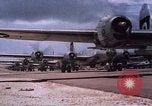
Manufacture and deployment of Boeing B-29 Super Fortress bombers during World War II
Film beginning shows a line of Indian women carrying large wooden bowls on their heads as they walk past a line of Boeing B-29 Super Fortress bombers parked on an airfield ramp in India during World War 2. A B-29 bomber descends and lands on the airfield runway. Scene shifts to the Boeing factory at Wichita, Kansas, where most of the aircraft were manufactured during World War 2. (They were also made by Bell Aircraft Company in Atlanta (Marietta), Georgia, and by the Glenn L. Martin Company in Omaha, Nebraska.) In the Wichita plant, a large room filled with B-29s under construction is seen. A line of women uses hand power tools to finish aircraft parts. A large section of a B-29, including landing gear and tires, moves by overhead crane to be mated with another section in an assembly operation. Men manually push a landing gear with tires installed, along a floor. Workers walk along underneath an assembled B-29 as it is towed out of the factory. Tail view of a B-29 with engines running. View of man working on a B-29 tail rudder. Wing flaps being lowered in function check. Scene shifts, again, this time to China, where a line of B-29s is seen on a ramp at a secret base. A jeep drives under the left wing of a parked B-29, guarded by an armed Chinese sentry. Chinese laborers work with hand tools to make a ditch to drain water from the airfield ramp. Chinese workers unload and roll 55 gallon drums of gasoline for aircraft fueling. A Chinese name (Ding How!)painted on the fuselage of a B-29. Major General Claire Chennault shakes hands with some of a B-29s crew as they prepare to depart on a bombing mission. A Chinese soldier gives the crew a "thumbs up" sendoff. The B-29 takes off on the mission. a group of airmen sit atop a B-29 to watch the takeoffs. Camera focuses on another takeoff and then shows a B-29 aloft, glinting in sunlight and then cruising above clouds. Glimpse of B-29 flying over snow covered mountains (possibly in Japan).
U.S. Army Air Forces repair and re-fly a battle-damaged B-17 after an emergency forced landing in World War II
Film opens showing a large formation of U.S. Army Air Forces B-17 bombers flying high overhead as they return to bases in the United Kingdom, during World War 2. Closeup of one plane shows Triangle tail code of the 97th Bombardment Group, and tail number 42-23383. View looking past tail tunner turret towards numerous aircraft in a formation. Scene shifts to view from a B-17 of black flak clouds from German anti-aircraft guns. A B-17 in flight with flak damage to a wing, and another with a destroyed left tail stabilizer and elevator. Closeup of feathered right inboard engine on a B-17 in flight. More views from behind the formation, and looking straight up at passing B -17s overhead. View looking down at a B-17 approaching for landing. Closeup of both right engines feathered on a B-17 in flight. (Narrator states an aircraft named "Stella" had three engines inoperative and was unable to reach the field to land.) Army Air Forces controllers communicating by radio with crews of aircraft. View from ground of the B-17 ("Stella") coming in for a crash landing in an oat field, with landing gear not extended. Closeup from cockpit, of number 3 engine running and number4 feathered. View from inside the aircraft as it crash lands. View of it in the field. It displays tail number 42-5910 and a "G" tail code in a white triangle, identifying it as belonging to the 40th Bombardment Wing, 305th Bomb Group at RAF Grafton Underwood Trucks are seen carrying mechanics and technicians to the crash landing site. Next, the B-17 is seen surrounded by repair crews. It is sitting in a cleared area and its landing gear is intact. Closeup of the aircraft's flak torn fuselage. A severely damaged gun turret on the ground next to the aircraft. Section of cockpit sitting on the ground. Views of mechanics working in their portable shops as they make repairs to the B-17 aircraft. Machinist running a lathe in one of the portable shops.View from ground of the mechanics at work on the aircraft's engines, as engineers employ earth-moving equipment in the background to create a temporary runway to facilitate takeoff. Closeups of the earth-moving equipment at work. More closeups of mechanics working to restore the aircraft. Some work on an engine suspended from an A-Frame. Closeup of two mechanics, one of whom displays images of a Lockheed P-38 lightning fighter aircraft and a B-26 Marauder aircraft on his jacket. More views of eath-moving operations. Closeup of a mechanic being moved by crane as he guides a propeller into place on the B-17. Closeups of mechanics affixing propellers on the plane. View of engineers employing surveying instruments as they ready the emergency strip for the B-17's takeoff. Closeup of the aircraft ("Stella") surrounded by seated mechanics, as she is about ready to fly again. View from behind spectators, including local English people, as the aircraft engines start. The repaired B-17 taxis onto the improvised air strip, and raising lots of dust as she takes off. Glimpse of local people waving as the aircraft becomes airborne.
U.S. Army Air Forces B-29s with P-51 fighter escorts, bomb Tokyo, Japan, during World War II.
From "The Last Bomb", showing U.S. Army Air Forces bombing targets in and over Japan during World War 2. B-29s taxi on airfield and take off from runway. Crew in cockpit of aircraft. More B-29s taxi on runway at Tinian airfield. B-29s leave flight lines at Saipan airfield. B-29s taxi and take off from runway. Last B-29 takes off from Saipan airfield. Controller in tower talking into radio. Controller in Guam attends phone call. Take off times of each wing are noted by men at desk. Man attaches copy on report board. B-29 in flight over Pacific Ocean. Crew inside the plane. Navigator marks the chart. Aircraft makes run over Iwo Jima Island. Bulldozer leveling the surface at Sulfur island of Iwo Jima. P51s parked at airfield. Officers discuss around chart. P-51s warm up in flight line. P-51s taking off from airfield. Group of P-51s in flight. Controller at Guam talks over phone. Officer marks positions of each wing on mission board. P-51s fly low over water. Pilot of P-51 speaks. Crewman's hand at instrument panel. P-51s in flight behind B-29s. Smoke marker is dropped from an aircraft. Groups of planes separate. B-29s defend against attacking Japanese planes. A Japanese plane drops phosphorous bomb which explodes in the way of formation of B-29s. P-51 peels off to attack Japanese plane and protect B-29. P-51 fires at Japanese plane. Japanese plane is hit and goes down in flames. Formation of B-29s heading for mission. B-29s dropping bombs on Tokyo.
CRITICALPAST.COM: About Us | Contact Us | FAQs - How to Order | License Agreement | My Account | My Lightboxes | Shopping Cart | Advanced Search | Featured Collections | Website Terms & Conditions | Privacy Policy ©2026 CriticalPast LLC.
License Agreement |
Terms & Conditions |
Privacy Policy
©2026 CriticalPast LLC.