


 Francais
 Deutsch
 Italiano
Refine Your Search
B-24-Burma stock footage and images
- Showing 1393 to 1398 of 3678 results more
more Hide
Hide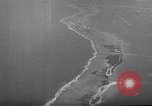
B-29 "Dave's Dream" making a test run over Bikini Atoll during Operation Crossroads
Aerial view of Bikini Atoll and surroundings during Operations Crossroads, the first postwar atomic bomb tests. Test ships are seen positioned in bay. The B-29, "Dave's Dream", which would drop the first atomic device, in Test Able, is seen in flight on a trial run. The aircraft carries tail code B, and the numbers 7354. During this trial, the B-29 opens its bomb bay doors, and after a while recloses them and makes a sharp turn away to the right.
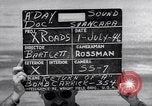
B-29 "Dave's Dream" returns to airfield in Marshall Islands after Test Able atomic bomb drop on Bikini Atoll
The B-29 "Dave's Dream" returns to airfield in Marshall Islands, after dropping atomic bomb on Bikini Atoll, in Test Able of Operation Crossroads, on July 1st, 1946, during U.S. nuclear testing. The B-29 lands and taxis to a parking place on the ramp. The area around the aircraft is cordoned off and the crew is confined therein as they deplane. Navy photographers take photos. An interviewer talks to crew members. The crew walks away from the aircraft along a cordoned pathway between numerous military personnel on hand to greet them on this historic occasion. The aircraft, number 44-27354, was actually participating in its second atomic mission. It also served as a photographic platform for the mission to Nagasaki on August 9, 1945, when it was named "Big Stink.". Pilot for the Bikini mission was Major Woodrow Swancutt of Wisconsin Rapids, WI. The aircraft was renamed "Dave's Dream" in honor of Captain David Semple, a bombardier killed during the crash of another B-29 on March 7, 1946, near Albuquerque, New Mexico. (World War II period).
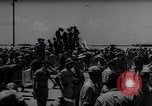
Operation Crossroads. Activities on ramp after return of B-29 "Dave's Dream" from Test Able atomic bomb drop at Bikini Atoll
Military personnel swarm about on the ramp of airfield in Marshall Islands, where B-29, "Dave's Dream," is parked after returning from the Able Test drop of atomic bomb on Bikini Atoll, as part of Operation Crossroads atomic testing. Seen is Major General Curtis Lemay, Commander of the 20th Air Force, to which the 509th Bombardment Group its atomic bombers (B-29s) were assigned. He is being interviewed in front of another B-29 atomic bomber, with symbol of atomic explosion on its nose area and the name "Atomizer" written on it.
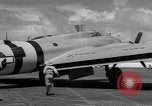
Operation Crossroads. Ground crews exercise caution offloading radioactive cargo from drone B-17s after Test Able explosion
Activities following the Test Able atomic explosion at Bikini Atoll during Operation Crossroads. Ground crewman unseals a cable from fuselage and uses it to pull and air sampler box off the top of a B-17 drone aircraft. He avoids being hit by it as it tumbles from atop the airplane. He then drags it to a spot on the ramp, where a man with a geiger counter checks it for radioactivity. Two men transport it on a long pole, to a fork lift. Several other B-17 drones are seen with ground crews offloading them remotely, by means of cables and remote activation of controls inside the B-17 bomb bays. A forklift operator loads an item into the rear hatch of a waiting C-54 transport aircraft.
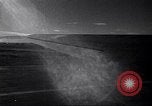
U.S. Army Air Forces B-26 operations in Tunisia during World War II
View from inside a U.S. Army Air Forces C-47 aircraft taking off from a field in Tunisia, during World War 2. Martin B-26 bombers seen parked on the field below. View from the air of a B-26 taking off. Formation of aircraft in flight. A B-26 viewed from above as it comes in for a landing.
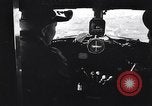
USAAF B-26 bombers return from mission in Tunisia and are debriefed by intelligence officer, during World War II.
Pilot and copilot in cockpit of a U.S. Army Air Forces C-47 in flight over Tunisia during World War 2. A formation of B-26 bombers seen overhead. Scene shifts to several B-26s landing in succession on a runway. Some twin engine aircraft seen parked at left edge of the runway and brief glimpse of a Spitfire fighter plane with engine running in dirt at right side of the active runway while B-26s are landing. Pilots holding a large map as they debrief a mission with an intelligence officer on the tarmac. The aircrews then walk to an operations room where they get some refreshments and continue discussing the mission.
CRITICALPAST.COM: About Us | Contact Us | FAQs - How to Order | License Agreement | My Account | My Lightboxes | Shopping Cart | Advanced Search | Featured Collections | Website Terms & Conditions | Privacy Policy ©2026 CriticalPast LLC.
License Agreement |
Terms & Conditions |
Privacy Policy
©2026 CriticalPast LLC.