


 Francais
 Deutsch
 Italiano
Refine Your Search
Baghdad Iraq 1956 stock footage and images
- Showing 151 to 156 of 876 results more
more Hide
Hide
U.S. Nuclear test "Cherokee" in Operation Redwing, off Namu Island, Bikini Atoll, Marshall Islands.
First air drop test of a thermonuclear weapon. The Hydrogen bomb nuclear weapon was dropped from a USAF B-52 bomber (not seen) that flew from Fred Island, Eniwetak (sometimes spelled Enewetak or Eniewetok), on May 21, 1956. View appears to be from an aircraft flying above altocumulus clouds, below higher stratiform layers. The film begins with a complete whiteout from the initial fireball. As that subsides, local stratiform clouds take on a rosy hue and the center fireball is seen rising above them. As the fireball rises, it takes on a somewhat hemispherical shape, flat on the bottom, from which a straight stem-like column extends toward the ground. The light of the explosion slowly fades and complete darkness ensues. Official accounts state that the intended ground zero was directly over Namu Island, but the flight crew mistook an observation facility on a different island for their targeting beacon with the result that the weapon delivery was grossly in error. The bomb detonated some 4 miles off target over the ocean northeast of Namu. As a result essentially all of the weapons effects data was lost. ( Note: According to ancillary reports, the delivery error resulted in blast overpressures and thermal effects on the 6 structural response targets between Iroij and Namu Islands, greatly exceeding specifications for any use in scientific military modeling of high yield aerial detonations. Plans for graded damages analysis failed when all the structures collapsed. Effects cameras also failed from the intense fireball heat.)
A bomb blast kills 1200 in Cali, Colombia.
Major events of 1956. A bomb blast in Cali, Colombia killed 1200 people. People and policemen search for dead bodies in the rubble. Men pull out dead from the rubble. Dead bodies piled up.

Hungarian revolution against Russian slavery in Hungary.
Major events of 1956. In an aftermath of Hungarian revolution against Russian slavery people flee from their homes. Civilian refugees loaded in trucks fled for freedom and safety. Man carries a child on his back as he moves to a safer place to escape the Red Army's atrocities. Views of men, women, and children refugees fleeing Soviet oppression.
Anglo French troops attack to seize the Suez Canal in Egypt.
Major events of 1956. Ships underway in Suez Canal, Egypt. President, Abdul Nasser announces the seizure of the canal. Soldiers move up in Egypt and dead Egyptian soldiers as a result of Anglo French attack. Anglo French planes bomb the canal area. Airborne troops land in the canal area. Debris due to aerial bombings spread on the street. Matter discussed at the United Nations meeting leading to a cease fire in the area. The Secretary General of the United Nations Dag Hammarskjold arrives in Egypt for negotiations. The United Nations Emergency Police forces enter a city in Egypt. People give a warm welcome to the forces.
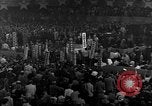
Stevenson is nominated as the Democratic candidate for the Presidential election during a national convention in Chicago.
The 1956 Democratic National Convention in Chicago, Illinois. A large number of delegates gathered at the convention. The delegates carry placards with names of various states on them. Signs read 'California', 'Tennessee', 'Texas', 'Indiana'. A man speaks into a microphone as he introduces Governor Adlai Stevenson of Illinois as the Democratic nominee for Presidential election.
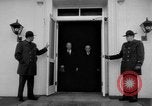
President Eisenhower bids farewell to Prime Minister of Canada, Louis St. Laurent, at Greenbrier Resort in West Virginia
West Virginia State troopers hold doors as President Eisenhower and the Prime Minister of Canada, Louis St. Laurent, come out of the Greenbrier Resort at White Sulphur Springs, West Virginia, United States. They are joined by U.S. Secretary of State, John Foster Dulles, and Bernard M. Shanley, aide to the President. They all laugh and smile as they pose for photographers. The Prime Minister waves at spectators, and shakes President Eisenhowers hand as they say farewell. A 1956 Fleetwood cadillac automobile is parked on the drive with flag of United States and ensign of Canada on its fenders. The car drives away with the Prime Minister and led by a West Virginia State police car.