


 Francais
 Deutsch
 Italiano
Refine Your Search
Baghdad Iraq 1956 stock footage and images
- Showing 25 to 30 of 876 results more
more Hide
Hide
United States Coast Guard in Operation Desert Storm against Iraq in Arabian Peninsula
Highlights the role of United States Coast Guard in Operation Desert Storm against Iraqi occupation of Kuwait in Arabian Peninsula. A poster of Saddam Hussein. Men of United States Coast Guard on duty during the Operation Desert storm as men send message on wireless, looks through binoculars. A plane at an airbase, rifles arranged, good luck posters and 9th United States Coast Guard insignia. Plane takes off, coast guard fires, plane in flight. A sign reads Baghdad and coast guards in a boat underway at sea.
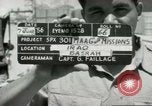
United States MAAG and military mission in Basra, Iraq.
United States MAAG (Military Assistance Advisory Group)and military mission in Basra, Iraq. Equipment being unloaded from freight by Iraqi workers on Basra dock, Iraq. Iraqi officers and American ordnance officer check arrival of military assistance equipment. Crate with sign reading 'From USA for Mutual Defense'.
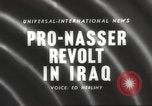
King Faisal II and Premier Nuri as-Said prior to the anti-western revolt in Iraq.
Scenes just prior to the mlitary Coup and mob revolt in Iraq. King Faisal II is seen addressing an assembly of people, prior to the revolt in which His uncle, Crown Prince Ilah was killed by street mobs, and the whereabouts of King Faisal II and Premier Nuri as-Said were unknown. Flashback scenes show them arriving in Jordan on an Iraqi Airways 4-engine turboprop airliner. They are greeted by King Hussein, Faisal's cousin, as they come down the steps of the airplane. A brass band plays as they cross the tarmac. Flags of Iraq and Jordan fly from flagpoles.The two cousin kings, Faisal II and Hussein, sit side by side and watch parade of tanks, armored vehicles and trucks. (Note: both King Faisal II and Premier Nuri as-Said lost their lives in the subsequent revolt.)
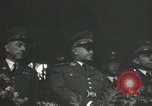
View of Iraqi military officers on reviewing stand in Iraq.
High ranking Iraqi military officers posing on a reviewing stand in Iraq, 1942
Iraq Petroleum Company (IPC) facilities post World War II
Iraqi and British officials at an event involving visitors at a facility of the Iraq Petroleum Company, following World War 2. Officials emerge from a warehouse building. One official wears sunglasses and holds a tobacco pipe. British officials accompanied by wives, walk along a boardwalk to a gangplank, where they climb aboard a ship. Change of scene shows a. street scene at a bridge where several street vendors display their wares. City buildings across the bridge, in background. A man wearing keffiyeh walks past. Camera moves to the wellhead inside an oil drilling rig, where Iraqi "roughnecks" are working with Byron Jackson Company oil drilling equipment. They insert a new section of pipe and proceed with drilling. Views up and down of the drill rig in operation. Views of other areas at the petroleum complex. Two huge pipes lying parallel. A worker climbs stairs of oil tank no. 235. Technicians work on large pieces of piping. View of a ship docked near the facility, on the Shat Al-Arab. At this point, the scene switches completely to the Persian Gulf City of Dubai and a waterfront scene dominated by Ali Bin Abi Talib mosque. (This is number 3, of three mosques by that name in the area, and is located on the creek in the old Bur Dubai part of the city.)
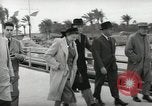
Operations at Iraq Petroleum Company (IPC) facility after World War II
Brief glimpse of British visitors walking toward a ship, after a postwar visit to an IPC facility in Iraq. Scene shifts to an oil derrick and drilling rig rising above oil storage tanks at a sandy site. Camera pans up the derrick. Change of scene shows gathering of British people with IPC officials at some kind of event. Next, a group of officials is seen briefly, outside a facility warehouse. Two men greet each other. A military officer stands nearby. Camera then jumps to inside the oil rig, shown earlier where Iraqi "roughnecks" wrestle pipe, insert a new section, and continue drilling. View of worker walking among oil tanks at the facility. Views of natural gas compressors; large transmission pipes; and a worker closing one, in a set of valves at the site. Broad view from the derrick, showing supplies and equipment laid out in the sand and a vista of miles, with distant structures including (possibly) worker housing and support facilities.